

Please Like or Comment on this post.
This helps show others that you valued my words.
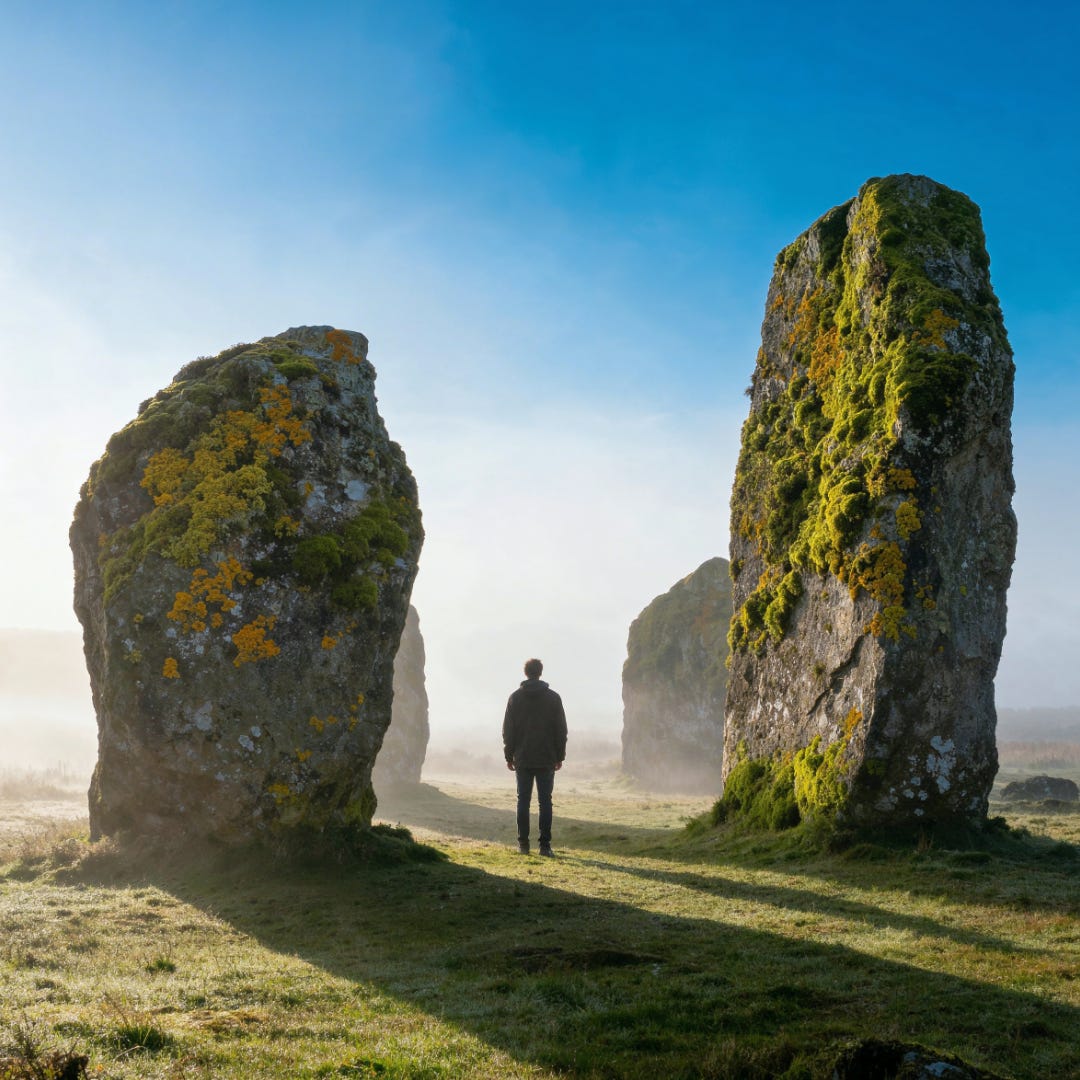
There is a moment in David Abram’s Becoming Animal where he catches a companion physically staggering backward at the sight of a rock face.
When the companion tries to dismiss the movement as merely internal, merely metaphorical, Abram will not let it go. A bird watching from the cottonwoods, he points out, would have seen a body moved by another body. The rock did not trigger a feeling. It effected a physical, material response in a breathing human animal. Two kinds of dynamism encountering each other. Two different ways of being Earth.
That passage (pg 55) stopped me when I first read it.
Not because it was new information. Because it named something I had been experiencing on the Camino for years without having language for it.
The Problem With Understanding Nature
Most people drawn to ecospirituality and nature-based practice arrive through their intellect.
They read Abram. They read Kimmerer. They follow the argument, understand the philosophy, and agree with the conclusion. The natural world is alive and relational. We are participants, not observers. The separation between self and world is a cultural story, not a biological fact.
They understand this completely.
Ironically, they continue to live almost entirely in their heads.
The intellectualizing comes from a good place. If you can understand something deeply enough, the thinking goes, you can then work with it, protect it, relate to it properly. Understanding precedes connection. Get the concepts right and the embodied experience will follow.
Abram’s work suggests this is exactly backward.
Trying to intellectualize what the living world offers does not increase empathy or kinship. It maintains the very separation it claims to be dissolving. You are still the thinking subject, and the natural world is still the object of your consideration, however sophisticated that consideration becomes. The mind remains the mediator between you and everything else.
What Abram is pointing toward is not a better understanding of nature. It is a different orientation of the self within it.
What the Body Already Knows
The rock moves you. Not as a metaphor, but rather in physics.
Abram draws a distinction that runs through all of his work, between cultures that speak about the natural world and cultures that speak directly to it, acknowledging animals, plants, and landforms as expressive subjects capable of communication. Not communication in words. Communication in song, in rhythm, in movement and gesture, in shifting shadow, and the quality of stillness.
Language, for traditionally oral peoples, is not a human possession. It is a property of the animate earth in which humans participate.
That framing is not romantic. It is descriptive of something the body already knows when the mind steps back far enough to let it.
You have felt it. The quality of attention that arrives when you sit in one place long enough. The way a landscape enters the body before the mind has finished deciding what to think about it. The way your breathing changes near water, near stone, near old trees, before you have consciously registered why.
That is not a metaphor, nor even in the mind alone. That is participation.
Why Contemplative Walking Is the Practice Abram Points Toward But Does Not Name
Reading Becoming Animal is a profound experience that changes almost nothing about how most readers actually move through the world.
This is not a criticism of the book. It is an observation about what books can and cannot do.
Abram can show you the argument for embodied ecological participation. He cannot give you the embodied ecological participation itself. That requires practice, and not necessarily comprehension. It requires showing up in a specific place, with a specific quality of attention, long enough for the body to begin responding to what is actually present rather than to what the mind has already decided is there.
Contemplative walking is that practice.
Not mindful walking, which trains you to observe your own internal states with greater clarity. Contemplative walking turns attention outward, toward the living world as a presence with its own agency, dynamism, and ways of communicating that do not require your interpretation to be real.
When you walk the GR65 Camino de Santiago route quietly, what becomes clear after the first day is that the trail possesses a certain essence. The landscape holds a distinct presence. The way light filters through a French morning at six o’clock in late May isn’t just a backdrop. It’s a message. You’re being communicated with in a language older than any word you know, and your body understands it before your mind has time to interpret.
That is what Abram means. That is what five Camino walks taught me in ways that reading his work alone never could.
Where to Begin If You Are Not Walking 500 Miles
You do not need the GR65 or the Camino Francés to begin this practice.
You need one place you can return to. One presence in the living world you are willing to sit with long enough for the intellectual layer to thin out and the body to begin its own kind of listening.
Abram describes the rock face as entering and altering a life through its very stillness. The stillness itself is the gesture. The silence becomes the activity.
Go outside this week. Find one presence that draws you. Stay longer than the mind says is necessary. Let the body begin to respond before you decide what to think about what is happening.
Notice when you stagger, even slightly.
That’s not a metaphor. It’s two types of dynamism interacting in the physical world.
That is the beginning of what Abram spent an entire book trying to point you toward.
The shift Abram describes — from speaking about the natural world to speaking with it — is the foundation of the Rewilding the Soul EcoSpirituality Certificate at Cherry Hill Seminary that I teach. It is also what the September 2026 Contemplative Walking Retreat on the Le Puy Camino is built around: seven days of walking a living landscape as participants rather than observers. If you are new here, this week’s posts are a complete introduction to that practice. No retreat or course required to begin.