

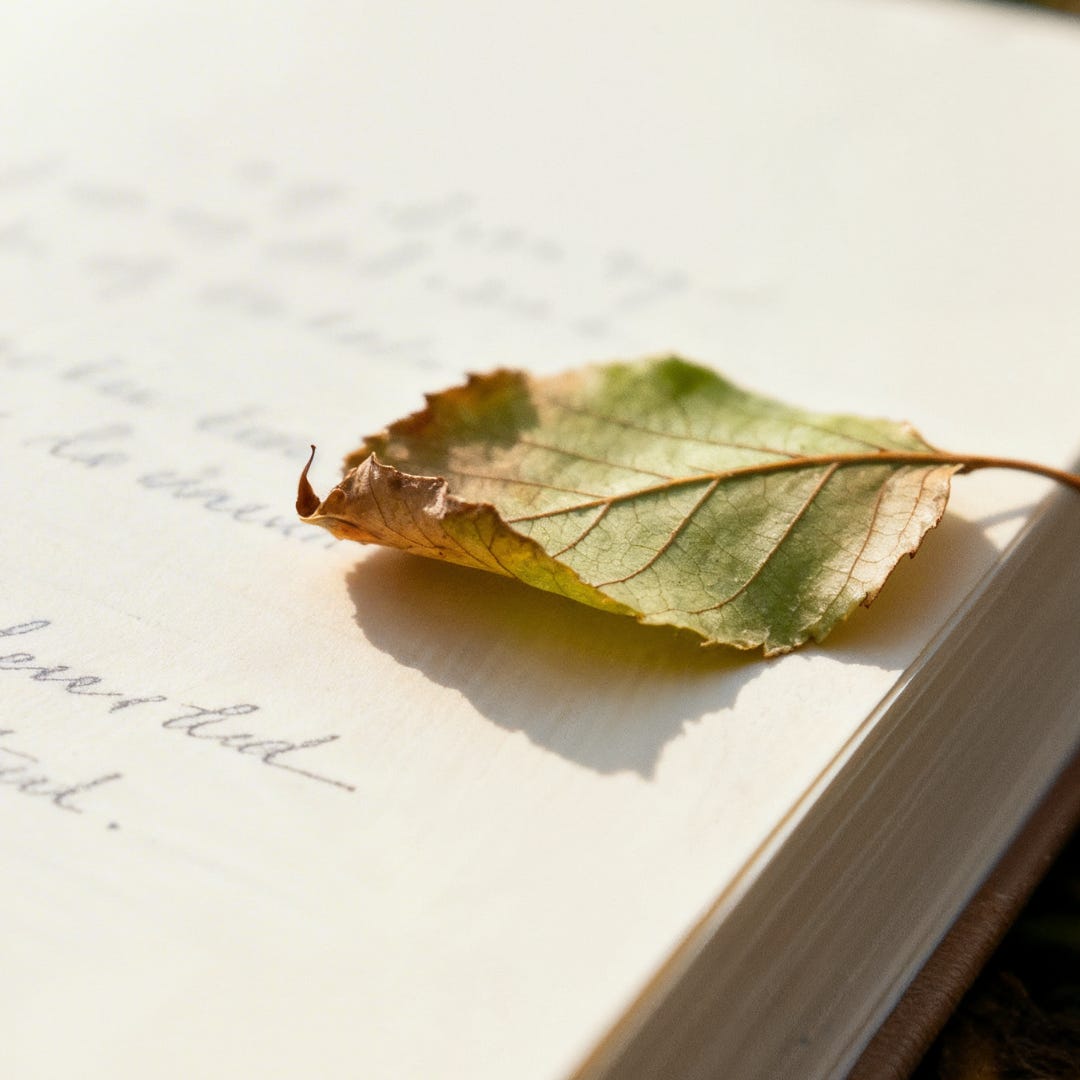
There is a moment after a sit spot or a wander when something is still happening in you.
The encounter is over, but it is not finished. A sound lingers. An image will not settle. A feeling has not yet found language. You are back inside, or still on the bench outside, and there is a quiet question underneath everything else.
What do I do with what I am carrying?
Most people do nothing. The moment dissolves. The day continues. Earth journaling is the practice of catching what the Land gave you before it disappears.
Why Most Journaling Misses What You Are Actually Looking For
This post is for two kinds of people:
Those who already spend time in nature but feel like something is not being captured or held, and
Those who already journal but sense that their practice is somehow circling around themselves rather than reaching outward toward the living world.
If either of those describes you, the problem is probably a matter of direction, and not intention of commitment.
Journaling is one of the most widely practiced reflective tools in contemplative life, and for good reason. Writing helps us make sense of experience, slow the mind, and give formless feelings a shape we can return to. A personal journal nourishes the soul. There is nothing wrong with it, and I often suggest it for people who need to make sense of what is going on in their head.
The limitation is the lens.
Most journaling turns inward. It asks: what am I feeling, what am I thinking, what does this mean for me? That is valuable. But if what you are trying to develop is a genuine connection or kinship with the more-than-human world, it is incomplete. The living world appears as a backdrop, a trigger, and a mirror for your inner life.
Earth journaling asks a different question entirely.
Not, “What did the river make me feel,” but “What was the river actually doing today?” Not, “How did this tree with the twisted branches affect me,” but “What did I notice when I slowed down enough to match its stillness?” The shift is subtle. Its consequences are not. One sentence is about you. The other holds both of you. Earth journaling lives in that second sentence.
In many ways, Earth journaling takes the reflection that traditional journaling does so well and brings it back into the world, where we have the opportunity to connect our reflection with the other living beings around us.
If you have never tried it, I invite you to a new experience, or at least a new perspective on something else you already know.
How to Begin the Practice
Keep this simple. The practice has one non-negotiable: contact before writing. This is not the journaling you do quietly alone in a library or a comfy spot, at least not without first having some connection with the natural world.
Go outside first. Sit or spend time with one place or one presence, like your sit spot, a particular tree, the patch of ground outside your door, or a being who attracts your attention while you are on a wander in nature. Give it fifteen to thirty minutes. Let the Land give you something before you ask yourself what to write. You cannot Earth journal from memory alone.
Write in proximity to the encounter. Immediately after contact, the experience is most alive. Remain outside if you can, or return to a nearby space before the day reclaims you. The encounter is still present in the body. Write before it leaves.
Begin with description, not interpretation. Let the living world have the first word. What was the tree doing? Holding, dropping, reaching, going still? What changed in the light between when you arrived and when you left? What did the crow do next? Description first. Your reactions and meanings will come. Hold them back long enough for the Land to speak.
Let the prompt emerge from the encounter. You do not need a writing prompt from a book or a course. What stopped you during your time outside? What surprised you, unsettled you, or arrived quietly when you had stopped looking? What will not leave you alone? Those become the questions your journal explores, and possibly answers.
Write toward the relationship, not only toward yourself. The distinction matters more than it appears. Not “the river made me feel peaceful,” but “the river was moving at this pace, and I noticed my body eventually slowed to match it.” That second sentence holds both of you. That is where Earth journaling lives.
Close with one line of reciprocity. What are you carrying back from this encounter? What will you return to notice next time? One sentence is enough. It completes the relational cycle and sets the conditions for the next visit.
If you try this, I invite you to explore this as feels right to you, and not as a set of steps that must be done in exactly this way. That would defeat the point of spending some time writing about your relationship with the natural world. Thus, use these prompts as aids to help bridge this connective form of journaling from a previous experience of only writing about what is happening inside you.
What Builds Over Time
One entry is a moment. A month of entries is a pattern. A year of entries is a relationship.
Robin Wall Kimmerer writes that the grammar of animacy, speaking of other species as persons rather than objects, changes not just how we talk about the living world but how we relate to it. Earth journaling is where that shift becomes practiced and documented over time. You begin to notice how a particular tree holds itself differently across seasons. You can trace what a sit spot teaches you in October that it could not teach you in April. You start to recognize a place the way you recognize a friend, noticing when something is different, sensing what belongs and what does not.
That is when care for the Earth becomes personal.
Not abstract. Not conceptual. Relational. Because you are personally connected and personally affected, which is where all genuine ecological concern actually lives.
Jon Young, whose sit spot practice has shaped nature connection work for decades, describes the moment when a familiar place begins to reveal its deeper patterns, when you know a bird’s routine well enough to notice when something has disturbed it. That depth does not come from a single encounter. It comes from return, and from the writing that holds what return teaches.
Your Earth journal becomes a record of who you are in relationship with.
Write with the Earth
Most of us have learned how to write about ourselves. Very few of us have learned how to write with the world.
After your next time outside, do one thing before you check anything else: open a journal. Write what the Land gave you. Start with what you observed. Stay with it longer than feels necessary.
Then return next week and see what the second entry holds that the first one could not.
What is the Land giving you that you are not yet writing down?
Please share what you notice the first time you try this.
Start outside. Start today.
The earth is not waiting for you to enroll anywhere.
Jeffrey, this is a thoughtful reflection.
Sometimes the moments we resist most quietly carry the lessons we need most. Thank you for sharing such clarity.
🇨🇦 www.salmiinconversation.com�
🇨🇦 www.salmizindagi.substack.com�
This earth journaling really resonates with me.
“Those who already spend time in nature but feel like something is not being captured or held”
Is something that I experience. I’m looking forward to exploring this practice. Thank you.