

I was at a conference recently when a gunman jumped onto the stage and threatened to kill himself.
After the evacuation, once he was taken away, and after we were cleared to return, I offered my services. As a university chaplain and certified spiritual director, I could hold space for participants who needed to talk or process what happened.
I offered to give back what I’ve received. My training. My presence. My capacity to witness difficult moments.
This might not seem like a nature-based example of reciprocity. But the strength to offer this came from my spiritual life that is literally grounded in the natural world.
The land has given me groundedness. So I give that groundedness to others.
That’s reciprocity.
The Difference Between Environmentalism and Reciprocity
I’ve come to see, as an ordained Wild Guide, that environmentalism isn’t the same thing as reciprocity.
Environmentalism often assumes nature is broken and we must fix it. Reciprocity says we’re in an ongoing relationship and we must honor it.
Environmentalism is transactional. Do good deeds. Offset carbon. Clean beaches. Check boxes. Feel better about yourself.
Reciprocity is relational. Recognize that you receive constantly from the land. Give back because relationship requires it. Not from guilt. Not from duty. From kinship.
Environmentalism sees nature as a victim needing rescue. Reciprocity sees land as kin deserving respect.
Both matter. Environmental action creates real change. But when we lose the relational aspect and turn giving back into just another task on our optimization list, we miss the whole point.
We’re not helpers standing outside nature, fixing it. We’re participants inside the web of life, giving back because we receive constantly.
That’s the shift Day 10 of the 13-day EcoSpirituality challenge asks us to make.
What Makes This Spiritual Practice
Environmental action is doing a good deed. Spiritual practice is recognizing mutual dependence.
Environmental action says I’m helping the land, as if I’m separate from it and positioned above it. Spiritual practice says the land sustains my life every moment, and I give back because I receive constantly.
One positions you as helper. The other recognizes you as participant in relationship.
When I offer chaplain support after trauma, I’m not “helping” people as if I’m above them. I’m recognizing we’re all part of the same web. Someone helped me learn these capacities. Teachers. Mentors. The land itself that grounds my spiritual practice. Now I pass that forward.
Same with the land. The land doesn’t need me to save it. The Earth existed billions of years before humans and will exist long after. But I do need to acknowledge what I receive and give back accordingly.
That’s spiritual practice. Recognizing mutual dependence. Acting from relationship, not obligation.
My Regular Practices
I volunteer editing Wikipedia because it helps me share knowledge, experience, and understanding of free and open information.
I get nothing back beyond knowing I’m helping others learn and make informed decisions. I take what I’ve received through education and research training, and I give it back to the commons.
That’s reciprocity in the digital realm. Taking what I’ve been given and offering it forward.
On the Camino, I practice reciprocity by doing no harm and leaving no trace. Stay on trails so I don’t damage vegetation. Pack out everything I bring in. Don’t pick living plants or disturb wildlife.
When I make offerings to land and spirits of place, they’re always biodegradable and respectful. Nuts. Bread. Small amounts of alcohol poured out for the gods and nature spirits of France. Never harmful. Never litter disguised as ritual. Actual offerings of value given in recognition of relationship.
This is the baseline. Not taking more than given. Not leaving harm behind. Acknowledging I’m guest on ancient paths that sustained pilgrims for over a thousand years before I arrived.
What Reciprocity Actually Looks Like
Reciprocity with land can be challenging to understand. It’s not a checklist. It’s recognition of relationship. But here are ways to begin:
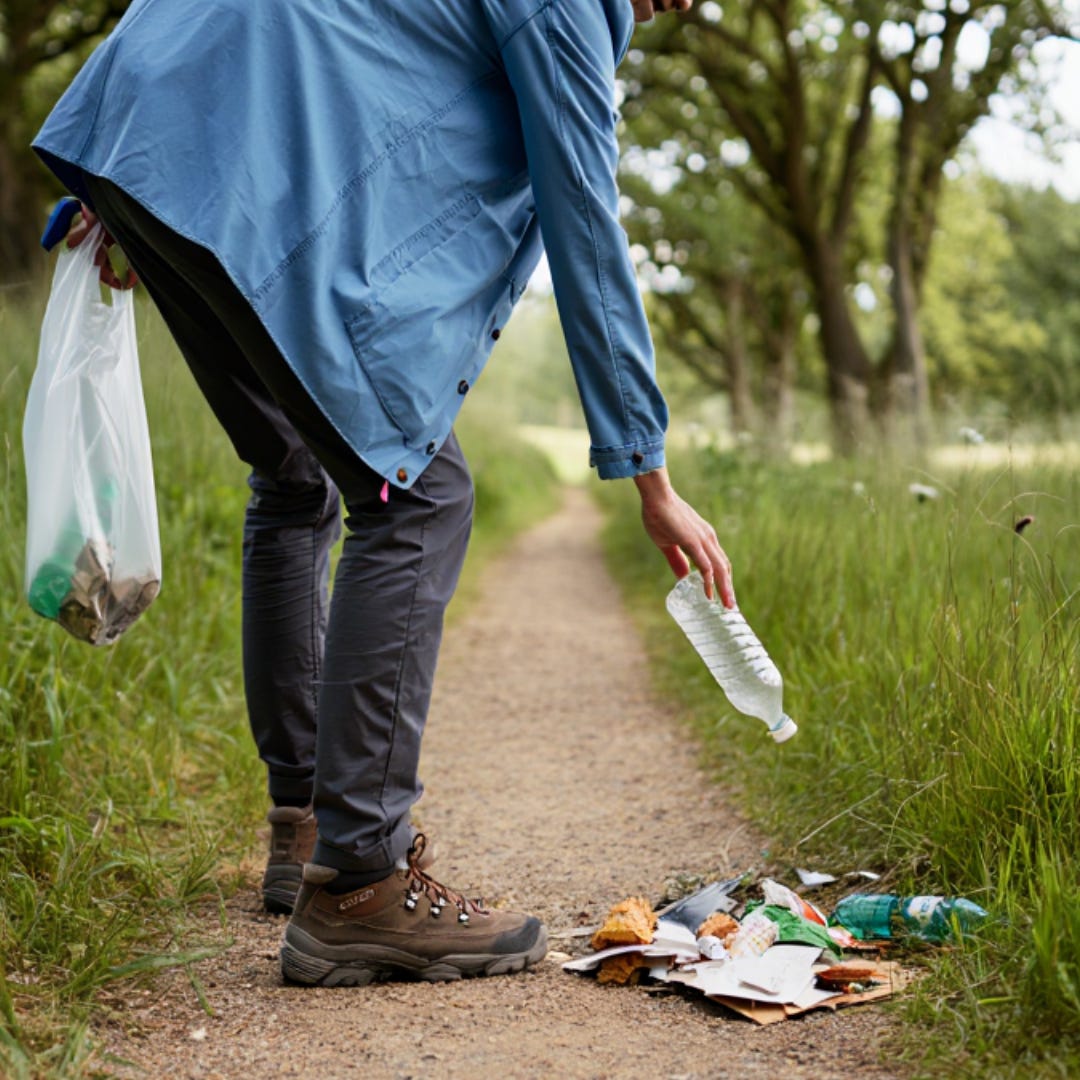
Pick up litter on every walk. Not because you’re “saving the planet,” but because you receive from this land and leaving it cleaner is basic respect. I do this on the Camino constantly. Some days I carry trash for miles because there’s no bin. That’s reciprocity, acknowledging I’ve walked on these paths, breathed this air, received this beauty.
Pull invasive species when you see them. In New York, that means things like garlic mustard or Japanese knotweed. Learn what doesn’t belong in your ecosystem and remove it when you can. You don’t need to clear entire fields. One plant pulled is one act of reciprocity. The native plants trying to grow in that spot will receive what you’ve given.
Leave water for birds and pollinators, especially in summer heat. I make sure that there is always some water in the front ditch where the frogs live. It needs refilling daily because so many creatures use it. That’s the point, I receive from the web of life constantly, so I give back in small, practical ways.
Plant native species rather than decorative non-natives. This matters more than most people realize. Native plants support native insects, which support native birds, which support the whole ecosystem. When you plant something that belongs here, you’re participating in reciprocity that extends far beyond your garden.
These aren’t the only ways. You might support local watershed groups because you drink that water. You might advocate at town meetings when development threatens habitat. You might make offerings to spirits of place in whatever tradition speaks to you.
The key is this: none of these actions are about being a “good environmentalist.” They’re about recognizing you’re in relationship with land that sustains your life.
Extraction Culture vs. Reciprocal Living
Most of us were raised in extraction culture. Take what you need. Use resources. Move on. Optimize. Consume. Dispose. Buy more.
Reciprocal living recognizes the land gives constantly. Air you breathe. Water you drink. Food you eat. Beauty you witness. Ground beneath your feet. Life itself.
If you receive constantly, you must give back constantly. Not once. Not when convenient. As ongoing practice.
Extraction asks, What can I get from this place? Reciprocity asks, What have I received from this place, and what must I return?
Extraction sees land as a resource to exploit. Reciprocity sees land as a relation to honor.
This connects to acknowledging indigenous peoples like the Parisii I wrote about earlier this week. They lived in reciprocal relationship with the land for millennia before empire brought extraction systems.
We can’t return to that entirely. We live in the systems we inherited. But we can practice reciprocity now. Today. In small ways that matter.
We can recognize when we’re extracting and choose differently. We can give back not from guilt but from recognition of what we receive.
Your Practice Today
Here’s what I’m inviting: choose one simple act of giving back today.
Pick up litter on a five-minute walk. Leave water for birds. Pull one invasive weed. Scatter native seeds. Plant something. Clean something. Restore something. Support something. Advocate for something.
The specific act matters less than the intention behind it. You’re giving back to the web of life that holds you. However, the intention alone will not help as much as even a single, small practice.
Not a good deed that makes you feel virtuous. As recognition of relationship. As spiritual practice acknowledging mutual dependence.
The land sustains your life. Your body. Your breath. Your food. Your water. Everything you are exists because Earth provides it.
Give back. Not from environmental guilt. From recognition of what you receive every moment.
That’s reciprocity. That’s spiritual practice. That’s how we move from extraction to relationship with the land.
Tomorrow we fix one specific thing. But today, just give back in whatever way feels right for you.
The land is listening. The land remembers. The land receives what you offer.
I’m developing a 13-Day EcoSpirituality Challenge and sharing what I’m learning here. Tomorrow: fixing one thing. If you’d like to practice along, consider subscribing for reflections on EcoSpirituality, sacred walking, and reciprocity with the more-than-human world.
What did you give back today? I’d love to hear in the comments below.
I love this! I'm a poet and environmental writer, and I think this idea of reciprocity is what is missing from the current conversations about our habitats. It reminds me of a section from Martin Buber's I Thou (where he talks about a tree). He writes:
"But it can also happen, if will and grace are joined, that as I contemplate the tree I am drawn into a relation, and the tree ceases to be an It. The power of exclusiveness has seized me.
This does not require me to forego any of the modes of contemplation. There is nothing that I must not see in order to see, and there is no knowledge that I must forget. Rather is everything, picture and movement, species and instance, law and number included and inseparably fused.
Whatever belongs to the tree is no impression, no play of my imagination, no aspect of a mood; it confronts me bodily and has to deal with me as I must deal with it—only differently.
One should not try to dilute the meaning of the relation: relation is reciprocity."
How about letting the squirrels ruin my porch pumpkins to get to the seeds? They make me crazy, but they’re happy. 😵💫