

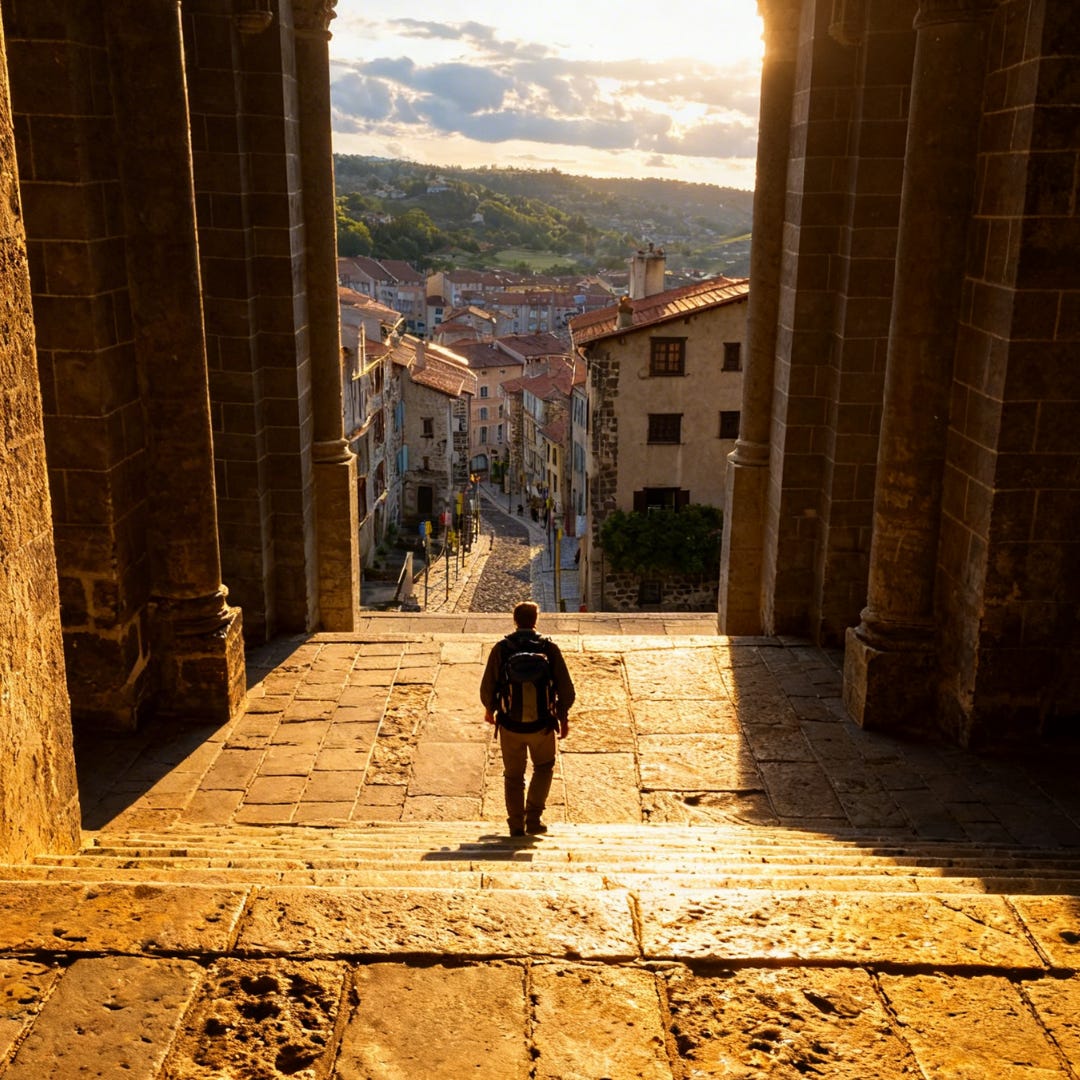
In May, I’m walking the first section of the oldest Camino de Santiago pilgrimage route in France again: the GR65.
Not a new section. Not further along. The same beginning I walked on my first French pilgrimage, starting again from Le Puy-en-Velay, the same ancient city where I stood four years ago, quietly wondering if I could do this at all.
I have walked this route multiple times. I know what is coming. I am going back to the beginning anyway.
This is not nostalgia. It is something more demanding than that.
If you feel restless unless you are moving toward a goal, if your spiritual practices keep getting upgraded but you do not feel changed, if you find yourself collecting evidence of growth rather than inhabiting it, this post is for you. Not because something is wrong with you. Because most of us were shaped in systems where approval was the currency of safety: school, work, family, and even religion. We carry that pattern into spiritual life without noticing.
We perform progress rather than pursue understanding. The two feel almost identical from the inside, at least at the beginning. The difference reveals itself over time in the quality of what accumulates.
Why Forward Progress Is Not the Same as Depth
The pilgrimage world celebrates accumulation.
More miles. New sections. Further along the route, further toward Santiago, further from wherever you started. There are apps that track your progress along the entire Camino de Santiago. Certificates awarded for completing defined distances. Social media feeds full of arrival photographs at destinations that mark another stage complete.
I understand the appeal. Forward movement is visible. It is shareable. It produces evidence that something is happening.
What it does not reliably produce is depth.
Depth requires something that actively works against forward motion. It requires returning to the same ground long enough for the surface version of the experience to exhaust itself and for something underneath to become accessible. You cannot accumulate your way there. You can only stay long enough, return often enough, release the need to be further along than you currently are.
Most pilgrimage content does not say this because it does not produce shareable content. A photograph of someone standing at the beginning of a path they have already walked does not perform as well as a photograph of arrival.
The beginning of a familiar path is where the interesting work actually lives.
What the Second Walk Through a Familiar Place Reveals
The first time I walked from Le Puy, I was managing anxiety.
Could I do this? Was I prepared enough? Would my feet hold? Was I walking correctly, eating correctly, carrying the right things? The questions were constant, consuming a significant portion of the attention that should have been on the path itself.
That anxiety was not weakness, but rather what a first walk requires. You do not yet know you can do it, so part of your energy goes toward proving you can.
The second walk through the same ground is different.
The proof has been established. The body knows it has done this before. The particular anxiety of beginning dissolves, and in the space it leaves behind, the path itself becomes visible in ways it could not be the first time through. The forest. The stone underfoot. The pace of villages. The way silence has texture. The way the land teaches without explaining itself.
There is never a going back in the sentimental sense. The person returning to Le Puy in May is not the person who first stood there. He is older, more practiced, carrying different questions, different griefs, and a different understanding of what the route is for. The path is the same. The walking is entirely new.
This is what return offers that progress cannot.
The Doctoral Program I Finally Finished
I started doctoral programs five times before I completed one.
Five different programs, five different moments of beginning, four exits before the eventual finish. For years, I told myself the issue was the programs, the fit, the timing, the circumstances. These things were partly true. But the deeper truth, which took me longer to reach, was that I was focused entirely on what completing a doctorate would mean, what I would do with it, and how it would be received.
I was performing the pursuit of a degree rather than inhabiting the actual work of learning.
The program I finished was the one where I stopped focusing on finishing. I stopped asking what the credential would signal to others and started asking what the research itself was teaching me. The pressure of the destination lifted. The experience became rich in ways the previous attempts never had. Learning became the point, and when it did, the degree came with it almost as an afterthought.
The Camino has taught me the same thing repeatedly, and I have had to learn it repeatedly, which is perhaps the nature of things worth learning.
The destination gives you a direction to walk toward. Arriving there is not the point. Everything that happens between the beginning and the end is the point, and most of us know this and spend considerable energy pretending otherwise.
The Approval Problem
Most people who say they want to go deeper in their spiritual practice are actually doing something else entirely.
This seems to relate less to sincerity and more to the fact that seeking approval has been how they survived.
They are trying to do it correctly in ways that others will recognize and affirm. They are collecting the right teachers, the right practices, the right vocabulary, the right credentials of seriousness. They are building a version of spiritual life that performs well in the communities they want to belong to.
This is not depth, but fluency in appearing to go deep.
Seeking approval accumulates evidence. Depth accumulates understanding. Evidence can be shown to others. Understanding changes how you see.

I am heading back to Le Puy in May because the path has more to show me than I was able to receive the first time through, and because leading others along it in September requires that I know it from the inside rather than from memory. The forest bathing I will slow for along the way, the rituals I will perform at particular points on the route, the hours of silence on a path I no longer need to prove myself on. None of this will produce evidence of anything.
It will deepen my understanding of a path I thought I already knew.
That is the only reason to go back to the beginning.
What Returning Actually Asks
Going back to a beginning you have already passed requires releasing something specific.
It requires releasing the version of yourself that is oriented toward being further along. The self that measures progress against others on the same path. The self that wants the credential of having covered more ground. The self that needs the outer world to confirm inner change.

The mature and experienced walker returning to Le Puy is not the same person who first stood there. He is also not superior to that person, not further along in any way that matters. He is simply different, carrying different things, capable now of a different quality of attention.
The beginning of a familiar path does not ask you to pretend you have not walked it before. It asks you to notice what you missed.
One Practice Worth Trying This Week
You do not need a pilgrimage route to practice return.
Choose one practice, place, or routine you have been upgrading or avoiding rather than simply doing. Return to it this week without optimizing it, tracking it, or performing it for anyone. Stay with it long enough for the restlessness to settle, because it will settle if you stay. Then ask yourself two questions honestly:
What have I been trying to prove here, and
What am I actually learning?
Write one sentence in response before you close the notebook.
Do it once. If it opens something, return tomorrow.
Please share questions, anything you learned, or perhaps something you tried as a result of this experience.
Do You Want to Walk Together?
Spring is on the path. The route is waiting.
If this opens something you want to keep exploring, go outside today and sit in one spot for ten minutes. Return tomorrow and sit again. Notice what becomes visible on the second visit that the first one could not hold.
If you want something more structured, the September 2026 Contemplative Walking Retreat on the Le Puy Camino in France is built around this exact principle. The practice is not scheduled alongside the walk. It is woven into every step of it. Seven days of walking the GR65 in a small group, with enough silence and enough return to let the path teach what it actually has to offer.
Start outside. Start today.
The earth is not waiting for you to enroll anywhere.