

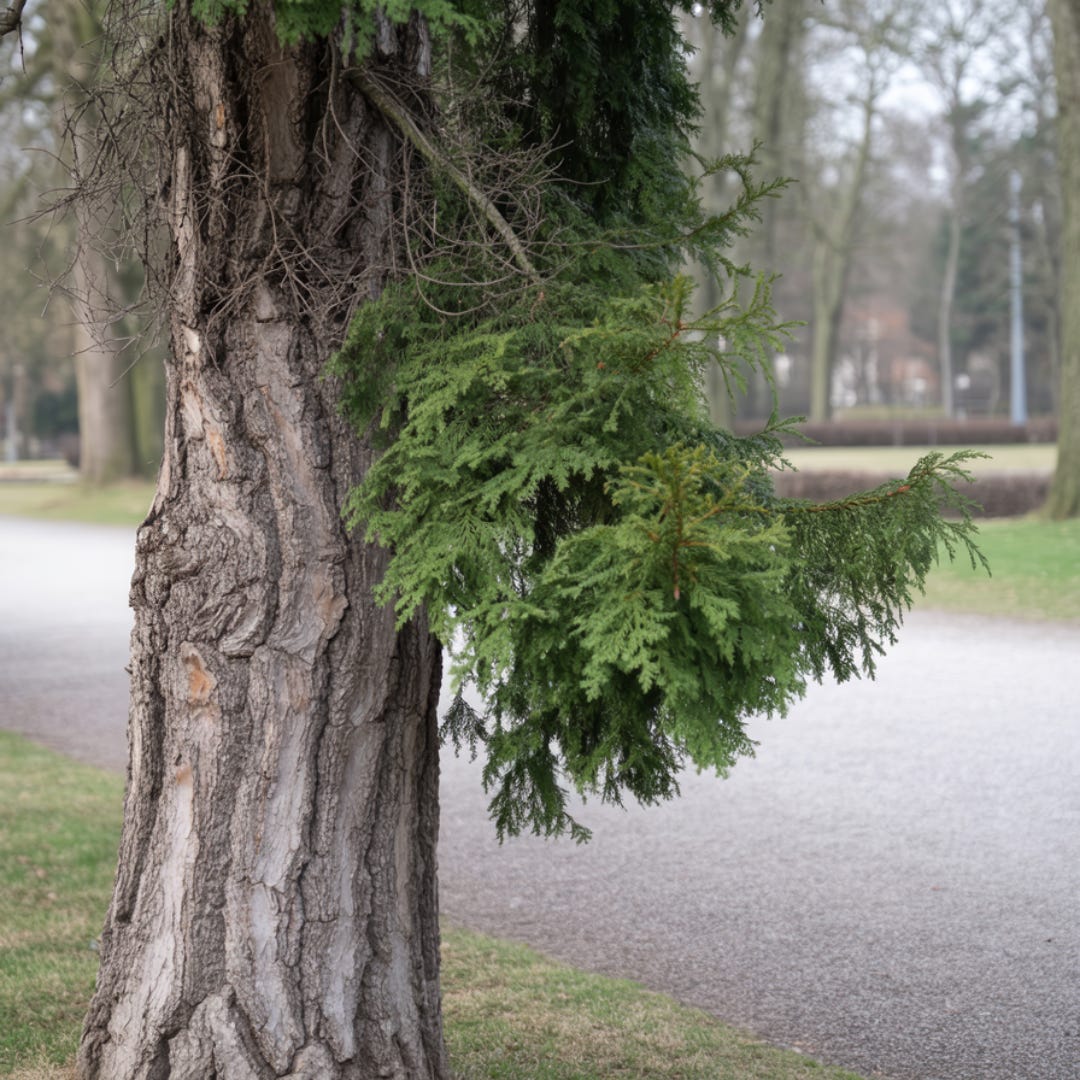
The first tree I ever listened to was an evergreen in the Luxembourg Gardens in Paris.
It was winter. Most of the trees in the garden were dormant, bare branches sketching patterns against the grey sky. But this one was still visibly alive, still green, still holding its fullness while everything around it had let go. I did not choose it for any mystical reason. I chose it because it looked like it had something to say when everything else had gone quiet.
I asked him what I should call him, and the name Hermann came to mind. I then, and still now, call him Hermann.
Before Hermann
I need to be honest about where I was when this began.
I was learning to notice the natural world for the first time. Not as scenery. Not as something to photograph or identify. As something to be with. I had spent years in graduate school, in academic work, in the life of the mind. I understood ecosystems intellectually. I could cite research on biodiversity and ecological grief. But I had no relationship with any living being other than humans and my dogs.
That is the gap most people do not talk about. You can know everything about the more-than-human world and still have no kinship with it. Knowledge about is not the same as relationship with. I had a PhD and cannot tell you the name of the tree outside my window, not to mention its type, age, or how or why it grows here.
Discovering a relationship with Hermann was where that changed.
What Listening Actually Means
When I say I listened to a tree, I do not mean I heard words. I do not mean the tree spoke to me in some mystical transmission. I mean, I stood still, repeatedly, in the presence of the same living being, and paid attention.
At first, I paid attention the way most of us do. I noticed the shape of the branches. The texture of the bark. The way light filtered through the needles. It was pleasant. It was also still observation from the outside. I was studying Hermann the way I might study a subject in a research project. Gathering data. Noting details. Comparing subjective notes about an objective reality.
The shift happened slowly, over weeks of returning. I stopped cataloging and started simply being there. I noticed that Hermann’s presence changed depending on the weather, the season, and the time of day. I noticed that my own presence changed depending on what I brought with me. Anxiety made the tree invisible. Stillness made it enormous.
Somewhere in that process, the relationship reversed. I was no longer visiting a tree. I was being received by one, one who had a name and was no longer an it, but a he.
What Hermann Taught
If I had not gained the sensitivity, close looking, and openness to kinship that came from standing with Hermann, I would not be able to teach Rewilding the Soul. I would not have understood ecospirituality as a lived practice rather than an academic concept. I would not have been ordained as a Wild Guide, someone called to connect people in kinship with the land.

One tree did all of that. Not a forest. Not a mountain. Not a pilgrimage. One evergreen in a Paris park.
This is what I try to teach, and it is also what sounds strange until someone tries it. The idea that you can have a relationship with a tree sounds like the kind of thing that makes reasonable people uncomfortable. It sounds precious. It sounds performative. It sounds like something that belongs on a bumper sticker rather than in serious spiritual practice.
Then you try it. You stand with the same tree for five minutes. Then you return the next day and do it again. Then the next. Somewhere around the third or fourth visit, something shifts. You stop trying to have an experience. You simply stand there. That is when presence begins to arrive. Not because you achieved something. Because you stopped performing.
I once guided a contemplative walking exercise in which a participant, analytical and skeptical by nature, was asked to spend five silent minutes with a tree of their choosing. Afterward, he was quiet for a long time. When he finally spoke, he said: “I chose the biggest tree because I thought it would give me the most to work with. Then I realized I was treating it like a project. Around minute three, I stopped trying to have an experience and just stood there. That was the first time I understood what you mean by presence.”
He did not need instruction. He needed to stop performing long enough for the relationship to begin.
The Honest Difficulty
I want to be careful not to make this sound effortless.
There are days when I stand before a tree and feel nothing. No insight. No connection. No sense of kinship. Just bark and silence, and the faint suspicion that I look foolish. The temptation on those days is to narrate meaning onto the encounter. To manufacture a spiritual experience because the quiet feels like failure.
The practice asks something harder. It asks you to keep showing up when nothing seems to be happening. To trust that relationship builds the same way it does with any living being: slowly, through repeated presence, not through dramatic moments. Most of the deepening happens in the visits you would describe as uneventful.
This is also why the language of “land management” has always troubled me. We manage projects. We manage employees. We manage productivity. When we apply that same framework to the living world, we reveal the consensus we inherited: the Earth is property to be administered, not a community of beings to be in relationship with. Even conservation, which means well, often defaults to the language of control. Managing land is not the same as being in kinship with it.
Hermann taught me the difference.
What Remains
Hermann was slowly dying for several years. I watched this happen visit by visit. A little less green. A little less fullness. The way you watch someone you love age, knowing what is coming, but unable to stop it.
Then one day, after I returned from travel, he was gone. Not dying. Gone. As if he had never existed. The space where he stood held nothing. No stump. No marker. No acknowledgment that a living being had occupied that ground for decades.

That absence taught me something I could not have learned while Hermann was alive. Grief for a tree is not lesser grief. It is not practice grief or metaphorical grief. It is the real thing. It arrives in the body the way all grief does, as weight and silence and the disorientation of reaching for something that is no longer there.
Hermann remains in my memory. His teachings remain in my practice. Every time I guide someone toward their first tree encounter, every time I teach that ecospirituality is embodied relationship rather than intellectual concept, every time I stand with a new tree and wait for the relationship to begin, Hermann is present.
What This Means for You
You do not need to go to Paris. You do not need a famous garden or an ancient forest.
You need one tree. The one outside your apartment. The one at the edge of the parking lot. The one you pass every morning without noticing. Go to it tomorrow. Stand with it for five minutes. Do not identify it. Do not photograph it. Do not try to have an experience.
Just be there. Then go back the next day.
The relationship will not arrive on your schedule. It will arrive when you stop performing and start showing up. That is what Hermann taught me. That is what every tree teaches, if you stay long enough to hear it.
You already know how to listen. You just need one being to listen to.
If this landed, please like this post and leave a comment below about your experience. I read every one.
Walk With Me
If my post today resonated with you, then these may as well.
Pack Light, Walk Present: The Contemplative Camino Packing Guide — Everything I know about preparing body and soul for pilgrimage. Complete packing list, 6-week training plan, contemplative preparation guidance, and a printable checklist. Available on my website (free for annual subscribers). Every purchase includes a complimentary live Packing & Planning Audit, one pilgrim to another. Either Get the Guide or become an Annual Subscriber and get it for free!
Rewilding the Soul: EcoSpirituality Certificate — A guided journey into direct, embodied relationship with the living Earth. Through Cherry Hill Seminary, starting in March 2026. Learn More.
September 2026 Contemplative Walking Retreat — Seven days on France’s ancient Le Puy path of the Camino de Santiago. Only 4 participants with only 1 space remaining. Private rooms directly on the route where pilgrims have walked for a thousand years. Silence as practice, not punishment. Details Here.
Subscribe to Where Insight Meets Earth for weekly reflections on contemplative walking, ecospirituality, and embodied practice.
Buen Camino. Bon Chemin.
“Knowledge about is not the same as relationship with” carries the piece and love being received by the tree is a humble posture
I met a tree long ago......she was on my daily 5 mile running route. I've always had an affinity for trees, but she was different. When I stood against her she taught me things I wished my mother had taught me. I called her the Mother tree. I don't get to visit her much anymore, because she's on a busy street, with now unpleasant neighbors nearby - but I still love her, and would be devastated if she died.