

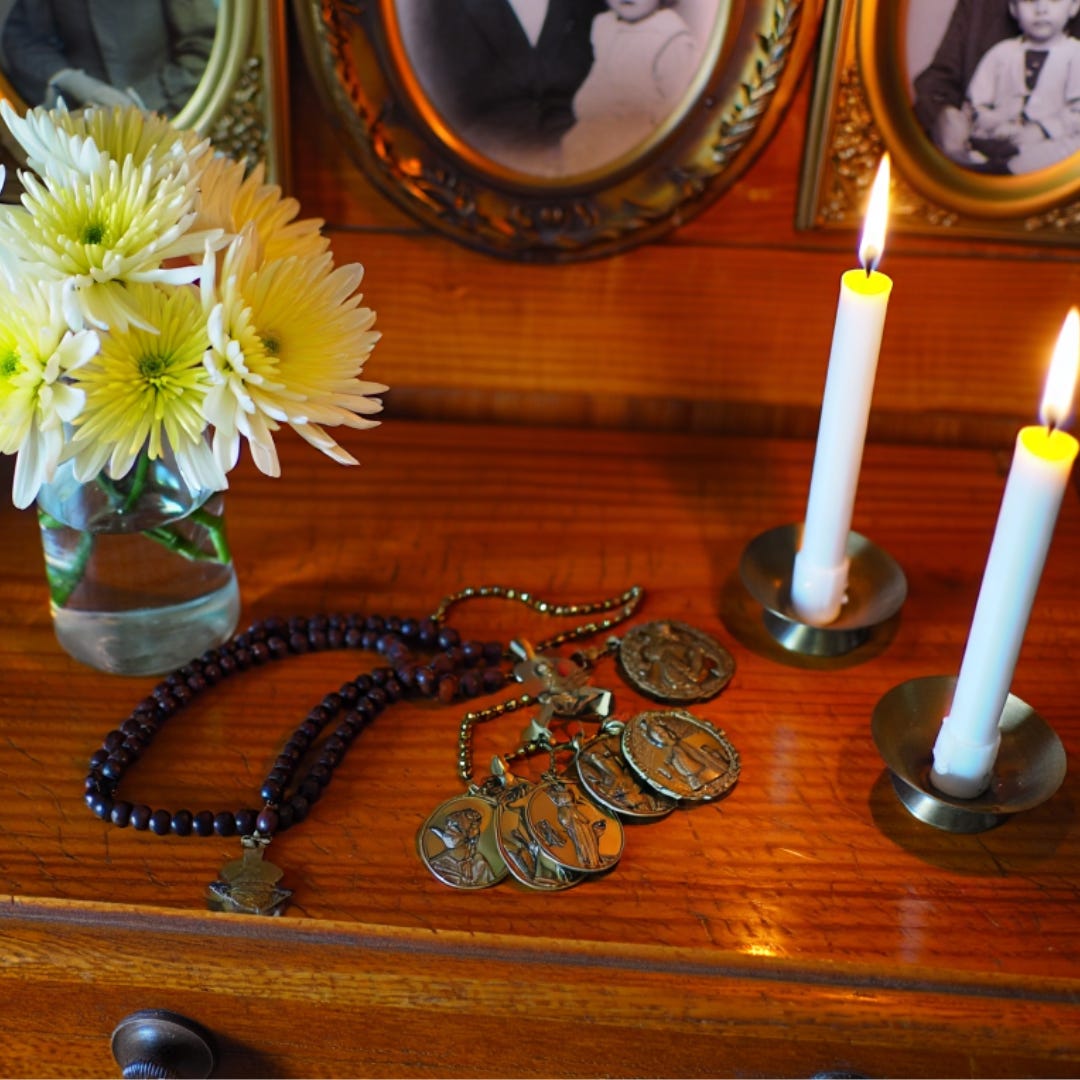
I’m building my ancestor altar right now, as I write this.
It’s on a shelf in my library, near my desk, where I can see it easily. Where it will invite reflection throughout the day. Where I can’t forget it’s there. So far, there are some photos, two books, a stone, and other memories I’m adding to honor those who have come before and whose thoughts and actions have positively helped me become who I am.
This is my first time creating an ancestor altar specifically for Samhain.
I’m figuring it out as I go, and it is part of what I want to share with you—not a perfect guide from someone who has it all figured out, but a real-time account of what I’m actually doing. Because if you’re considering creating sacred space for your ancestors this Samhain, you don’t need to have it all figured out either.
You just need to start.
Call It Whatever You Need to Call It
First, let’s address the word “altar.”
For some people, this word carries religious weight they’re not comfortable with. It might feel too pagan, too Catholic, too formal, too much. If “altar” doesn’t work for you, that’s fine. Call it whatever you need to call it.
Memorial. Sacred space. Remembrance shelf. Ancestor corner. Honoring place.
The name doesn’t matter. The intention does. What matters is creating intentional space to acknowledge those who came before you. To recognize that you’re here because they were here first. To honor what they gave, whether that’s life itself, ideas that shaped you, love that held you, or lessons learned from their mistakes.
Don’t let terminology block you from the practice.
What’s Actually Going On Mine
Here’s what I’m putting on my ancestor altar, and why.
Photos: I have a photo of my previous two pugs and one of my grandmother. All of them are remembered as being kind, gentle, and loving. These qualities shaped me. My grandmother showed me what steady love looks like. My pugs taught me about presence and unconditional affection. They’re ancestors, not in the “came before me generationally” sense with the pugs, but in the “their lives shaped mine” sense.
Books: I’m including three books by authors who are my spiritual ancestors. The Postmodern Condition by Jean-François Lyotard, Devotions by Mary Oliver, and Active Hope by Joanna Macy. These aren’t just books I liked. These are books, and people, whose thoughts have positively helped me. Their ideas live in me. They gave their wisdom freely, and I received it. They’re ancestors too.
An Avebury Stone: I have a stone from Avebury, the stone circle in England. I first visited there in 2011. That’s where the energies of the Earth first touched me in a way I couldn’t ignore. I’d been leaning toward nature spirituality before then, but it really began in earnest when I felt the magical presence of the natural world at Avebury in 2011. That stone represents Earth as ancestor. The land that holds us. The more-than-human world that came before us and will be here after. For disclosure, this was not hacked off of the standing stones, but rather one from within the village enclosed by the stones themselves.
Offerings: I’m still developing what offerings I’ll place here and how I’ll change them throughout the week. This part is evolving as I go.
The location matters too. This altar is on a shelf in my library, near my desk. I’ll see it every time I sit down to work. It won’t be hidden away in a corner I never visit. It will be present, inviting reflection, reminding me daily that I didn’t get here alone.
Saints as Ancestors: Reclaiming What I Threw Away
I used to be Catholic. When I left the church thirty years ago, I threw out a lot—including the saints.
I used to think of saints as semi-magical beings, like Catholic demigods. Special people with special powers who could intercede on my behalf if I prayed to them correctly. But something important got missed; they were people who did brave things. Real humans who made choices that mattered.
This shifted for me while walking the Le Puy Camino route in France—the route I’ll be leading as a contemplative retreat in September 2026.
There, I encountered Saint Francis of Assisi in a different way. Not as a plaster statue. Not as a distant holy figure. But as a person who chose radical connection with the natural world and the more-than-human others all around us. Who saw birds and wolves as kin. Who practiced what I’m only now learning to practice.
Saint Francis is one of my spiritual ancestors. So are other saints whose courage and choices created pathways I now walk. I’m reclaiming them, not as Catholic demigods, but as brave people whose lives influenced mine.
More-Than-Human Ancestors
Yes, I believe more-than-human ancestors have had profound effects on my thinking and life.
It would seem odd not to include them. Hermann, the tree who was removed entirely from the Luxembourg Gardens, is an ancestor. The Avebury stones are ancestors. The land I spiritually walk on also has traces and energies of indigenous ancestors.
We’re so used to thinking of ancestors as only human, only generational, only family. But if an ancestor is “one who came before and shaped what came after,” then trees are ancestors. Land is an ancestor. The more-than-human world that created the conditions for human life is our oldest ancestor.
This isn’t a metaphor. This is recognition of reality within a kinship worldview.
What I’ll Actually Do at This Altar
Creating the altar is one thing. But what do you actually do with it? This isn’t just decoration. This is practice.
Here’s what I’m planning:
Light a candle. Fire as offering. Fire as presence. Fire as the element that brings light to the dark half of the year we’re entering.
Make offerings. I’m still developing exactly what these will be, but they’ll be biodegradable, meaningful, and changed regularly. Not permanent fixtures, but gifts.
Journal my reflections. Write to my ancestors. Write about what I’m learning from them. Write questions I wish I could ask them. Write gratitude for what they gave.
Meditate with the ancestors as focus. Sit in silence at this altar. Not asking for anything. Just being present to their presence. Acknowledging the continuity between their lives and mine.
This is why it’s different from just a memory shelf. A memory shelf is passive. You glance at it sometimes and think, “Oh, nice photo.” Sacred space is active. You engage with it. You practice at it. You let it change you.
Like acknowledging birthdays or anniversaries, Samhain marks a moment to celebrate or remember something of importance. A threshold when we pause and recognize that these beings came before me, and I am here because they were here first.
What If Your Ancestors Were Complicated?
Not all ancestors did good things. Many ancestors caused harm to their families, to communities, to the land, to the people they conquered or enslaved. I have these ancestors, too. We all do.
What do you do with them at Samhain?
I’ve heard some people use this time to pray for them. To look for opportunities to make reparations for their harm. To process where we came from and how we were made, not all of it by good means. This can become cathartic. An opportunity to acknowledge that, yes, this happened, and that I’m still here despite the difficulties. Maybe even because of difficulties.
Personally, I’m not focusing on harmful ancestors this year. That’s an intentional choice. I’m focusing on those who helped me become who I am in positive ways. But that doesn’t mean the harmful ones don’t exist or don’t matter.
If you have complicated ancestors, and most of us do, you get to choose how to engage. Honor the good. Learn from the harm. Make reparations where you can. Or simply acknowledge they existed and you’re working to break harmful patterns they started.
There’s no one right way.
What If You Don’t Have Photos or Objects?
Some people don’t have photos of their ancestors. Some people don’t have objects that belonged to them. Some people don’t even know who their ancestors were.
You can still create ancestor space.
Write poetry for them. Create artwork honoring them. Use symbolic objects that represent the qualities you hope they had or the ancestors you wish you’d had. Have a journal where pages are dedicated to ancestors—write to them, about them, for them. Make a list of spiritual ancestors whose books or art shaped you, even if you never met them.
The physical objects matter less than the intention. You’re creating space to acknowledge that I am here because others came before me. That recognition is the practice.
The Only Essential Element
Here’s what you actually need to create an ancestor altar: a felt need to be aware of and honor those who came before you and helped you become who you are today.
That’s it. That’s the only essential element.
Everything else—photos, objects, candles, offerings, perfect placement—is optional. Nice, but optional. What matters is the intention. The recognition. The willingness to pause and say: I didn’t get here alone.
You can create this space on a small shelf. On a corner of your desk. On a windowsill. In a drawer you open intentionally. It doesn’t have to be elaborate. It doesn’t have to be Instagram-worthy. It just has to be yours.
Temporary or Permanent?
My ancestor altar will be temporary.
I know permanent altars sound like a great idea. Create it once, keep it year-round, always have this sacred space available. But here’s what I’ve learned: permanent things become invisible. We get used to them. They become background. We stop engaging.
Temporary creates intentionality. Temporary means this week, this Samhain season, I’m focused on ancestors. I’m actively engaging, and when I take it down, I’ll remember what it was like to have it. The absence will matter.
Next Samhain, I’ll build it again. Differently, probably. With different photos, different books, different offerings. Because I’ll be different. My relationship with my ancestors will have evolved.
Temporary doesn’t mean less sacred. It means more intentional.
What Happens on October 31st?
I’m still developing what I’ll do specifically on Samhain itself at this altar.
I’m admitting this because I want you to know that you don’t have to have it all figured out before you start. I’m writing this on Tuesday. Samhain is Friday. I’m building as I go. Figuring it out. Letting it evolve.
Maybe on October 31st I’ll light a special candle. Maybe I’ll sit longer in meditation. Maybe I’ll read aloud from Mary Oliver at the altar. Maybe I’ll write letters to my ancestors and burn them as offerings.
I don’t know yet, and that’s okay. The practice reveals itself as you engage with it.
Start Today
If you’re considering creating ancestor space for Samhain, start today.
Don’t wait until you have the perfect items or the perfect plan or the perfect understanding. Start with what you have. One photo. One book. One stone. One candle. One intention.
Call it whatever you need to call it. Put on it whatever reminds you of those who came before. Light a candle. Sit for five minutes. Journal one sentence of gratitude. That’s enough.
The ancestors aren’t keeping score. They’re not judging your altar’s aesthetic or your ritual’s correctness. They’re just here, in memory, in influence, in the ways their choices shaped the world you inherited.
Acknowledge them. Honor them. Let them know you recognize: I am here because you were here first.
That recognition is the practice. Everything else is just details.
Are you creating ancestor space for Samhain? What’s going on your altar (or memorial, or sacred space)?
Reply and let me know. I’m building mine alongside you.
Walking with the ancestors,
Jeffrey
P.S. Tomorrow I’ll share more about what I’m planning for Samhain eve itself—the practices, the silence, the threshold. If you’re interested in learning more about contemplative walking as spiritual practice, or about the Le Puy Camino retreat I’m leading in September 2026, subscribe to receive my weekly reflections.
This is a very useful and practical post, Jeffrey. I have several altars in my room. I engage with the eveyryday, I pick something up, or move it around. I am a very tactile person as well as visual so I make sure they convery seasonality. That the items know I do not take them for granted. I put out different beaded meditation circlets from time to time, swapping them off - I have quite a few. I talk to the prints or icons. They are part of my family.
As to saints . . . in my experience they are not as 'tight-assed' on the other side as some of then were here. They don't mind if a pagan interacts with them - usually through a meditation circlet made to honour them.
I don't have a one specifically dedicated to the ancestors, because in a way everything on all of them exhibit the journey that made me me and got me where I am. Though for Samhian, besides remembering the roadkill whom I led to their portals, and who gave me their names in return for that guidance, I will intentionally remember and name those who are my ancestors - of blood, of spiritual path, of the land.
Thank you for helping me to shape out more fully what I might do on Samhain