

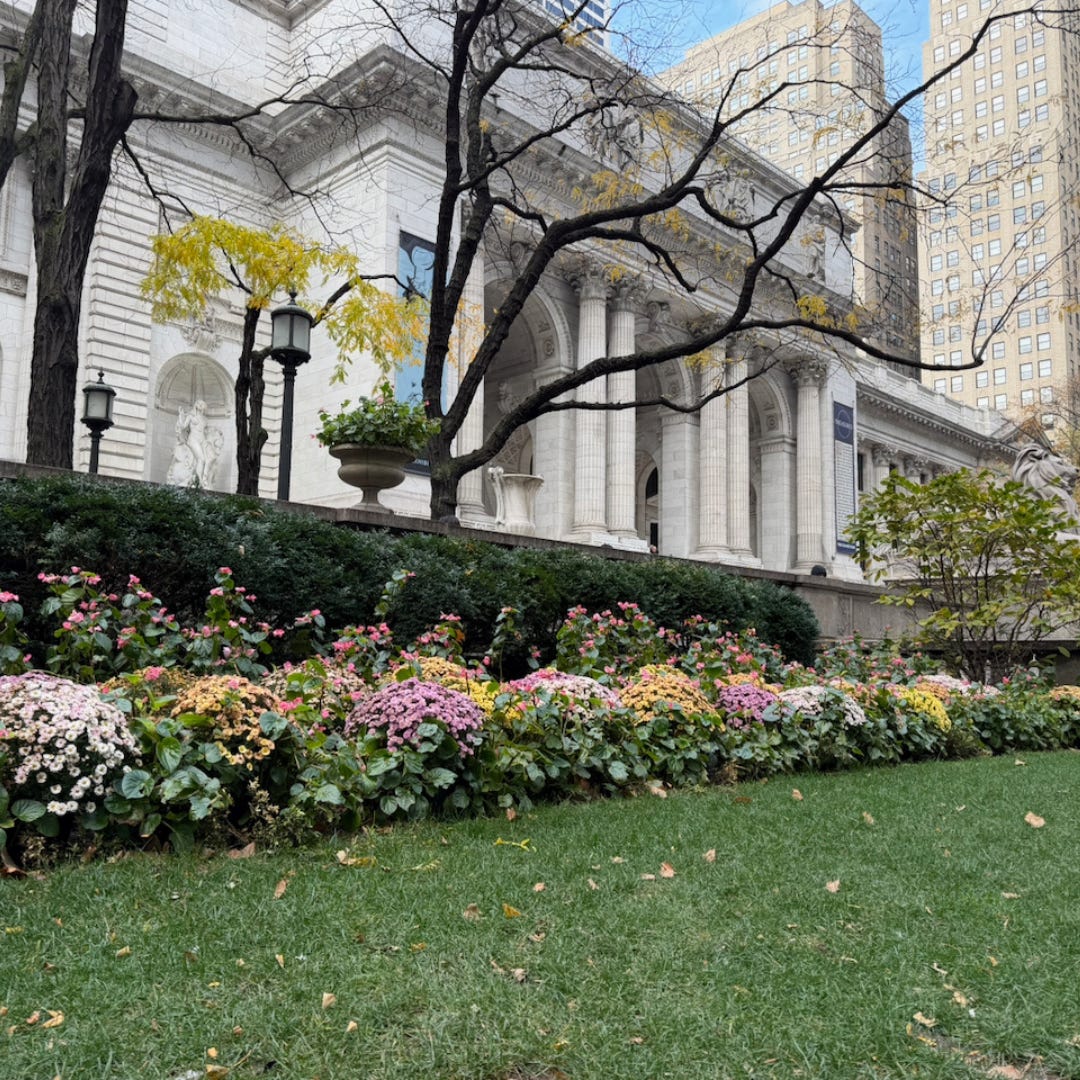
I was walking to the dentist this week.
Nobody looks forward to dental appointments. Crown work, especially. I was mentally preparing myself for an unpleasant few hours when I passed the New York Public Library on Fifth Avenue.
The mums stopped me in my tracks.
Spectacular bursts of rust, gold, and burgundy. Hundreds of them were planted in front of those famous marble lions, Patience and Fortitude. I’ve walked past this building literally hundreds of times. I always noticed the color. But this time, something different happened.
I suddenly saw the lives making that color.
Living beings planted here temporarily. Performing as decoration. Soon to vanish completely when garden crews rip them out to make room for Christmas displays.
That realization changed how I see seasonal beauty. This is about more than appreciating flowers. It’s about recognizing we treat living beings as background decoration, then dispose of them without thought.
What We Actually See (and What We Miss)
I’ve walked past the New York Public Library many times over the years.
I think about the architecture. The iconic lions. Crowds of tourists taking photos. The fantastic gift shop. The library itself as a monument to knowledge, housing millions of books and centuries of human wisdom.
But there are always flowers there. Living beings celebrating their brief existence right in front of me. If only I stop for them.
The irony isn’t lost on me. Patience and Fortitude, the marble lions, were named during the Great Depression. They’ve become symbols of knowledge, permanence, civic pride. People travel from around the world to photograph these monuments.
Meanwhile, actual living beings growing at their feet go largely unnoticed.
This is the contrast I’m inviting you to see: knowledge housed in marble buildings seems more valuable than the life growing in front of those buildings. I’m not dismissing knowledge. I’m a professor. I spend my days in libraries and classrooms.
But I’m asking us to reframe how we see. What deserves our attention? The permanent monument or the brief life?
The Disposable Life Cycle
Here’s what happens to those mums.
Garden crews plant them in September or October. Annual varieties, not perennials. Their purpose is temporary cheer during what many perceive as a cheerless time of year. That window between summer’s end and winter’s arrival when everything feels like dying.
The mums bloom beautifully for a few weeks. They perform exactly as designed. Background decoration that makes people feel better about autumn without requiring them to think about autumn.
Then frost comes. Or Christmas approaches. Either way, the mums vanish.
Not naturally, the way tree leaves fall and decompose and feed the soil. Garden crews rip them out of the ground. Living or dead, doesn’t matter. They’re disposed of to make room for different colors, different seasonal messages, different temporary cheer.
This is not a local thing; it seems to happen in towns and cities and monuments worldwide. I just never thought about it in this way.
This is what capitalism does to living beings. Treats them as decoration. Values them only for the service they provide to human emotions. Disposes of them the moment their usefulness ends.
The mums never asked for this role. They’re just living, the way all beings live. Celebrating existence the only way they know how: color, growth, persistence despite knowing their time is brief.
Nobody tells them they’re background. Nobody asks if they want to be decoration. They simply are, until suddenly they’re not.
What Celebrating Actually Looks Like
When I stopped in front of those mums, I did something that probably looked strange to other pedestrians.
I said hello. Out loud. Not just in my head.
But that wasn’t enough. I needed them to know something more. So I told them: “I see you. I see your lives.”
Not just your color. Not just your decorative purpose. Not just the temporary cheer you’re providing for people rushing past on their way to dentist appointments.
I see that you are alive. That you have your own existence. That your brief time here matters, even if the city will rip you out in a few weeks.
Many people walk by these mums. Most are aware of them the way we’re aware of anything in our peripheral vision. Background. Scenery. Nice splash of color to brighten the concrete.
But how many actually see them as beings with their own lives?
This is what celebrating looks like. Not just appreciating beauty. Not just noticing color. But witnessing the actual existence of a living being and acknowledging that existence out loud.
Telling them: you are not just decoration. You are someone, not something.
Where Else This Happens
Once you start seeing this pattern, you notice it everywhere.
Annual flowers in public parks. Planted in spring, yanked out in fall. Cut flowers in grocery stores. Severed from their roots, displayed in plastic buckets, thrown away when they wilt. Potted plants on sale after holidays. Poinsettias in January, marked down seventy percent because their seasonal usefulness ended.
Living beings treated as temporary decoration in every public space, every commercial building, every attempt to make concrete environments feel “natural” without actually honoring nature.
We do this constantly. We surround ourselves with living things, then treat them as objects. Background. Scenery. Decoration that requires no relationship, no acknowledgment, no recognition of the life we’re exploiting for our temporary emotional comfort.
The mums outside the library are just the most visible example. But this pattern runs through every interaction between modern humans and the more-than-human world.
We take. We use. We dispose. We rarely stop to witness what we’re actually doing.
The Practice: Three Steps
Here’s what I’m inviting you to do the next time you encounter seasonal flowers.
Step 1: Stop.
Actually stop walking. Stop scrolling. Stop rushing to wherever you think you need to be. The flowers aren’t going anywhere yet. Neither are you, really.
Stop in front of them. Look directly at them. Not peripheral awareness. Direct attention.
Step 2: Greet them.
Say hello out loud. “Hello, mums.” “Hello, tulips.” “Hello, whoever you are.”
Use your voice. Speaking out loud does something greeting silently in your head doesn’t do. It makes you accountable to your own attention. It makes the greeting real.
If saying hello to plants feels too strange, start there. Notice that resistance. Ask yourself why speaking to a living being feels awkward while speaking to marble monuments feels normal.
Step 3: Witness their lives.
Tell them you see them. Not just their color, their decorative purpose, their contribution to seasonal cheer.
Tell them you see their actual existence. Their brief time here. Their lives that matter regardless of human purpose.
“I see you. I see your lives.”
That’s it. That’s the practice. Three steps that take maybe sixty seconds.
But those sixty seconds shift something fundamental. You’re no longer treating living beings as background decoration. You’re recognizing them as beings with their own worth.
What Shifts When You Practice This
When you start honoring temporary beings instead of just permanent monuments, several things change.
You become more sensitive. More aware. More capable of noticing what’s actually alive around you rather than just what’s architecturally impressive or culturally significant.
You develop insight into your own relationship with living things. How often you use them without seeing them. How casually you accept their disposal. How little you question the systems that treat beings as decoration.
You recognize that your own problems are only that: your own problems. All these other living beings have their own lives, their own needs, their own brief existences that matter completely independent of your dental appointments or work deadlines or personal struggles.
This connects directly to contemplative walking practice. To pilgrimage. To everything I teach about kinship with the more-than-human world.
When you walk the Camino, when you take any contemplative walk, you’re practicing exactly this: noticing what’s actually alive around you. Not just the grand vistas or famous monuments. The small, brief, easily overlooked lives that make up the majority of existence on this planet.
The mums outside the library aren’t less worthy of attention than Patience and Fortitude. They’re more temporary, yes. More vulnerable. More likely to be disposed of without ceremony.
That’s exactly why they deserve your witness. Because nobody else is stopping to see them.
Before They’re Gone
The mums outside the New York Public Library will be gone soon.
Maybe they’re already gone by the time you read this. Garden crews work quickly. Seasonal transitions happen overnight. One day there are hundreds of living beings celebrating autumn. The next day there’s bare soil waiting for winter decorations.
That’s the nature of temporary beauty. It doesn’t wait for you to notice it.
But there are seasonal flowers everywhere. In your neighborhood. Outside your office building. In public parks. In front of stores trying to make concrete feel welcoming.
Living beings planted temporarily. Performing as decoration. Soon to vanish when their usefulness ends.
The next time you see them, stop. Greet them. Tell them you see their lives.
Celebrate their brief existence before they’re gone. Not because it changes their fate. Not because it saves them from disposal.
Because witnessing matters. Because every life deserves to be seen. Because the practice of honoring temporary beings transforms how you move through the world.
The mums taught me that. Right there on Fifth Avenue, between the marble lions and my dentist appointment.
Sometimes beauty stops you in your tracks. Sometimes it reminds you that knowledge housed in buildings matters, but so does the life growing right outside those buildings.
Sometimes it teaches you that the briefest lives deserve the most attention, precisely because we’re trained to overlook them.
Walk With Me
If this resonates, subscribe to Where Insight Meets Earth for weekly reflections on contemplative walking, ecospirituality, and deepening kinship with the more-than-human world.
The EcoSpirituality Certificate I am teaching begins March 2025 and explores exactly these practices: how to honor living beings we’ve been taught to overlook, how to develop kinship with the more-than-human world, how to notice what’s temporary before it’s gone.
Hit reply anytime. I read and respond to every message.
Walking beside you,
Jeffrey