

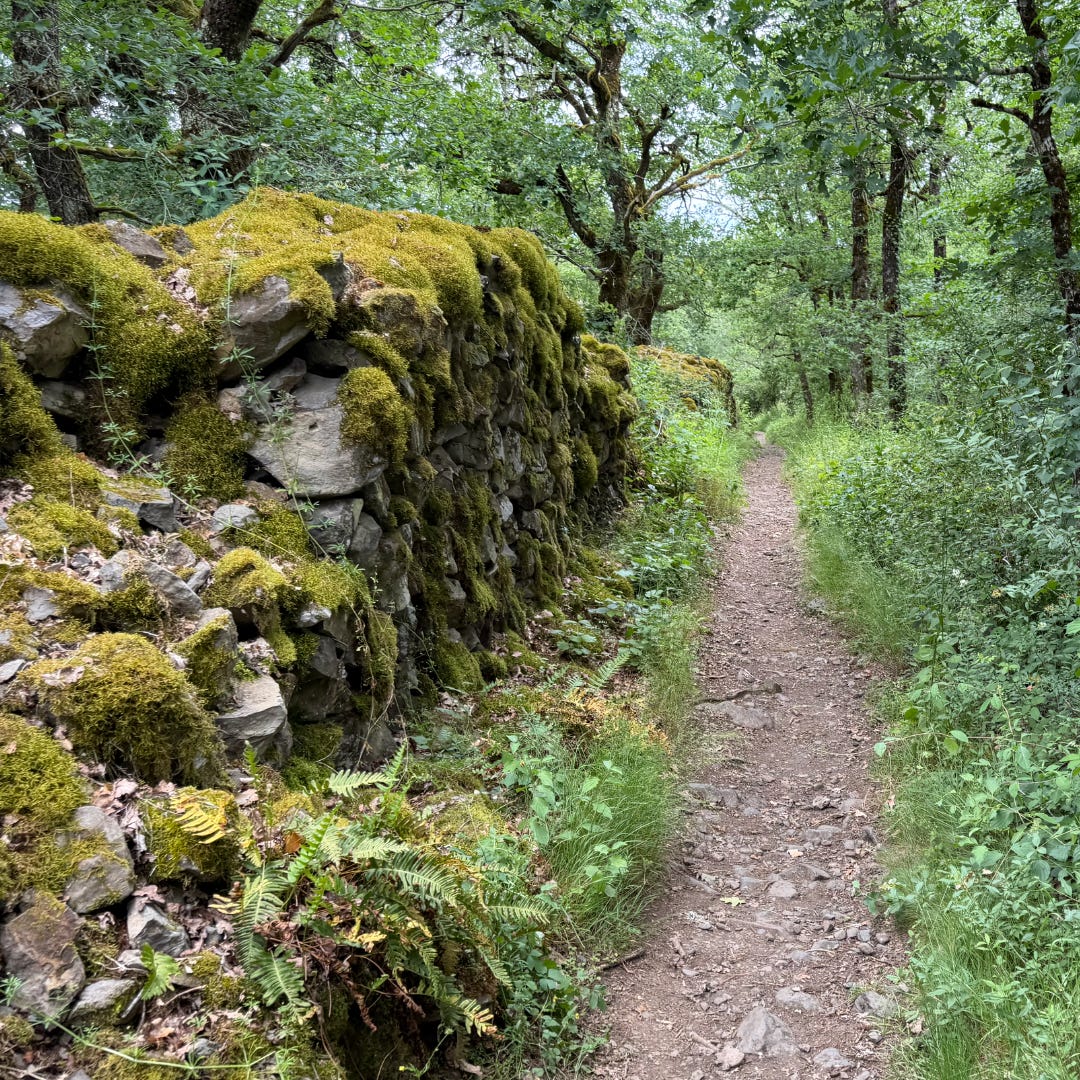
A book will hold still for you.
You can return to the same page a hundred times and find the same words waiting: patient, unchanged, indifferent to whether you come at all. This constancy makes sacred reading possible in its traditional form. When the text is a hillside, an oak, or a pond outside a French village, something decisive changes. The reading goes both ways.
The text notices you back.
I wrote about Earth-Based Lectio Divina in April, and I have been refining the practice since. What follows is the version I am now deepening into in my own practice and teaching: four movements, framed by arriving and returning, that you can try on an ordinary walk.
Four Movements, Nine Hundred Years Old
Guigo II, a twelfth-century Carthusian monk, named four movements in his Ladder of Monks. It has since been adapted by many contemporary people seeking to develop their spiritual practices.
Lectio is slow reading until something stops you. Meditatio means staying with it until it moves through the body. Oratio is responding from whatever has surfaced. Contemplatio releases all effort and rests in what is present. In Guigo’s formulation, reading seeks, meditation finds, prayer asks, and contemplation tastes. That sequence is the framework of the practice, and it has served contemplatives for nine hundred years.
The sequence stays. The text changes, and so does the orientation beneath it.
My adaptation rests on three premises:
The living world has agency.
Encounter is mutual.
Reciprocity is required.
Hold these three, and each movement becomes a relationship rather than a technique. That shift is the whole of it. Reading a book leaves you with understanding, while reading the Land leaves you with a relationship, and a relationship changes both parties. The oak you return to across a year knows your seasons. The stream you sit beside recognizes your weight on its bank. Contemplatives across many traditions have found their way to the same discovery: that sustained attention to any living presence opens into kinship, and that kinship is what most of us are actually hungry for when we say we want to spend more time in nature.
Where Arriving and Returning Belong
The version I published in April contained five movements, and one of them belonged somewhere other than the ladder.
I had placed Arrive at the beginning and Return at the end, alongside the four central movements. Both are important, and both are part of the frame rather than rungs of the ladder. Guigo’s monk also arrived at his cell and returned afterward to labor and community. The tradition left those actions unnumbered because they surround the practice rather than constitute parts of it. Naming them as additional steps made the ladder longer than it needed to be and burdened the practice with too much preparation.
So, go outside. When you finish, come back carrying what you received.
That is the frame of Earth-Based Lectio Divina. Inside it are four movements: Receive (lectio), Ponder (meditatio), Respond (oratio), Belong (contemplatio). Read them once and then forget the list, because they describe what already happens when you give a living being your sustained attention. The names are here to help you recognize where you are, rather than to be followed in order.
The 4 Steps in Earth-Based Lectio Divina
1. Receive
Let your attention settle on one presence: this oak, this crow, this patch of moss along the wall, rather than the landscape at large.
Stay with the one and let the many recede. Take in what it offers through your senses, slowly, the way lectio was always meant to be practiced. Let the hunt for meaning wait.
Inner posture: I allow encounter and let meaning come as it will.
2. Ponder
Stay with what you have received and let it work on you.
What is this presence doing, swaying, holding, decaying, emerging? What does it stir in your body or memory? Let associations rise without forcing them into an interpretation.
Inner posture: I am part of what I am noticing.
3. Respond
What you receive from the living world creates an obligation.
Answer what you have encountered, with gratitude, apology, curiosity, or a promise of care. Your response may be spoken, silent, or embodied. If you have picked up a stone or fallen leaf, return it as you finish. Reciprocity does not always mean leaving an offering, and sometimes the most fitting response is to depart with care.
Inner posture: I am in relationship here.
4. Belong
Everything before this was preparation.
The receiving, the pondering, the response, all of it was clearing ground for the movement that follows, and this is the one worth walking out for. Stay. Let your awareness widen. The Land speaks at a pace we are unaccustomed to, slower than conversation and slower than thought, and this is the movement that finally gives it room. Something may arrive after several minutes: a shift in the light, a bird returning to the branch it left when you approached, the sense that the place has stopped holding its breath around you. Whatever comes will not announce itself, and much of what passes between you here registers somewhere below language.
You are in the company of kin, and the work is to stay long enough to become part of the scene rather than a visitor standing in it.
Inner posture: Nothing to do. I belong here.
The phrase I use for carrying this, updated along with the movements: receive one being, ponder what it offers, respond with care, and stay long enough to belong.
Four Movements, One Morning in France
Thirty minutes outside Espalion in June, in light rain, two frogs called loudly enough to stop me mid-stride.
I had seen the pond and would have walked past it. Their calling pulled me three meters off the path. I stood at the edge in the rain while they carried on, wholly consumed by their own urgent morning. This was Receive, and notice who initiated it.
The frogs had read me first.

I stayed for several minutes. What rose in me was the odd but accurate word honored: honored to witness something real that was not performed for me and did not require me. In Ponder, the encounter worked through my body before my mind found language for it.
My response was smaller than the moment deserved. I recorded a short video because the encounter seemed worth remembering. I said thank you. Then I left them their pond, which was Respond.
I stayed on after that, which is the part I had walked out for. Two small lives in a puddle of a pond, a man in wet boots, all of us in the same rain, and none of us needing anything further from the others. That was Belong. It did not last long, and I have carried it since.
Begin Where You Already Walk
Most people drawn to nature-based practice carry some anxiety about doing it properly.
They wonder whether they are spiritual enough, knowledgeable enough, or attuned enough, and they wait for permission that is already theirs to give themselves. The living world asks for presence, and expertise stays optional. What the practice requires is that you arrive, stay, and come back another day, because repetition is where depth lives and how relationship grows.
The tree you visit once is a stranger. The tree you visit across a full year becomes a teacher, holding your seasons as you learn to hold its own.
Go outside this week. Find one presence that draws you. Stay a little longer than feels natural, and notice what notices you back.
What nearby being would you choose, and what has it already shown you? If you try the practice, I would be glad to hear what happened in the comments.
If you find this useful, please like or leave a comment.
The Rewilding the Soul EcoSpirituality Certificate at Cherry Hill Seminary, where I teach, is currently underway with this year’s cohort. The September 2026 Contemplative Walking Retreat I am leading on this same section of the Le Puy Camino is full. New offerings, including future retreats and additional teaching opportunities, will be announced here in the months ahead. For now, the practice itself is what matters most, and it is available to you wherever you are walking this week.
Where Insight Meets Earth is a reader-supported publication. To receive new posts and support my work, consider becoming a free or paid subscriber.
This is simple, beautiful and can be explored for a lifetime. Thanks 🙏
Loved hearing about your work at the contemplation today, and reading your posts I see you are a kindred spirit! Walking / pilgrimage is one of my core practices, as well. I love this lectio divina method you are describing. And I love hearing experiences from others doing it - it's good to reinforce the connection and reality of it all.