

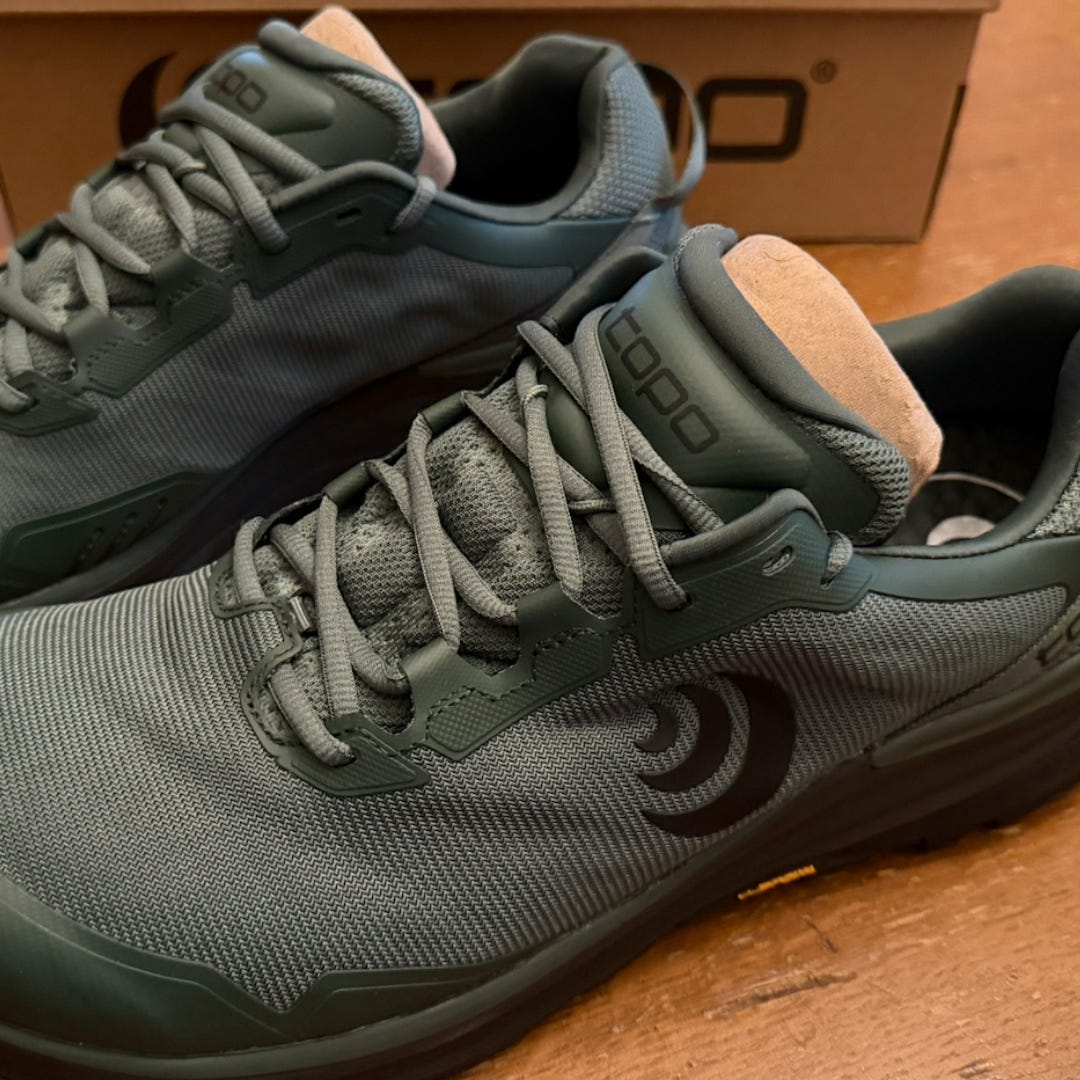
A new pair of shoes arrived this week (yes, those are them in the picture above).
Topo Athletic Traverse thru-hiking shoes—thin, light, breathable, with excellent traction and a metal rock plate to protect against the stones and roots that line the GR65 path of the Camino de Santiago de Compostela across rural France. I will walk 97 miles in them in May, and then lead a small group along the same route in September.
I have done this before each of my previous five Camino walks. New shoes, broken in before departure, chosen not for what the reviews say but for what my feet have taught me over years of getting it wrong.
Being intentional about footwear on the Camino is really a microcosm of life.
What My First Camino Taught Me About My Feet
On my first Camino, I wore waterproof shoes.
This seemed sensible. The GR65 crosses rivers, passes through mud, and moves through weather that does not consult your itinerary. Waterproof seemed like the responsible choice.
By day three, my feet were destroyed.
Waterproof shoes trap heat. When you walk long distances in warmer months, your feet sweat. When your feet sweat inside a waterproof shoe, the moisture cannot escape. What was designed to keep water out also keeps water in. The resulting blisters were among the most instructive experiences of my first pilgrimage, though not in the way I had hoped.
Now I walk in non-waterproof shoes that breathe. When they get wet, they dry. When my feet sweat, the moisture moves through the fabric rather than pooling against my skin. I also buy a size larger than my everyday shoes to account for foot expansion over long walking days, and I choose a wider toe box because my feet need room to spread.
No review told me any of this. My feet did.
The Perfect Shoe Does Not Exist
Here is what most first-time pilgrims get wrong about footwear.
They search for the perfect shoe.
The perfect shoe does not exist. What exists is the shoe that fits your specific feet, your specific terrain, your honest assessment of your season and conditions, and your equally honest reckoning with what has punished you before and what has not.
We all have feet. However, they do not all react the same way to 97 miles of walking (which is what I have planned for this year). Some people thrive in trail runners. Some need the ankle support of a boot. Some find waterproof essential and some, like me, find it damaging. The only way to know which category you fall into is to have walked enough to find out, and to be honest about what you learned.
Good enough, chosen honestly, beats perfect, chosen theoretically, every time.
What the Shoes Are Actually Asking Of You
Buying the right shoes is only the beginning of what preparation requires.
You cannot arrive at the Camino in new shoes and expect them to carry you through seven days of walking. The shoes need breaking in. Your feet need conditioning. Your body needs to know what sustained daily walking asks of it before the route begins asking it of you in earnest.
This means training before departure. Walking in the shoes regularly, in the weeks before you leave, with enough time remaining to identify problems and address them. Nothing replaces this step. No amount of research or quality gear substitutes for the honest feedback of your own body in motion.
This is where self-care enters the planning process, not as an afterthought but as its foundation. Knowing what your feet need. Knowing how your body responds. Knowing when something is working and when it is not, and being willing to act on that knowledge rather than push through and hope.
The Camino will teach you all of this eventually.
You will simply walk more comfortably if you arrive having already done that homework.
A Microcosm of Everything Preparation Requires
I look at these shoes and see more than just footwear.
I see five previous walks and everything they taught me about my own needs. I see the blister on day three of my first Camino that I could have avoided if I had been more honest about what my feet required rather than what seemed reasonable from the outside. I see the gradual process of replacing assumption with self-knowledge that every Camino has continued.
I also see this coming September, when I will walk this same route with a small group of four, each of whom will arrive with their own feet, their own needs, their own version of the lessons I had to learn the hard way.
The shoe choice is a microcosm of all of it. Know yourself. Be honest about your needs. Choose good enough over perfect. Do the work before departure so the route can teach you something more interesting than what you should have prepared.
Spring is here. The GR65, and indeed all Camino pilgrimage paths, are waiting.
I have new shoes, and they come from years of learning more about myself.
Please share questions, anything you learned, or perhaps something you tried as a result of this experience.
Do You Want to Walk Together?
If that moment outside opens something you want to keep exploring, go back tomorrow and explore the same spot, or even a short distance away. You may be surprised at what you notice.
If you want something a little more structured, the September 2026 Contemplative Walking Retreat on the Le Puy Camino in France offers an even more immersive experience. Seven days of walking the GR65 in a small group, with the practice not scheduled alongside the route but woven into every step of it. This is a solo practice within a small group to help free yourself from the challenges of the world for some much-needed time away, physically walking in the natural world.
Start outside. Start today. The earth is not waiting for you to enroll anywhere.