

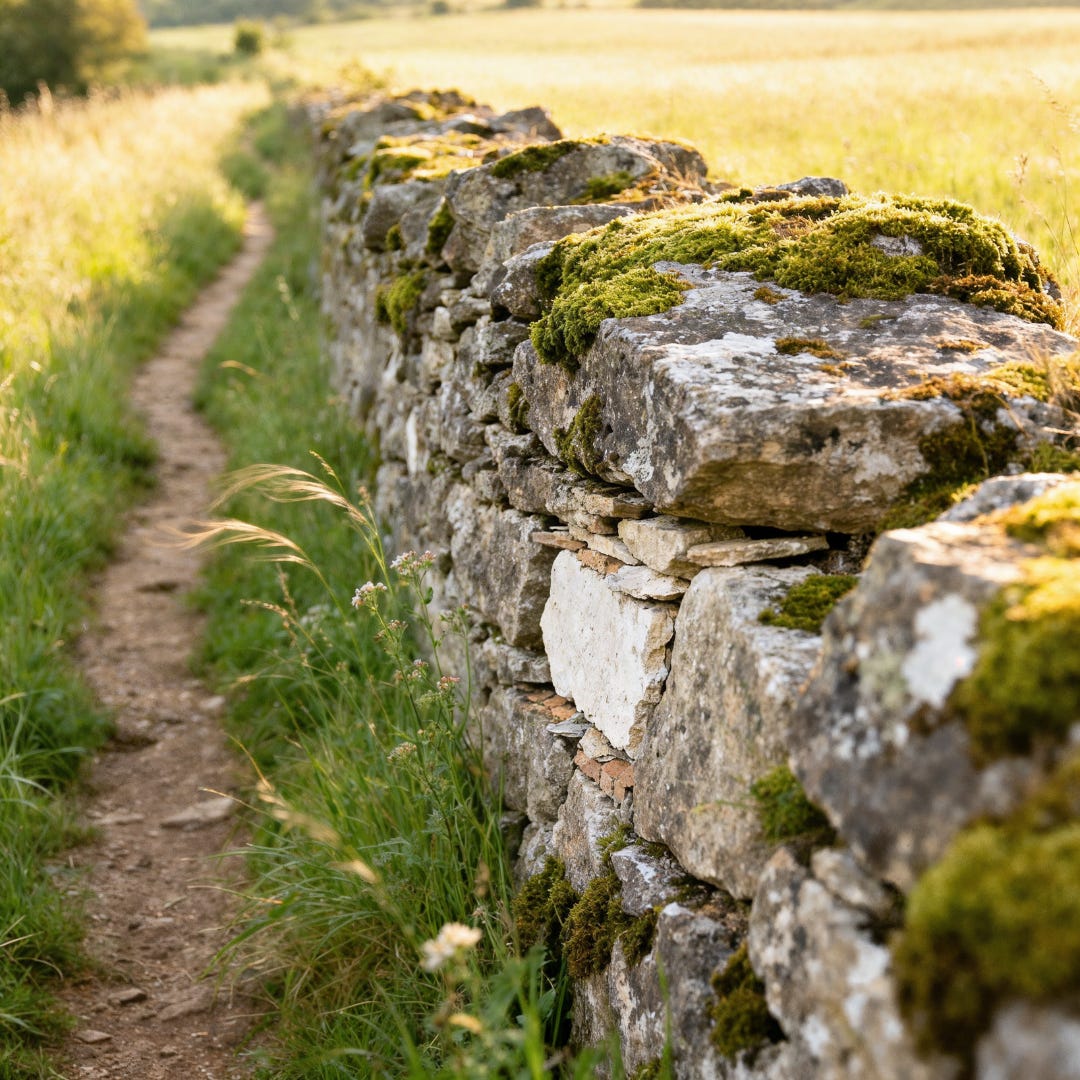
The route stays the same. You do not.
If you have been chasing new experiences, hoping one of them will finally deliver the depth you are looking for, this post is for you. Not because new places are wrong. But because the pattern of always moving on may be the very thing standing between you and what you are actually seeking.
I have walked the Camino de Santiago five times now, four of them on the Le Puy route in France along the GR65. Each visit has been a week at a time, returning to the same path but walking a different section. The same stones underfoot, the same quality of French rural light, the same particular silence of the path before dawn, but a new stretch each time. This coming May, I am beginning the route again, this time starting from the very beginning, for the same reasons this post is about. Not because I have exhausted the path. Because I have not.
The question itself tells me something about what we have been taught to want.
If Your Spiritual Practice Feels Shallow, Novelty May Be Why
We live inside a story that says depth comes from breadth.
The more places you have been, the more routes you have walked, the richer your interior life becomes. Travel culture sells this. Wellness culture sells this. Even pilgrimage culture, which ought to know better, sometimes sells this. There is always another route. A more remote path. A less traveled way. A harder challenge that promises to deliver something the last one could not.
I understand the pull. Novelty is not trivial. New landscapes genuinely teach.
But the practitioners who go deepest in contemplative walking are rarely the ones who have been to the most places. They are the ones who keep returning to one.

Why Returning to the Same Route Changed What I Was Able to Receive
The first time I walked the Le Puy route in 2022, I paid attention to everything. The landscape was new. The villages were unfamiliar. The physical demands were consuming most of my bandwidth. There was little space for anything other than noticing and surviving.
The second time, I started to relax into it.
The third time, something quieter began. I stopped performing the walk. The route no longer needed my full attention because some part of me already knew it. That freed something up. The walk moved into my body and out of my head. I began noticing what I had walked past before. Not new things. Things that had always been there.
A particular quality of light in the late afternoon on the Aubrac Plateau. The way the wind comes down from the north before a change in weather. The specific silence of the path before dawn, different from the silence at midday.

None of those things appeared on my first walk. They were not hidden. I simply did not have enough stillness yet to receive them.
Return created the stillness. The route did not change. I did.
How to Build the Internal Compass That Novelty Keeps Resetting
As a professor of research methodology, I spend considerable time teaching people how to develop reliable frameworks for understanding what they are encountering. One consistent finding across research traditions is that genuine understanding requires more than a single encounter.
You cannot know a place from one visit. You can appreciate it. You can be moved by it. You can collect an impression.
Knowing requires return.
The same is true for the inner work that contemplative walking makes possible. The first walk strips away the obvious layers. The second walk goes deeper. The third and fourth walks reach the places that do not open quickly.

What forms through that process is what I call an internal compass. A settled sense of your own responses, your own rhythms, your own particular way of being present. You learn what you are like when the novelty has worn off. When there is no new stimulation to distract you from yourself.
That knowledge cannot be acquired any other way.
If you feel spiritually restless, always seeking the next experience, the next teacher, the next practice, it is worth asking whether you have ever given one place enough return visits to form that compass at all.
What to Do When Returning Feels Boring
The hardest moment in any return pilgrimage is the one where you think: I have seen this before.
That thought is not a sign the route has nothing left to offer. It is a sign that you have not yet learned to be still enough to receive what is actually there.
I felt this on my third walk. On a long flat stretch after Figeac, I caught myself thinking I already knew what was coming. The route corrected me.
A farmer was repairing a stone wall at the edge of his field. He looked up as I passed and nodded, briefly and without performance. Something about that nod landed differently than anything had on my first two walks.
I had been walking past people for days without actually seeing them. The route had not become boring. I had become inattentive.
When the return feels dull, do not leave. Get quieter. Slow down further. The place has more to teach. You have simply reached the edge of your current capacity for stillness, and that edge is exactly where practice deepens.
What You Stop Doing Once You Commit to Return
Something else happens with repeated returns that surprised me.
You stop trying to produce an experience and start simply having one.
The first walk carries an internal pressure to make it count. To have insights. To come back changed in ways you can report. That pressure is understandable. You have invested significantly in being there. My first Camino was on my bucket list, one that shifted nearly everything for me since then.
By the fourth and fifth walks, that pressure has dissolved. You already know the route counts. You no longer need to extract meaning from it. You can simply walk.
That shift, from producing to receiving, is one of the core movements in contemplative walking practice. It is also one of the hardest to teach directly. It tends to arrive on its own, through repetition, once a place has become familiar enough that performance is no longer available as a distraction.
This is why the sit spot practice in nature-based traditions asks practitioners to return to the same location, again and again, over weeks and months. Not to collect observations. To build relationship. That principle is foundational to the Rewilding the Soul EcoSpirituality Certificate beginning next week at Cherry Hill Seminary, and it is the same principle the September 2026 Contemplative Walking Retreat on the GR65 is structured around.
Relationship requires return. There is no shortcut to it.
How to Begin Your Own Return Practice This Week
You may not be able to return to the GR65 this year. Most people cannot.
But you have a route near you. A path, a park, a street, a patch of ground. Something you have walked past without walking into.
Here is what to do with it.
Go back to the same place three times this week. The same route, the same direction, the same time of day if possible. On the first walk, notice what is there. On the second walk, notice what you missed. On the third walk, stop performing observation entirely and simply be present to what arrives.
You are not trying to have a profound experience. You are practicing the willingness to return when novelty has nothing to offer.
That willingness is the whole practice. Everything else grows from it.
If you want to build that practice with structure and community, the Rewilding the Soul cohort is beginning now. If you want to build it on the GR65 itself in the company of four fellow seekers with private rooms along the route, the September retreat still has one place remaining.
Both are there if the solo return practice calls you toward something deeper.
But start with one place. Go back tomorrow. Notice what you missed the first time.
The route will be waiting. Let me know how it goes!
Do You Want to Walk Together?
If that moment outside opens something you want to keep opening, go back tomorrow and explore the same spot, or even over a short distance. You may be surprised at what you notice.
Perhaps you want to try it with others, or at least in a small community? If so, I can offer two paths beyond what I try to write here several times each week.
The Rewilding the Soul EcoSpirituality Certificate at Cherry Hill Seminary offers a structured path for building outdoor contemplative practice into the fabric of your daily life. It is designed for people who are serious about moving from caring about the earth to belonging to it, who want guidance, community, and a curriculum to support that move. It also starts next week.
The September 2026 Contemplative Walking Retreat on the Le Puy Camino in France offers something more immersive. Seven days of walking the GR65 in a small group, with the practice not scheduled alongside the route but woven into every step of it.
Both are there if the solo practice calls you toward something more.
But start outside. Start today. The earth is not waiting for you to enroll anywhere.
It is already practicing.
Couldn't agree more. I love the Heraclitus quote: "A man never stands in the same river twice, because it is not the same river and he is not the same man." Off to CF #4 in 51 days.....