

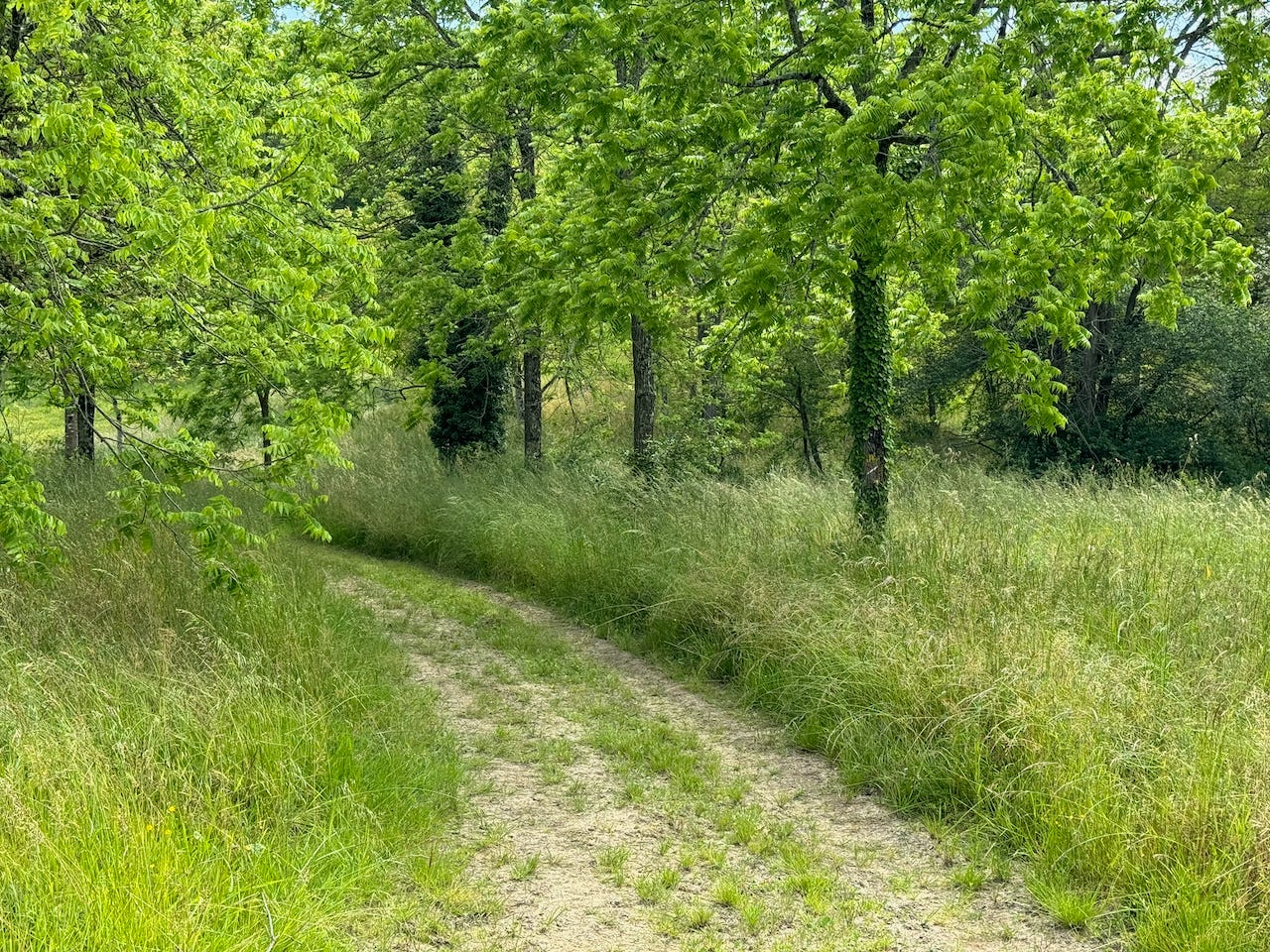
I expected the Camino to fix me.
That is not what I told people, of course. I said I was going for the challenge, for the history, for the silence. All of that was true. But underneath it was something more honest: I was exhausted in a way that rest could not touch, disconnected in a way I could not explain, and I had a quiet hope that walking the Camino de Santiago in Spain initially, and then France eventually, would sort it out.
The Camino did not fix me. It did something harder and more useful. It gave me questions I could actually live inside, and a practice that changed how I move through the world, the work I do, how I believe, and how I seek to serve others.
That practice is what this publication, Where Insight Meets Earth, is about.
But First, a Question
Before I tell you how I got here, I want to name something I suspect about you.
You are not someone who needs to be convinced that the natural world matters. You already know that. You may read about it, grieve about it, feel the loss of it in ways you cannot always articulate. You are educated, intentional, and you care—perhaps more than is comfortable.
Still, something feels missing. Not a gap in knowledge, but a gap in contact. The Earth feels like a place you inhabit rather than a community you belong to. You have tried the available approaches—the apps, the practices, the books, and even the retreats—and some of them have helped, but none of them have quite reached the thing underneath.
That thing underneath is what this publication is for.
What Changed Me Was Not What I Expected
On my second Camino—my first on France’s ancient Le Puy route—I got bronchitis.
Not a little sick. Full bronchitis. Coughing, wheezing, struggling to breathe through villages and across plateaus I had been anticipating for months. I had some medication. I called my doctor. We made a plan. Then I faced the only question that actually mattered: quit, or keep walking slowly.
I kept walking.
When your body is busy trying to breathe, you cannot walk for performance. You cannot track your pace or think about distance or feel virtuous about your step count. Your body is entirely occupied with the basic work of moving forward. So your attention goes somewhere else entirely.
It went outward.
I noticed the landscape in a way I had not when I was healthy and striding along efficiently. The quality of light on the path. The sound the walking poles made against stone. The way the fields held the morning. I was not monitoring my experience. I was in relationship with where I was.
That was the moment I understood what walking could actually be. Not exercise. Not transportation. Not a way to clear the mind or a productivity practice dressed in hiking boots. Something older and more honest: a way of being in kinship with the world you are moving through.
A hundred healthy miles before the Pandemic had not taught me that. Five days of walking sick did.
What the Practice Has Revealed Since Then
I walk in Paris often, through large parks on the outskirts of the city, with a mantra from my PATH Rule of Life repeated with each step.
On one January morning, four miles into an 8.5 mile loop through Bois de Vincennes, two large ravens appeared in the path ahead of me. They stood perhaps twenty feet away, watching me approach.
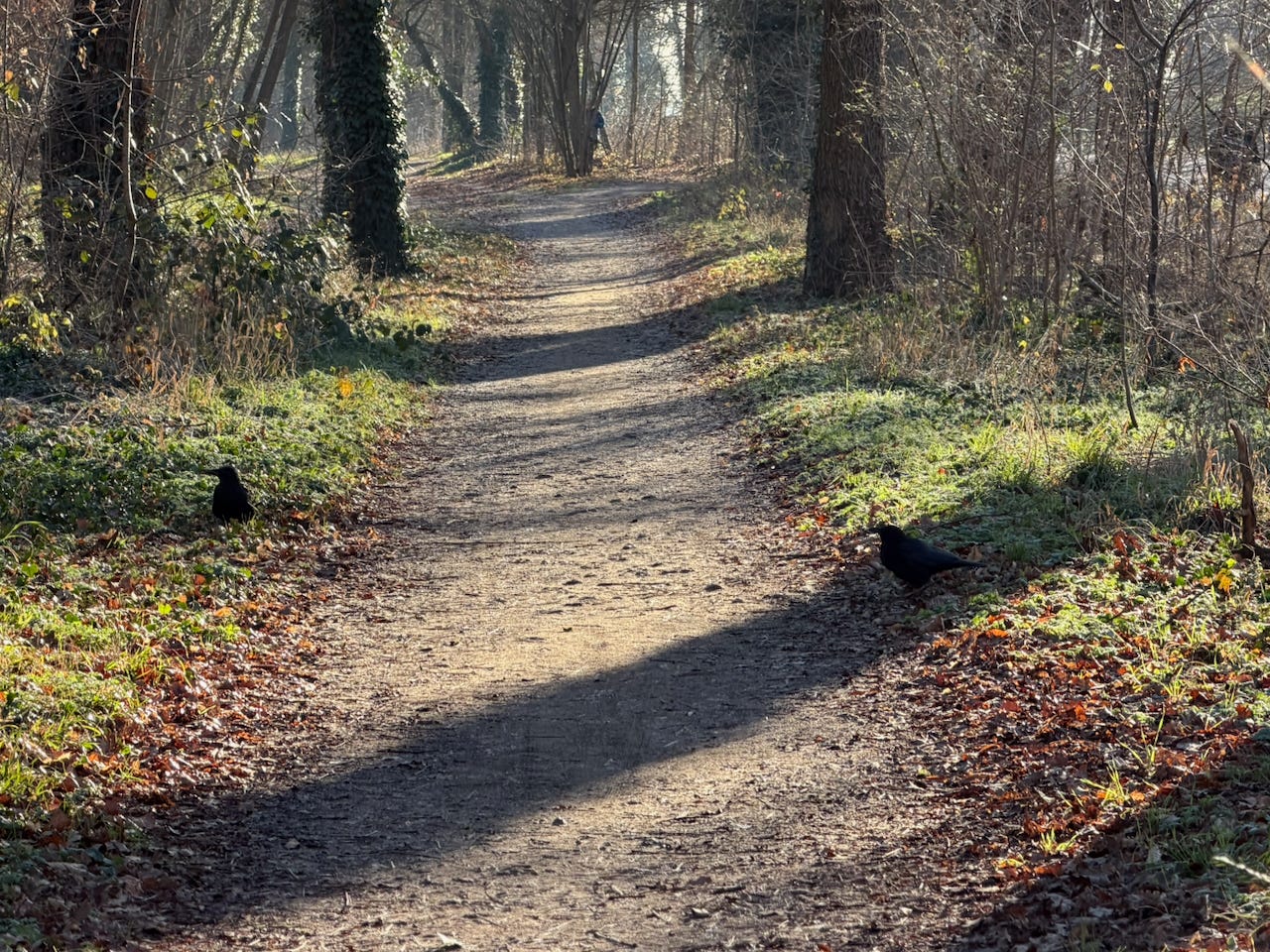
In any other circumstance, I would have walked past them without a second thought. Two birds in a park. Unremarkable.
But I was not in any other circumstance.
I had been repeating “May I be present to sacred reality” for over an hour. The mantra had been doing its slow work — quieting the mental chatter, releasing the list of things I was composing in my head, returning me again and again to what was actually there. So when the ravens appeared, I did not just see them.
I watched them.
I stopped. Not because I decided to stop, but because stopping felt like the only honest response. The ravens noticed me noticing them. Something shifted in the encounter. We were no longer two categories passing each other in space. We were three beings sharing a moment.
This is what contemplative walking actually offers. Not stress relief. Not a mindfulness technique. A different quality of relationship with the living world around you — one that is available on a city sidewalk, in a neighborhood park, on an ancient pilgrimage route, or right outside your door this morning.
The Tree Who Taught Me the Most
In Luxembourg Gardens in Paris, there is — or was — a large evergreen I came to know over many visits.
I am not sure how it happened, but his name somehow came to me as Hermann.
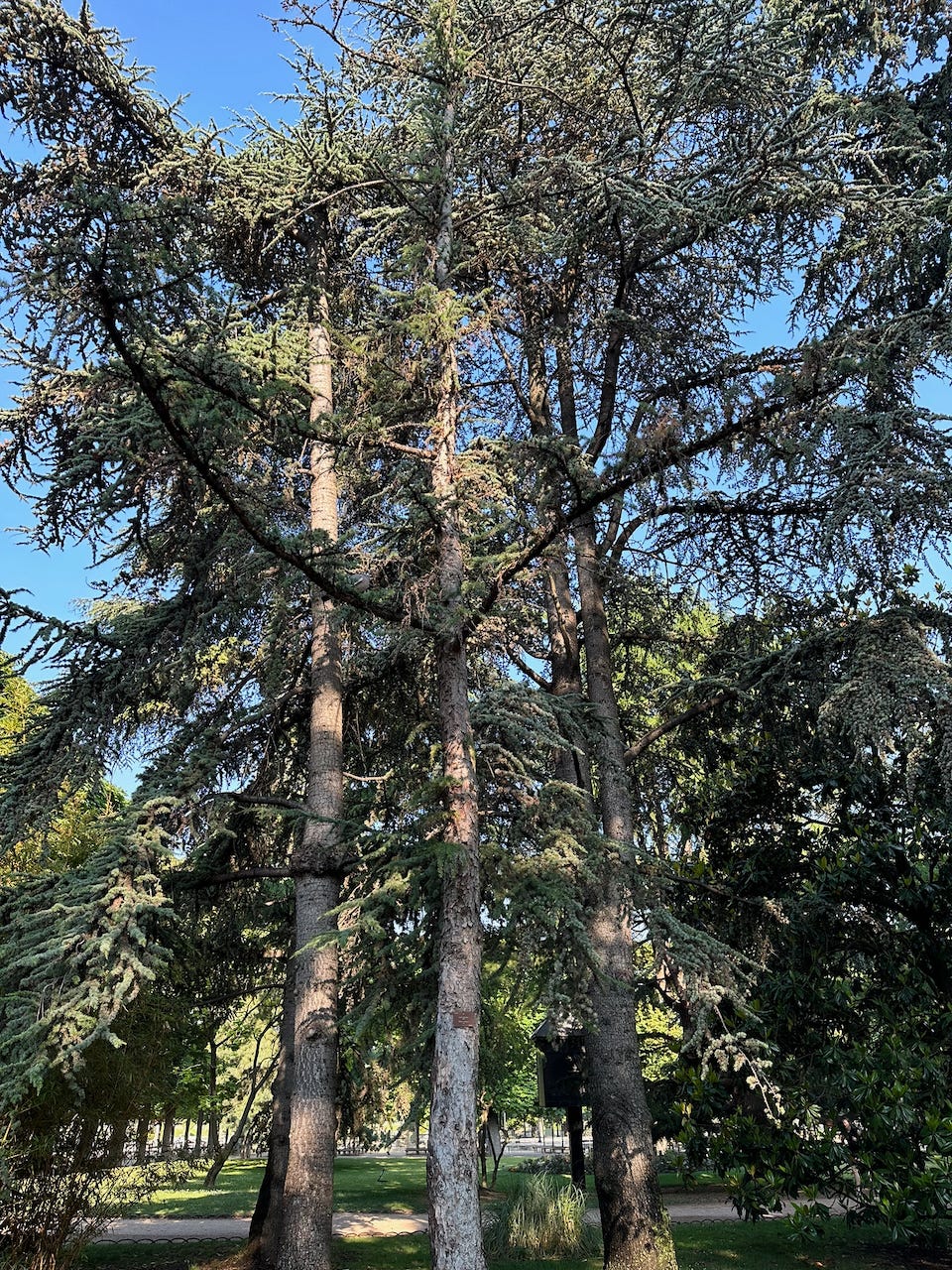
I first noticed him in winter, when most trees around him were bare and dormant. Hermann was still fully himself. Still green. I was in the early stages of learning to pay attention to the natural world in a different way, and something about his constancy in a dormant season drew me back.
I kept returning. The relationship developed the way relationships do—slowly, through repeated presence, through showing up even when nothing dramatic happens.
Hermann is gone now. I returned from travel once to find the space where he had stood completely empty. No stump. No marker. No acknowledgment that a living being had occupied that ground for decades. The absence arrived in my body the way all loss does — as weight and silence and the disorientation of reaching for something no longer there.
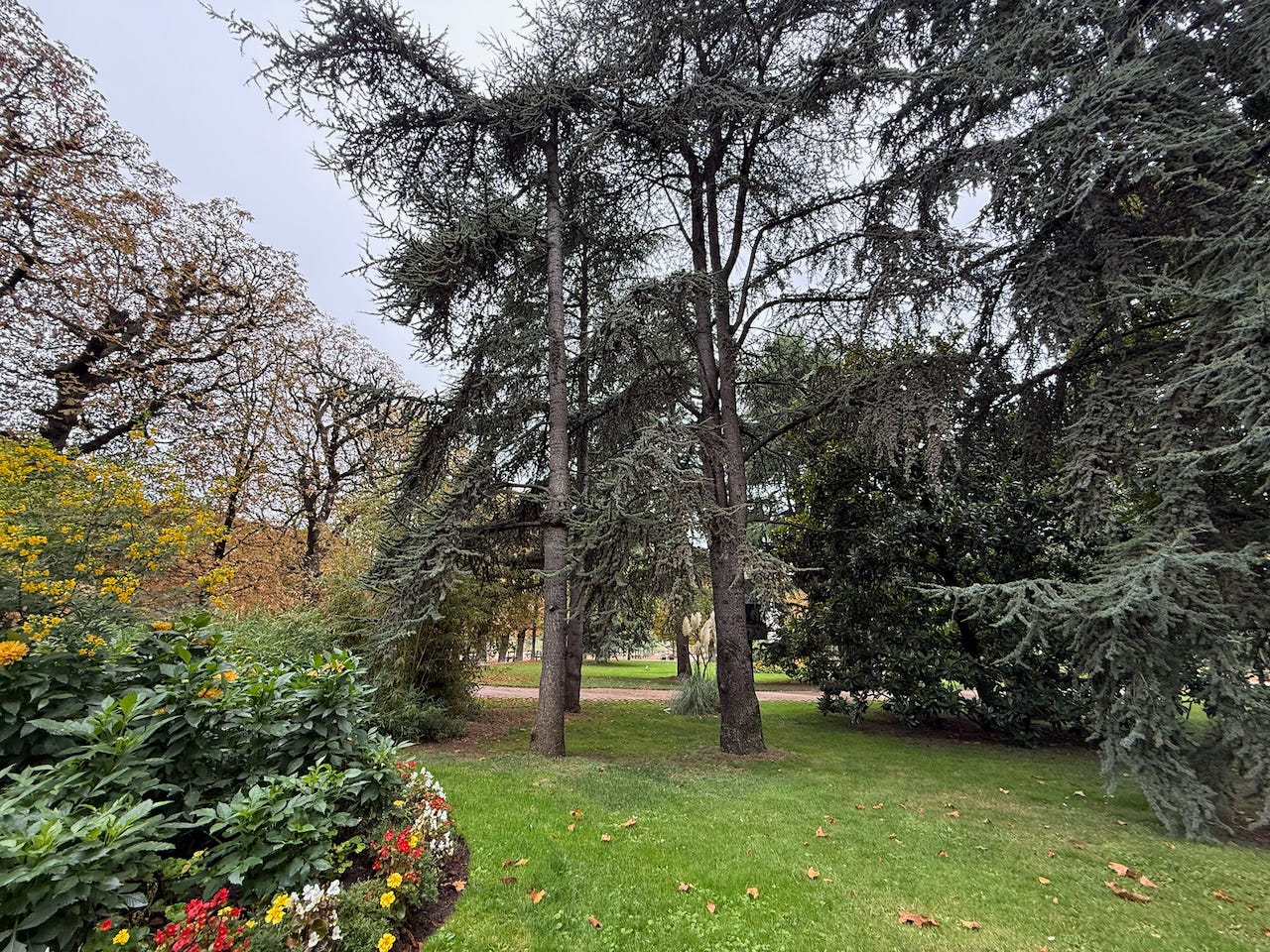
Grief for a tree is not lesser grief. It is the real thing.
What Hermann taught me, and what his life and his death together taught me, is that ecospirituality is not a set of beliefs, a spiritual framework, or a way of thinking about nature. It is embodied relationship with specific living beings, in specific places, over real time. The moment we make it abstract, we have already lost the thread.
That teaching is at the center of everything I write here.
What You Will Find in This Publication
Three times a week—Monday, Wednesday, Friday—these reflections arrive in your inbox.
You will not find productivity hacks disguised as spirituality, climate doom without practice, or generic mindfulness advice. You will not find someone who has this fully figured out and is now graciously sharing the solution from a position of mastery.
What you will find is someone one week ahead of you on the path, sharing what the walking is revealing.
Contemplative walking practices you can do in fifteen minutes or an hour. Ecospirituality rooted in relationship and kinship, not guilt or obligation. Seasonal wisdom from the Celtic wheel of the year. Pilgrimage reflections from over 500 miles walked across five journeys along the Camino de Santiago, primarily on the routes in France. Permission to slow down, grieve what is dying, and trust what is still quickening in the dark.
This is contemplative depth for people who need silence to connect and who suspect that the more-than-human world has been waiting patiently for them to extend their attention beyond themselves long enough to notice.
I am Jeffrey Keefer—Chaplain at New York University, Ordained Wild Guide, and Professor of Research Methodology. My PhD is in Educational Research. I have walked The Camino de Santiago de Compostela five times, four of them along France's ancient UNESCO World Heritage Le Puy route, covering over 500 miles of pilgrimage paths. I tell you this not to establish distance, but because you deserve to know who is on the other end of these emails, and because the academic formation, the tree named Hermann, the bronchitis, and the ravens all belong to the same person, trying to hold them together honestly.
Why People Actually Come Here
On my fifth Camino, I had dinner with a Swiss man walking alone.
He described his purpose easily: a retirement celebration. We talked about routes and villages and the usual pilgrim conversation. Then, as dinner finished, he shared something quieter.
He was also walking for his daughter, who had died ten years earlier. He had never come to terms with it. The retirement was completely true. But underneath it was a weight that had required 625 miles behind him to begin speaking aloud to a stranger at a dinner table in rural France.
I think of him often when I consider the people reading this.
People subscribe for reasons they can articulate. They want contemplative practice, or a break from digital overwhelm, or a way to reconnect with nature that does not require a religious framework, special equipment, or a trip to France. Those reasons are real and completely welcome.
But some are carrying something heavier underneath. A grief that needs walking. A question too large for words. A sense that the life they have built, which looks fine from the outside, has somehow lost contact with something essential.
This publication is built for both the stated reason and the weight beneath it.
Where to Go Next
If you are new here, these posts will give you a sense of what we explore together:
If you want to begin a practice today:

If you are carrying ecological grief:

If you are curious about what presence actually offers:

If you sense that your relationship with the Earth needs tending:

Whether you visit these other posts, subscribe, or find yourself called to what I write about, I am interested to hear about what brought you here. Please hit reply or leave a comment below. I always answer.
An Invitation
All of my posts arrive directly in your inbox, ad-free and algorithm-free, on Monday, Wednesday, and Friday.
Free subscribers receive every post I publish, full archive access, and the ability to comment and connect with others asking similar questions.
Paid annual subscribers receive all of the above, plus Pack Light, Walk Present: The Contemplative Camino Packing Guide, and an invitation to meet for a free Camino Packing and Planning Audit conversation.
If these reflections serve your journey, I hope you will subscribe and stay. If you are already here, I am glad you found your way.
Hit reply to any email. I read and respond to every message.
We walk this path together.
Jeffrey
P.S. In March 2026, I am launching the Rewilding the Soul EcoSpirituality Certificate at Cherry Hill Seminary — a year-long journey into Earth kinship through contemplative practice. In September 2026, I am leading a Contemplative Walking Retreat on the Le Puy Camino. Four participants. Private rooms. Silence as practice, not punishment. If either of these calls to something in you, I would love to hear from you.
I, too, expect some new thing to fix me, and it never does. What I love, though, is how if I shift my disappointment about not being fixed to awareness and curiosity, something more interesting happens!
Thank you for sharing Hermann's photo with us.