

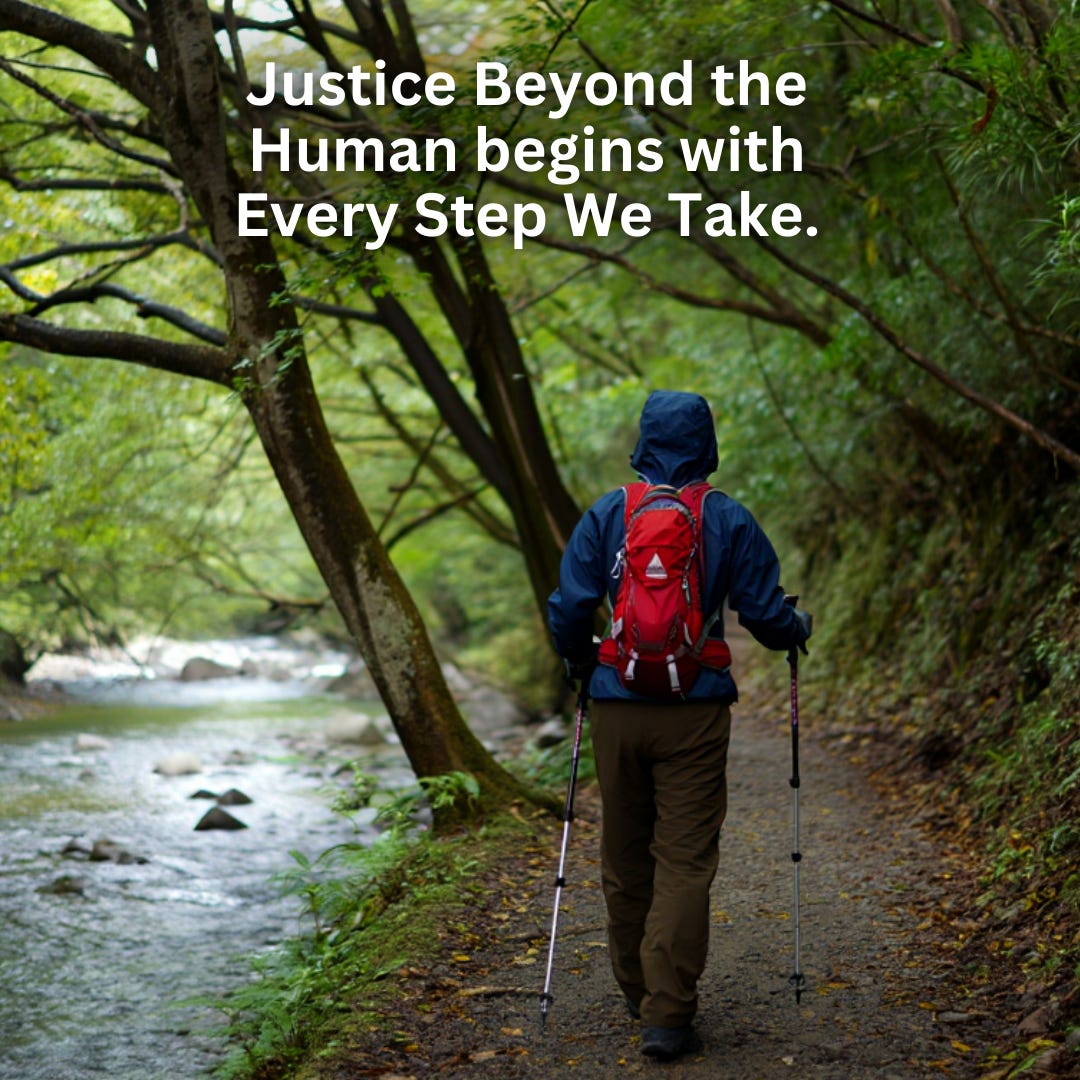
When Justice Stops at the Human Line
What if justice weren’t only for humans?
In U.S. courts, corporations are already treated as “legal persons.” A company can own land, sign contracts, and even claim constitutional rights like free speech under Citizens United v. FEC (2010). If an abstract, profit-seeking entity can be recognized as a person, then why not a river that sustains life, a forest that breathes, or a reef that sings?
This paradox points to a deeper forgetfulness. We’ve built systems where non-living constructs enjoy rights, while living ecosystems that breathe, flow, and shelter us are treated as property, as objects, as endless resources to extract and harvest.
When we silence rivers and forests, we also silence something within ourselves.
A Pilgrim by the Stream
On my third Camino pilgrimage, I paused beside a stream winding through a quiet meadow. The water was shallow and clear, moving with a patience that felt older than the road itself.
I crouched down, letting the cold water run through my fingers. This was not new, but a deepening—a reminder of what I had long carried within me. Each pilgrimage draws me further into this truth: the living world is not a backdrop, but kin.
Each pilgrimage draws me further into this truth:
the living world is not a backdrop, but kin.
The stream did not surprise me; it confirmed me. Once again, I was reminded that this is sacred work: to recognize presence where others see property, to listen for testimony where others hear silence.
The stream deserved honor, and thus protection, just as much as the weary pilgrims walking beside it. We carried passports and rights; it carried resilience and life itself. Who was defending it? Who was listening?
This recognition pressed more deeply into my steps. Walking became witness—each bird overhead, each tree rooted along the path, each stream crossing stone.
Pilgrimage was never only about my own growth; it has always been a sacred promise to pay attention to the living world around me. Each walk deepens my covenant to notice rivers, trees, and birds as companions on the journey, not background scenery.
Spending time in nature is what keeps me rooted as a pilgrim. It connects me again and again to the truth that I walk not alone, but within a vast community of life.
Spending time in nature is what keeps me rooted as a pilgrim.
It connects me again and again to the truth that I walk not alone,
but within a vast community of life.
Walking, then, became more than movement from one place to another.
Walking became a practice of reverence — and an act of justice for the Earth itself.
Sacred Traditions Never Forgot
Many spiritual traditions never lost sight of this truth: rivers, mountains, and forests are kin.
Indigenous cosmologies honor land and water as living relatives. The Haudenosaunee Confederacy speaks of making decisions with “all our relations” in mind, while Māori communities recognize rivers as ancestors.
Biblical texts describe rivers clapping their hands and mountains rejoicing, voices within creation itself.
Buddhist interbeing reminds us that our existence is possible only through soil, sun, and rain.
Celtic wisdom sees stones, streams, and groves as dwelling places of Spirit—not symbols, but embodiments of the sacred.
We did not invent this vision. We forgot it—or perhaps it was hidden by those who profit most from exploiting the Earth.
We only need to remember it.
Corporate Personhood and Nature’s Claim
Here’s the paradox: U.S. law already extends personhood to non-human entities—corporations. If corporations can hold property, sue in court, and claim constitutional rights, then our legal system has already accepted that “personhood” does not require being human.
This precedent should challenge us. If we grant rights to paper entities that exist only on balance sheets, how can we deny them to rivers that flow, forests that breathe, and ecosystems that sustain us?
How can a company created with a few documents hold more rights than a forest that has stood for centuries?
Eco-justice movements are building directly on this logic. By showing that non-human entities already have legal standing, they argue that the more-than-human world deserves recognition not as property, but as kin with rights.
The Rights of Nature Movement
This remembering forces us to ask: if corporations can be granted personhood, how might our laws change when rivers and forests are given the same standing?
This vision is no longer just a spiritual metaphor—it’s becoming law.
Ecuador (2008): The constitution enshrined the rights of Pachamama (Mother Earth), guaranteeing ecosystems the right to “exist, persist, maintain and regenerate” (YES! Magazine). Courts later enforced these rights to stop mining in the Los Cedros cloud forest (Center for Biological Diversity).
New Zealand (2017): The Whanganui River was granted legal personhood under the Te Awa Tupua Act, with guardians appointed to represent its interests (Aquatech News).
Global ripple effects: Rivers in Colombia, Canada, and India are gaining recognition as rights-bearing beings (Inside Climate News). Even the Great Barrier Reef is under discussion for legal personhood (The Guardian).
These are not symbolic gestures—they are enforceable legal shifts. The movement is already reframing nature not as property, but as parties with rights worth defending.
This is a fundamental shift from object to subject. From exploitation to protection. From an it to an individual.
When a river can sue, the balance shifts.
When forests can be represented in court, exploitation is no longer the default.
Equity Beyond the Human
Eco-justice cannot stop at human borders. To fight only for our own survival is to repeat the old story of dominance.
True equity must include the silenced voices of the Earth itself: the forests logged, the rivers dammed, the species displaced.
This is not sentimental. It is survival.
And it is also spiritual. Expanding justice to the more-than-human world restores our own integrity. We live no longer as isolated individuals, as a species apart, but as members of a sacred community. A community of all living beings who share the same fragile desire: to go on living.
Justice is no longer charity. It becomes kinship.
Walking as Witness
Walking contemplatively is one of the simplest ways to embody this kinship.
Every step can be an act of witness:
Greeting a tree as you would an elder.
Pausing at a stream, imagining what it would say if it could stand in court.
Listening to birdsong as testimony, not background noise.
Pilgrimage is not escape; it is training—training to pay attention, and to carry the voices of the land into the spaces where decisions are made.
Activism grounded in walking becomes less about abstract policies and more about lived relationships. We are no longer advocates speaking for strangers; we are kin defending kin.
Sacred Practices That Align Spirit and Action
Eco-justice needs not only laws but rituals. Spiritual practices sustain activists and deepen movements.
Blessing water before drinking is a simple gesture of gratitude and recognition.
Prayers for forests spoken aloud when entering wooded paths.
Mindful walking as solidarity with beings whose futures are uncertain.
These are not small gestures. They shape the heart so that activism flows from reverence, not only outrage. When inner work and outer action align, movements endure.
Because protest without prayer burns out.
And prayer without protest rings hollow.
A Final Takeaway
Justice beyond the human is not a distant dream—it is already happening in courtrooms, in pilgrimages, and in the quiet rituals of ordinary people who choose to walk differently.
The precedent is already here: corporations have personhood. The question is whether we will extend that same recognition to the beings that actually sustain life.
The next time you cross a stream or stand beneath an ancient tree, pause. Imagine what justice would look like for this being. Ask how you might serve as its advocate.
Because justice is not only about laws and courts.
Justice is about kinship.
Each step you take can be more than motion. It can be reverence. It can be justice.
Reflective Challenge
If one part of your landscape could stand in court, what would it say?
How might you be its advocate?
Ready to explore contemplative practices for life's challenging moments? Join my Substack newsletter for weekly insights on walking the path between ancient wisdom and modern life. Because every off day is actually an invitation to go deeper.
Hey Jeffrey, thanks for sharing this post. I appreciate your words and the work that you're doing. I work for an organization called the Community. Environmental Legal Defense Fund or CELDF. We have been a pioneer in the rights of nature movement in the US, and we're now on Substack. You might be interested in following. Hope you're well, and thanks again!