

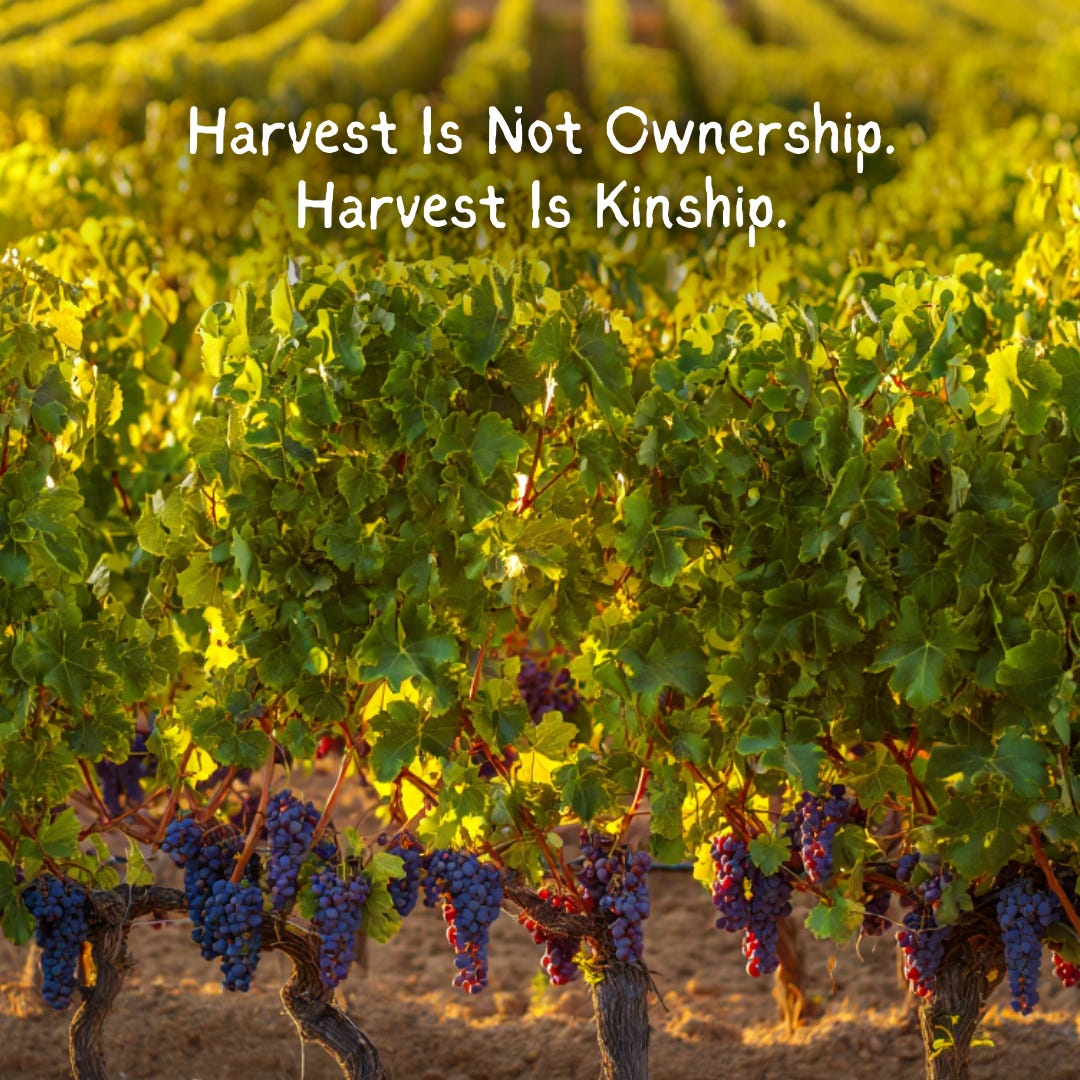
Harvest Is Not Ownership; It Is Kinship
The end of summer is upon us. The light shifts lower, evenings stretch cooler, and across fields and gardens, the work of harvest is underway. Our culture often treats this season as a time of ownership: “my” vegetables, “our” crops, the plenty we have stored away.
But harvest is not ownership. It is kinship.
Every apple, every grain, every drop of wine carries a story larger than ours. Gratitude is a good beginning, but left alone it risks being shallow. This season invites us to ask: what if gratitude is not enough?
A Pilgrim’s Autumn Walk
On my first Camino pilgrimage, I walked through northern Spain in late September. The vineyards were alive with color, their grapes heavy on the vine. Figs hung ripening on the branches. The harvest was underway.
For me, it was the first time I truly saw the land not only as scenery but as living presence. The soil held the vine. The water ran unseen into its roots. The sun turned its sugars. The air, the hands, the seasons—all were part of one great web of relationship.
I turned from the voices of fellow pilgrims eager to share their stories, and instead began listening for the quieter testimony of the natural world.
Looking back, I realize that walk was my first real beginning as the pilgrim I am today: one who seeks to honor and connect with the earth as kin, not backdrop.
Harvest is not transaction. Harvest is relationship.
Ancient Traditions Remembered This
For millennia, human cultures have recognized that gratitude extends beyond the human.
Indigenous traditions remind us with the phrase “all our relations” — rivers, mountains, plants, animals, and humans together in an interconnected kinship. Gratitude meant reciprocity: caring for and honoring these relationships, not merely thanking.
The Hebrew Bible echoes this vision. Every seventh year, the land itself was given a Sabbath rest (Shmita), allowing fields and vineyards to lie fallow. Biblical laws of gleaning required that leftovers be shared — not just with people in need, but also with the land itself, wild animals, and travelers. Gratitude here was embodied in generosity and covenantal care.
Celtic wisdom, too, carried this awareness. The festival of Lughnasadh, celebrated around August 1, honored the first fruits of the harvest and acknowledged the sacred partnership between earth, sky, and people — gratitude expressed in ritual and feasting.
For these communities, gratitude was never simply saying “thank you.” Gratitude was always a covenant. Always action. Always kinship.
Why Gratitude Alone Is Not Enough
Today, we speak often of gratitude. Journals, retreats, and even leadership seminars encourage us to practice daily thanksgiving. And this is good. Gratitude softens the heart and opens the spirit.
But if gratitude stops at the edge of the human, it remains shallow. If I give thanks for bread and forget the soil, the seed, the rain, and the pollinators, then my gratitude is only half-true.
This is where kinship deepens gratitude. Gratitude names the gift. Kinship honors the giver. Kinship commits us to protection, to advocacy, to justice.
Modern Echoes: Rights of Nature
Around the world, people are rediscovering this truth through law and activism.
In 2008, Ecuador became the first country in the world to enshrine the rights of Pachamama — Mother Earth — in its constitution, granting ecosystems the right to exist, persist, and regenerate. More than a decade later, the Constitutional Court applied these rights in a landmark case, halting mining in the Los Cedros cloud forest. For the first time, a forest was defended not as property, but as a rights-bearing relative.
New Zealand followed with its own bold step in 2017. The Whanganui River was legally recognized as a “living whole” under the Te Awa Tupua Act. For Māori communities, this was not innovation but affirmation: the river has always been an ancestor, carrying its own voice and dignity.
Nor are these isolated examples. In Colombia, Canada, and India, rivers and forests are beginning to receive similar recognition. The Rights of Nature movement is gaining global momentum, reframing ecosystems not as resources to be managed but as kin whose rights must be defended.
These are not symbolic gestures. They are legal kinships. They echo what Indigenous elders, ancient scriptures, and Celtic festivals always knew: the Earth is not a resource. The Earth is relative.
To say thank you to the land without defending it is like thanking a neighbor while watching their house be robbed. Gratitude without justice is incomplete.
Walking as Kinship Practice
Walking, for me, is where this truth becomes embodied.
On pilgrimage paths, each step becomes an act of witness. You begin to notice the soil underfoot, the bird that startles from a branch, the way the light shifts on a stream. Walking teaches us that we do not move alone. Every step is already accompanied by air, water, soil, trees, and unseen kin.
As this season shifts, try this practice:
On your next walk, pause to name aloud one non-human being you are grateful for.
Thank the tree, the river, the soil, the bird.
Then ask yourself: how might I walk in a way that protects this kin?
This is not sentimental. It is covenant. Gratitude turns into kinship when it demands we walk differently.
A Final Takeaway
That first Camino walk in autumn was where I began to see differently. The vineyards, the figs, the soil beneath my feet — they weren’t only backdrop. They were kin, holding me as much as I walked upon them.
Years later, as harvest returns each season, I carry that same lesson: gratitude is not just for what we receive, but for the living community that makes receiving possible.
Harvest is not ownership. Harvest is kinship.
Gratitude is a beginning, but it is not the end. It becomes complete only when it turns into kinship — when thanksgiving becomes protection, when appreciation becomes advocacy, when reverence becomes justice.
As we step into autumn, may we walk with the same awareness I discovered on that first pilgrimage: each step, each harvest, each season is an invitation to begin again in kinship with the Earth.
An Invitation to Kinship
At harvest’s edge, gratitude is easy. Kinship is harder.
What one action this season could carry your thanks beyond words into justice?
Please share your thoughts about this in the comments.
🌿 Stay Connected
Thank you for walking this path with me. Each week, I share reflections on pilgrimage, eco-spirituality, and ways we can honor the more-than-human world with justice and reverence.
If this post spoke to you,
consider subscribing so future writings arrive directly in your inbox,
or share it with a friend or community who may also be seeking new ways to walk with gratitude and kinship.
Your presence and voice matter. Together, we can remember that harvest is not ownership—it is relationship. Thank you for reading.