

I spend too much time indoors.
There. I said it. I am a five-time pilgrim on the Camino de Santiago, an ecospirituality guide, and a writer who regularly writes about kinship with the earth. I still find myself sitting inside for hours, doing the things that are supposed to keep me grounded, wondering why I feel vaguely restless when I am done.
Most of us call that feeling “stir crazy.” We treat it like a personality quirk, or a sign that we need a vacation, or evidence that our meditation practice needs adjusting.
It is none of those things.
What “Stir Crazy” Is Actually Telling You
Your body is not being dramatic.
When that hollow, agitated feeling settles in after a long stretch indoors, something real is happening. Your nervous system is registering an absence. Not the absence of productivity, or fresh air, or exercise. Those matter, but they are not the deepest part. The deeper absence is contact with the more-than-human world. With bark and soil and wind and the particular quality of light that comes through actual leaves rather than a window.
We were not built for rooms. We built rooms because they are useful. That is a significant distinction.
The stir-crazy feeling is your oldest self sending a message that the room, however beautiful, comfortable, or well-equipped for spiritual practice, is not enough.
Why Every Major Spiritual System Defaults to Indoors
Look honestly at where modern spiritual practice happens.
Meditation apps are designed for your couch or your desk chair. Yoga studios are climate-controlled rooms with carefully curated playlists. Religious services take place in buildings designed to separate sacred space from ordinary outdoor life. Books about self-help and spiritual growth are written to be read in bed, or on a commute, or in a coffee shop. Even most retreat centers, places explicitly designed for spiritual renewal, organize most of their programming inside four walls, with outdoor time scheduled as a pleasant supplement rather than the primary practice.
This is not a conspiracy. It is just how spiritual infrastructure evolved. Indoors is convenient. Indoors is controllable. Indoors is where most of us already are.
Convenience and controllability are not the same as completeness.
Indoor Practice Is Not Wrong. Incomplete Practice Is the Problem.
Nothing in this article is an argument against sitting meditation, or prayer, or yoga, or any practice you have built over years of sincere effort.
Those practices matter. They have shaped you. They have held you through difficulty. They deserve respect, not dismissal.
The problem is not the practice. The problem is the assumption that the room is the whole world. That if you sit quietly enough, or breathe consciously enough, or read wisely enough, you will arrive at the full depth of what spiritual practice can offer. Without ever stepping outside and staying there long enough to let the Earth actually receive you.
That assumption is not challenged often enough. Because every book, every app, every tradition, every teacher is, almost without exception, delivering the practice from inside a building.
What Shifts When the Practice Moves Outside
I noticed this first on the Aubrac Plateau.
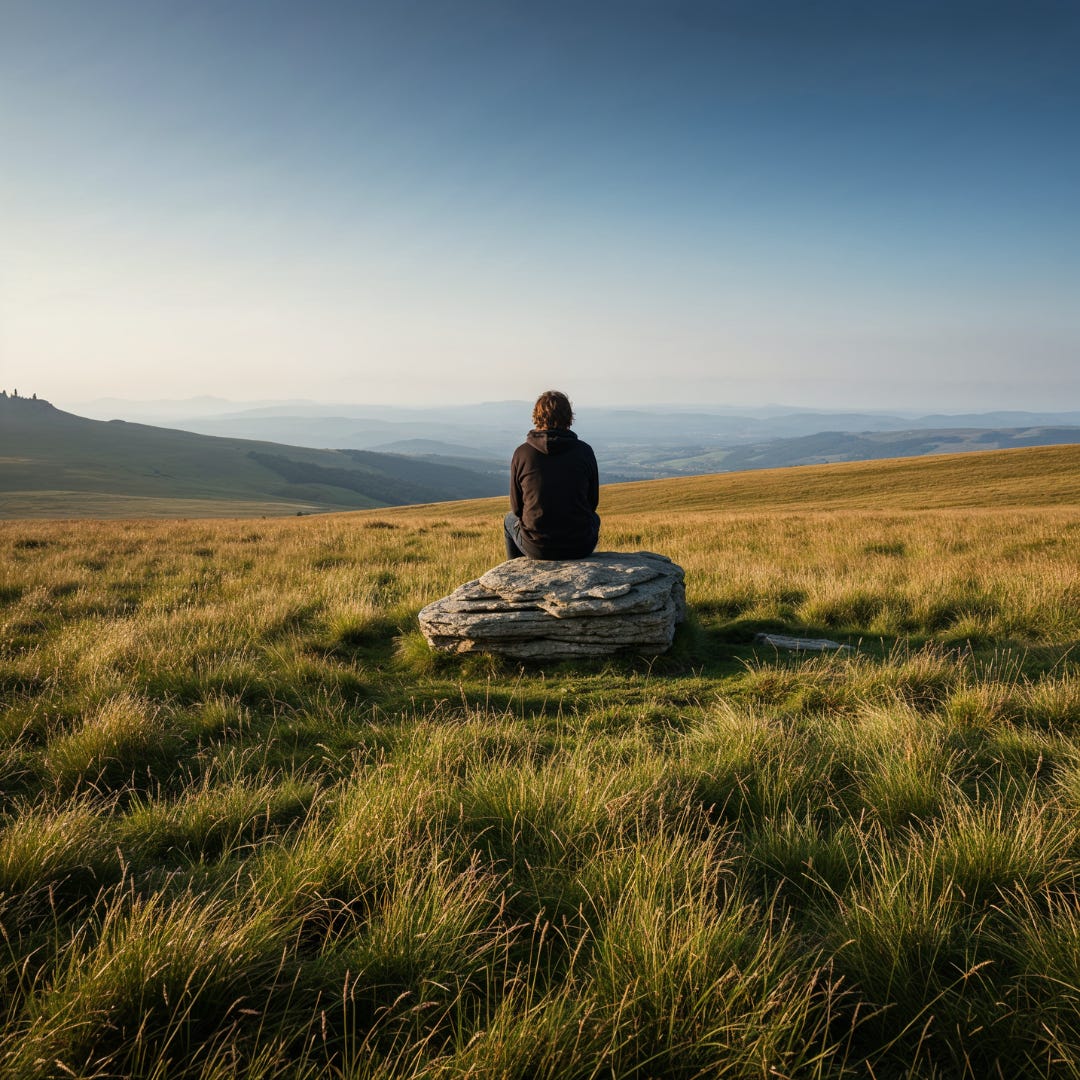
It was my first Camino in France in 2022. I had been walking for days. The plateau is high and exposed, a wide treeless expanse in south-central France where the wind does not ask permission. I sat down on a stone, not because I planned a meditation. I sat because my legs were tired. The wind moved through the grass. A hawk(?) turned slow circles above me without any apparent urgency.
Something released in my chest that I had not known was held.
Not because I was mindful. Not because I was present in the way a meditation teacher would describe. But because the Earth was not waiting for me to perform anything. It was simply itself, and I was simply inside it. That was enough.
That is the difference between indoor practice and contemplative walking. Indoor practice turns inward. Contemplative walking turns outward, toward an actual relationship with what is already alive around you.
The more-than-human world does not need you to be spiritually ready. It only needs you to show up.
Something You Can Try Today
Before anything else, try this on your own.
Go outside. Not for exercise. Not with a podcast. Not with a destination. Go outside with the specific intention of letting the earth be the practice, not the backdrop for it.
Choose one thing. A tree, a patch of ground, the quality of the light on a building, the sound the wind is making right now in whatever is outside your door. Stay with it longer than feels comfortable. Do not name it, do not photograph it, do not think about what it reminds you of. Just let it be what it is, and let yourself be what you are, in the same moment.
Notice what that feels like in your body. Notice whether the stir crazy feeling shifts.
That is the precursor to contemplative walking. Not a technique. Not a method. A practice of showing up to the world that is already there.
Let me know how it goes!
If You Want to Go Further
If that moment outside opens something you want to keep opening, go back tomorrow and explore the same spot, or even over a short distance. You may be surprised at what you notice.
Perhaps you want to try it with others, or at least in a small community? If so, I can offer two paths beyond what I try to write here several times each week.
The Rewilding the Soul EcoSpirituality Certificate at Cherry Hill Seminary offers a structured path for building outdoor contemplative practice into the fabric of your daily life. It is designed for people who are serious about moving from caring about the earth to belonging to it, who want guidance, community, and a curriculum to support that move. It also starts next week.
The September 2026 Contemplative Walking Retreat on the Le Puy Camino in France offers something more immersive. Seven days of walking the GR65 in a small group, with the practice not scheduled alongside the route but woven into every step of it.
Both are there if the solo practice calls you toward something more.
But start outside. Start today. The earth is not waiting for you to enroll anywhere.
It is already practicing.
This is SO true and I never thought about it that way - even as a spiritual teacher myself. I never thought about it. This past weekend our weather has been so beautiful that even with all the construction around us - I went and just stood outside to be with the outside. ❤️
I loved reading about your Camino and the ways it has informed your spiritual practice. I have a dear friend who is a regular pilgrim and I can’t wait to subscribe and share your substack with her. I hope you’ll check out my substack too. I write about interpersonal communication, but like you weave personal experience into theoretical content.