

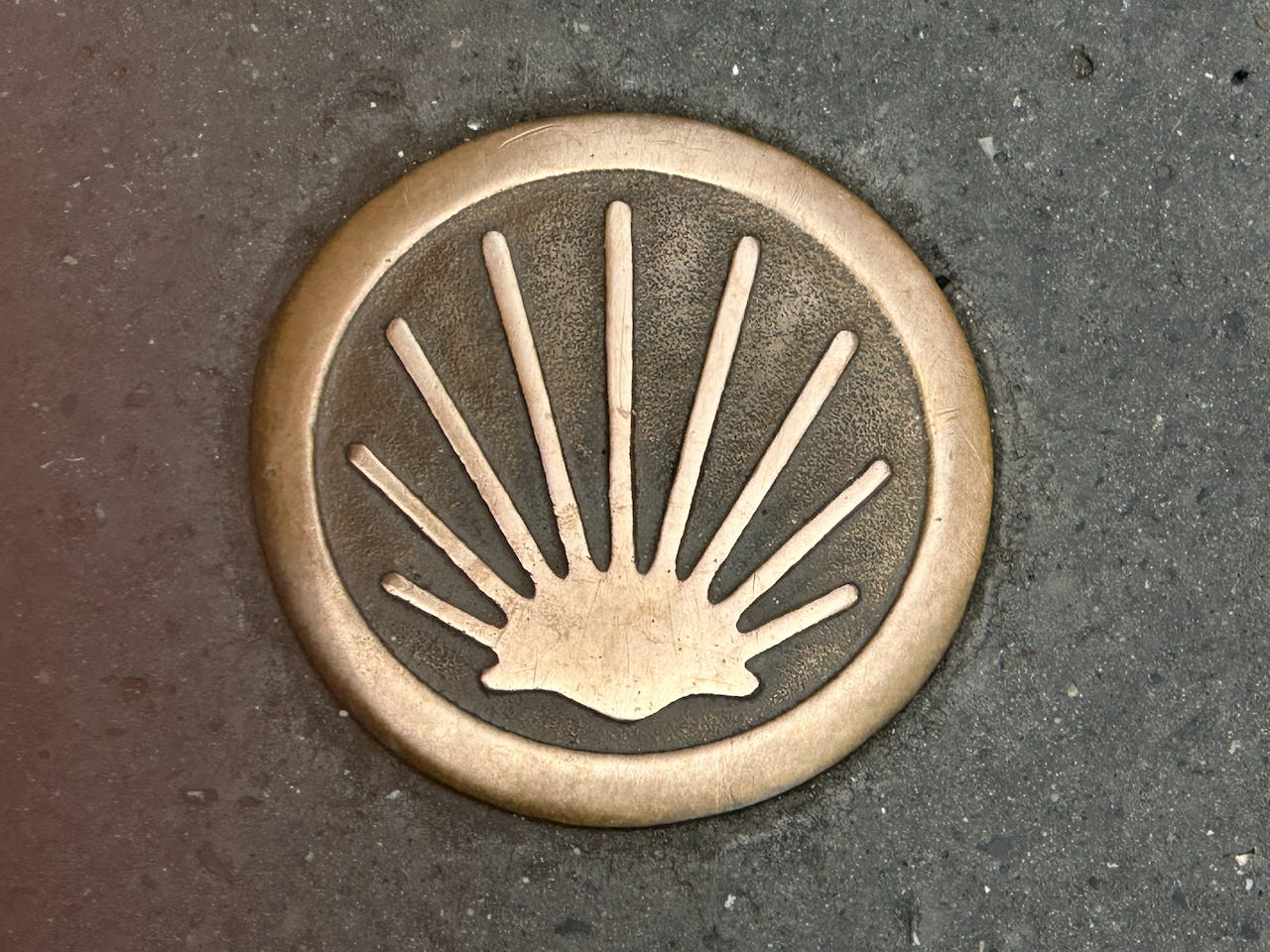
Most people think pilgrimage requires leaving the city behind.
Next week, as I walk from the Tour Saint-Jacques through the heart of Paris along the Rue Saint-Jacques to the ancient town of Antony, I’ll be proving them wrong. Not because I have to, but because I need to.
I’m on vacation in Paris—a break from my usual rhythm of life and work. But even on holiday, I feel the familiar call to walking meditation. The need to connect with something deeper than museum visits and café conversations.
This isn’t my usual May pilgrimage on the Le Puy route in rural France. This is different, an urban pilgrimage along one of medieval Europe’s most important but forgotten sacred pathways, the Via Turonensis. A single day of silent walking through one of the world’s busiest cities, following the exact route medieval pilgrims traveled for over a thousand years on their way to Santiago de Compostela.
The Ancient Route Hidden in Plain Sight
The Via Turonensis was one of four major Camino routes originating in France, beginning in Paris and passing through Tours before joining the other paths in northern Spain.
For centuries, pilgrims gathered at the Tour Saint-Jacques, the only remaining piece of the church of Saint-Jacques-de-la-Boucherie, to begin their journey of hundreds of miles on foot. They would walk south along the Rue Saint-Jacques, one of the oldest streets in Paris, carrying their scallop shells and walking sticks, leaving behind everything familiar for the uncertainty of the road.
Today, tour buses circle the tower. Tourists often photograph the Gothic stonework without realizing its significance. The street that once channeled streams of pilgrims now channels traffic and commerce. But the path remains as it always has.
As an ordained Wild Guide who has walked over 400 miles of the Le Puy route, I know that sacred geography doesn’t disappear just because cities grow up around it. The stones remember. The direction holds. The invitation persists. The energies of countless people walking for their own reasons for over a thousand years lie hidden just out of sight.
What draws me to this urban pilgrimage is precisely what might seem to work against it: the challenge of finding sacred space within secular noise, of maintaining contemplative attention while navigating modern Paris, of honoring ancient intention while walking contemporary streets.
Walking Meditation in the City
Rural pilgrimage offers obvious gifts—silence, beauty, the rhythm of the countryside.
Urban pilgrimage invites different skills while offering unique insights. Walking through a busy city in contemplative silence creates a unique kind of awareness. You become hyperattentive to the contrast between internal stillness and external motion. You practice presence not in spite of the distractions, but because of them.
After years of walking the countryside paths of France, I’ve learned that the essential elements of contemplative walking—intention, attention, rhythm, openness, connection with nature—can be cultivated anywhere. What changes isn’t the practice, but how you hold it, feel into it, embrace it.
Next week, I’ll begin at sunrise at the Tour Saint-Jacques, before the city’s inhabitants and tourists fully awaken. I’ll walk the Rue Saint-Jacques with the same careful attention I bring to forest paths—not trying to block out urban sounds, but listening through them for something deeper. Not avoiding the city’s energy, but moving through it at walking pace, carrying the intention and silence that countless pilgrims have carried along this exact route.
The destination, Antony, was a significant stop on the medieval pilgrimage route—a place where pilgrims rested before continuing toward Tours. Today it’s a suburb, accessible by the commuter RER train, but still connected to Paris by the ancient walking path that predates all the intervening development.
Sacred Time in Secular Space
This single-day urban pilgrimage represents something I’m increasingly convinced our culture needs: the integration of contemplative practice with ordinary environment.
Not everyone can disappear to rural France for a week of walking. However, almost anyone can dedicate a day to mindful movement through their own city, following the paths that hold historical or personal significance.
Urban pilgrimage democratizes the practice. It makes sacred walking accessible to people who can’t travel to remote landscapes but still need the reset that comes from intentional movement, from breaking ordinary routine, from connecting with something larger than their immediate concerns.
Walking from the Tour Saint-Jacques to Antony—roughly 15 kilometers through the heart of Paris and its southern suburbs—will take most of the day at a contemplative pace. Long enough to shift consciousness, to move beyond the mental chatter that fills ordinary hours, to remember what the medieval pilgrims knew: that transformation happens through sustained attention over distance and time.
The Practice Wherever You Are
What I’m planning for Paris, you could adapt anywhere.
Every city has its historical pathways, its forgotten routes, its places where previous generations walked with intention. Native trails, historic districts, riverside paths, old trade routes—the specific history matters less than the commitment to move through familiar space with unfamiliar awareness.
The essential elements remain the same whether you’re walking in the French countryside or urban streets: begin with intention, open to the wonders of the world around us, and trust the rhythm of walking to create the inner conditions for insight and renewal.
Medieval pilgrims tacitly understood something we’ve forgotten as a whole, that sacred space isn’t separate from ordinary space. It’s ordinary space approached with sacred attention.
Next week, I’ll walk the Via Turonensis through Paris carrying these questions with me. Can the same transformation that happens on rural pilgrimage routes emerge on city streets? Can urban walking carry the same contemplative power as countryside paths? How will I experience urban pilgrimage at this time in my life?
I don’t know what I’ll discover. However, I suspect that the stones and pilgrim markers along the Rue Saint-Jacques have their own teachings, distinct from the rural routes I know so well. I imagine the insights will be shaped by the environment—more about integration than escape, more about finding the sacred within the familiar than discovering it in the remote.
But the fundamental promise remains: that walking with intention, even for a single day, even through a busy city, can create the space for whatever renewal you most need.
If you’ve been waiting for the perfect retreat, the ideal countryside, the right amount of time to begin your own contemplative walking practice, perhaps the invitation is simpler: start where you are, with whatever time you have, on whatever path calls you.
The sacred doesn’t require pilgrimage to distant places. Sometimes it just requires pilgrimage through the place you already are.
🌿 Thank you for reading Where Insight Meets Earth. If this spoke to you, I’d love for you to share it with someone who might need permission to find the sacred in the ordinary.
If you’d like to keep walking with me, subscribe to receive future reflections on pilgrimage, eco-spirituality, and kinship with the more-than-human world.
For those called to experience the transformative power of the Le Puy route of the Camino de Santiago, I will be offering a small-group contemplative walking retreat in May of 2026. Learn more about walking this ancient path with an ordained Wild Guide at Walking Through Nature.