

The destination is the least important part of a pilgrimage, and likely the least important part of most things worth doing.
We are taught the opposite. Reach the goal, arrive, finish, and the meaning will be waiting there. It rarely is. The meaning was in the walking the whole time, and one hidden village on the Aubrac made it impossible for me to forget.
Coming Down off the Plateau
The village was not there, and then it was.
For hours I had walked the Aubrac Plateau in steady rain, the plateau stretching grey and treeless in every direction, the trail dropping at last into a wooded valley where the Boralde runs down toward the Lot River. I came through the beech wood with the river loud somewhere below me before I could see it, and then the path turned and Saint-Chély-d’Aubrac was in front of me, rooftops in a clearing, a stone bridge, the whole end of the day arriving at once.
I had not been walking toward it. I had been walking down.
Some villages on the Camino announce themselves from a long way off. You catch a church tower or a cluster of pale stone across a valley, and you walk toward that point for an hour while it grows slowly larger. The approach becomes a measurement. How much farther, how many more turns, your eyes fixed on the place you have not yet reached, while your feet do the work of closing the gap.
You know this kind of approach, I think. The thing you can see coming for a long time, and the way the waiting for it can quietly empty the hours in between.
The Bridge That Has Waited 600 Years
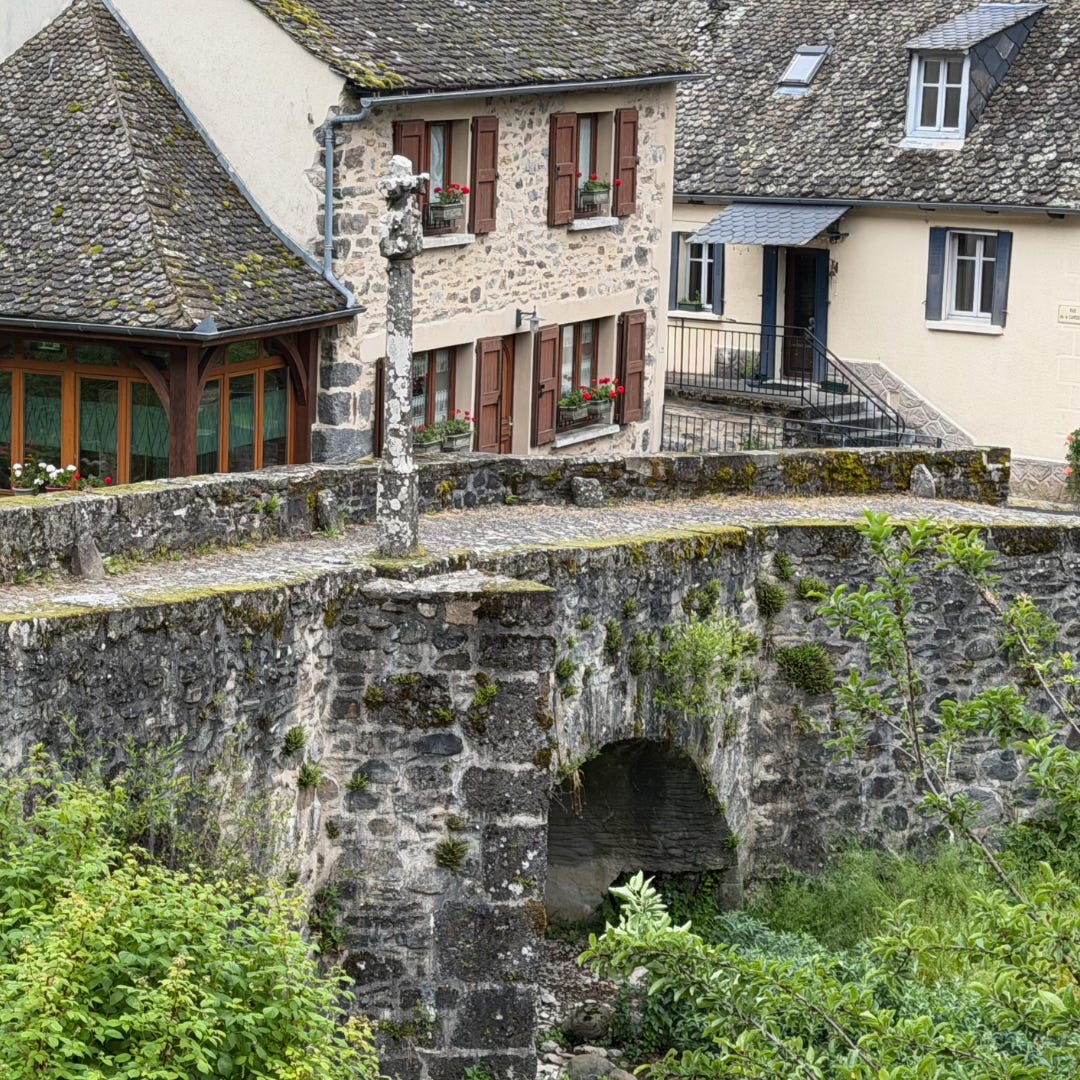
You cross into the village over the Pont des Pèlerins, the Pilgrims’ Bridge.
It spans the Boralde in two stone arches, narrow and worn, built in the 1300s and crossed since then by every pilgrim who has come down off the plateau on the way to Santiago. On its parapet stands a small cross of the same age, carved with the figure of a pilgrim, one hand resting on his staff, a rosary held in the other. Six centuries of weather have softened his face nearly to nothing. The cross was placed there to give heart to tired walkers at the end of the descent, which is to say it was made for the exact condition I was in, soaked and emptied out and glad past words to see a roof.
I have come into this village more than once. The photograph that illustrates its Wikipedia page is one I made here in 2022, on an earlier Camino, which is its own quiet lesson in returning to the same places until they begin to know you.
Stand on that bridge a moment with me. Whatever you are walking through right now, tired or hopeful or unsure, you are not the first to come down off a hard height and cross here glad of a welcome. The worn pilgrim has watched the soaked and the weary arrive for 600 years. You are somewhere in that long company, and so am I.
Why a Village Out of Sight Changes the Walk
Here is what the hidden village taught me.
When you can see the destination, you walk toward it, and the seeing pulls you out of the miles you are actually in. The path becomes the distance between you and the thing you want, ground to be covered rather than ground to be met. A village you cannot see offers you nothing to aim at. There is only the descent, the rain on the beech leaves, the sound of a river you have not yet found, and the connection with the natural world along the path. Saint-Chély withholds itself, and in withholding it keeps you inside the walk, because the walk is the only thing on offer until the village chooses to appear.
Then it appears, and because you were never allowed to want it from a distance, it arrives as a gift rather than as a goal you finally reached.
Sit with your own attention for a moment. Where are your eyes fixed today, on the ground under you, or on some point out ahead you have not yet reached? If you have been straining toward that point for a while now, what has been passing by unnoticed while you stared at it?
I do not ask in order to hand you an answer. The question is the practice. Pilgrimage works this way in miniature. The learning lives in the walking, in what the path does to you across the long hours, and the arrival is one more thing the path hands you along the way, not the reward waiting at the finish.
What Arrives When You Stop Watching for It
You do not need a plateau or an old stone bridge for this.
Most of what is worth doing slowly works the way that descent worked. You fix on the outcome, the finished thing, the place you are trying to reach, and the fixing quietly robs you of the days you are passing through to get there. The hours stop being where you live and turn into the gap before you arrive. A walk teaches the correction in the most physical way I know. Ease off the straining toward the end, stay in the ground under your feet, and what you were rushing toward tends to arrive on its own, often in the moment you have finally stopped watching for it.
The best arrivals are the ones you could not have walked straight toward.
I came down off the Aubrac that afternoon wanting nothing but to be dry, and the village met me before I knew it was near, the way the good things often do. The cross stood waiting where it has waited for 600 years. The bridge carried me over the Boralde as it has carried the soaked and the weary for longer than my own country has had a name. I was not at the end of anything. I was still walking, and the village was simply one more gift of the walking.
So I leave you where the path leaves all of us, still in the middle of it. Wherever you are headed this week, let your eyes come back to the ground you are on. What you are walking through is the pilgrimage.
I would like to hear from you. What are you walking toward right now, and what might you be missing while your eyes stay fixed on it? Leave it below, and I will read every one.
If you find this useful, please like or leave a comment.
The Rewilding the Soul EcoSpirituality Certificate at Cherry Hill Seminary, where I teach, is currently underway with this year’s cohort. The September 2026 Contemplative Walking Retreat I am leading on this same section of the Le Puy Camino is full. New offerings, including future retreats and additional teaching opportunities, will be announced here in the months ahead. For now, the practice itself is what matters most, and it is available to you wherever you are walking this week.
Where Insight Meets Earth is a reader-supported publication. To receive new posts and support my work, consider becoming a free or paid subscriber.