

I started the Winter Solstice by going to the gym.
This was my first time back in several months. The irony wasn’t lost on me. Here we are on the shortest day of the year, and I’m inside on an elliptical machine instead of greeting the sun from a hilltop.
But the morning held more than it appeared.
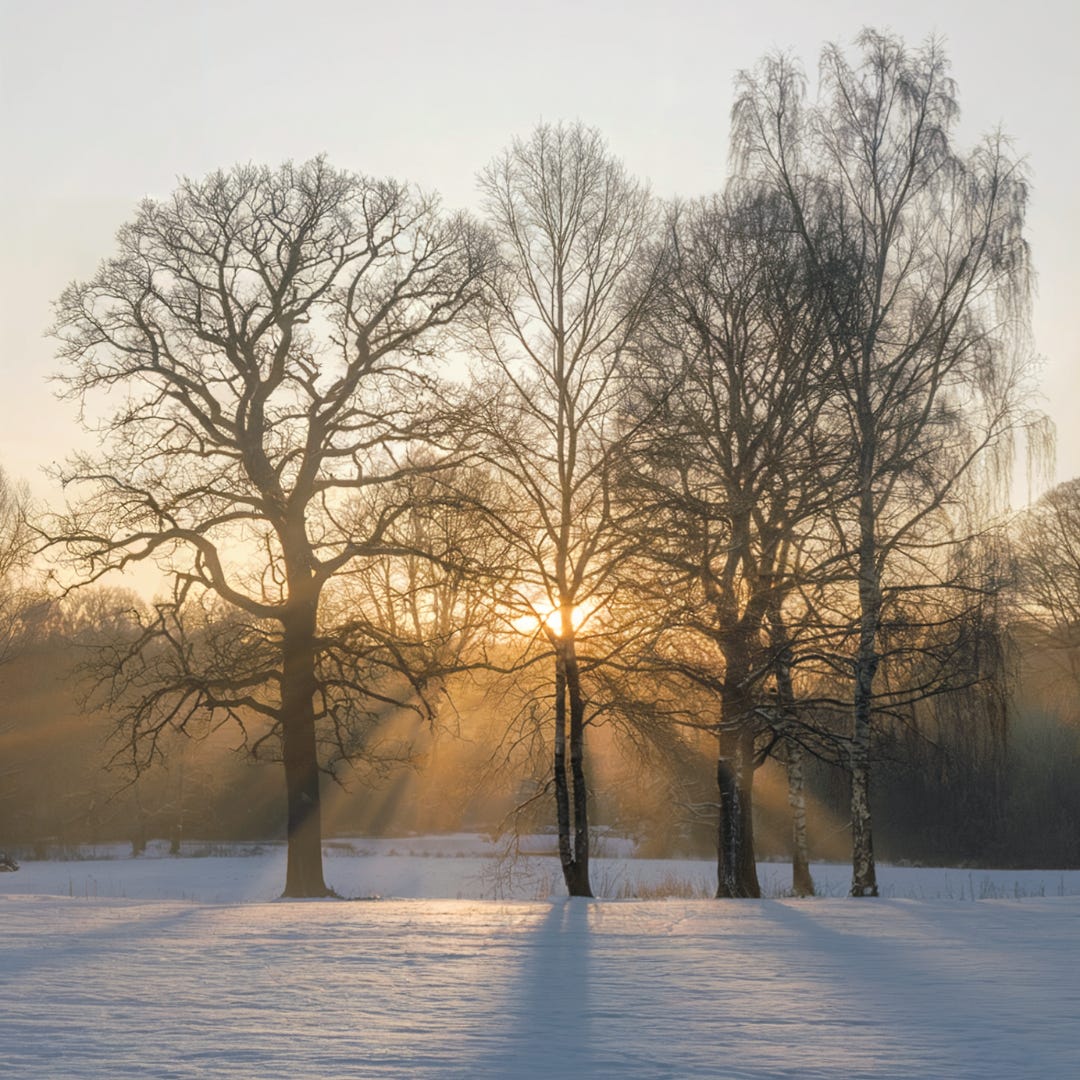
On my way there and back, I stopped in a park. I stood among the bare trees and placed my hand on the moss-covered bark of a tree, externally quiet for the winter. I didn’t say anything profound. I just paused. Let myself be there, in the cold, with the plants and trees who have been practicing stillness far longer than I have.
When I passed a mausoleum, I said a quiet prayer. For the dead, for the living, for whatever connects us across that threshold.
At the gym, I read a classic nonfiction book I’ve been struggling with for months while my body moved. Tending the mind and the body at once, preparing for an upcoming day-long hike to an ancient megalithic site next week.
None of this looked like ritual, yet all of it was.
The Oldest Holiday
Nearly every ancient culture marked this day.
Stonehenge aligns with the solstice sunrise. The passage tomb at Newgrange in Ireland, built 5,000 years ago, floods with light only on the winter solstice morning. Indigenous peoples worldwide developed ceremonies for this turning point. The Romans celebrated Saturnalia. Scandinavia held Yule.
This wasn’t superstition. It was attention. Our ancestors understood something many modern folks have forgotten: marking time matters. That pausing at the thresholds helps us live more deliberately.
Today, the darkness reaches its peak. Tomorrow, the light begins its slow return. We’re standing at a hinge point that humans have honored for millennia.
Ordinary Acts, Held Differently
You don’t need candles, altars, religious beliefs, or special words.
Ritual is simply an ordinary act held with intention. Making tea can be ritual. Walking to your mailbox can be ritual. Standing at your window as the early dark settles can be ritual.
What transforms the ordinary into the sacred is presence. Attention. The decision to mark this moment as meaningful.
A Simple Practice on the Winter Solstice
If you want to honor the Solstice today, here’s one way.
Step outside, even for a moment. Feel the air on your skin. Take three slow breaths.
With each exhale, silently offer a word or phrase. It could be gratitude. It could be release. It could be a simple acknowledgment: I am here. The light returns. I return with it.
That’s enough. That’s more than enough.
The Solstice doesn’t require an elaborate ceremony. It asks only that we notice. That we pause. That we mark the turning with whatever presence we can offer.
The longest night is here, and after it, slowly, the light begins again.
How are you marking this day? I’d love to hear, even if it’s small, even if it doesn’t look like a ritual to anyone but you.
If you are nature-minded and seeking a deeper connection to ecospirituality, contemplative walking, and the more-than-human world, I invite you to subscribe or support me so I can continue this effort.
Walking with you through the turning,
~ Jeffrey
Love this and the permission that I don't have to be at Stonehenge or lost in the forrest all day to to make this day sacred and honor this turn of the wheel.❤️
I had the same thought this morning. My day can seem ordinary yet still be sacred.