

I love learning about contemplative walking. Moreover, I genuinely enjoy and value doing it.
Unfortunately, when I first got interested in Walking as a Spiritual Practice, I had a hard time figuring out where to start.
The Information Overwhelm Problem
I came across different traditions—Buddhist walking meditation, Christian pilgrimage, and secular mindful walking. Each had conflicting instructions:
Count your steps. Don't count steps. Focus on your breath. Focus on your surroundings. Walk in a straight line. Walk in circles.
You get the idea!
Every “expert” had their own way, the “right” way, to engage in walking as a spiritual, contemplative, or sacred practice. If only all these ways were the same!
I felt overwhelmed and made it way too complicated. Sound familiar?
The Breakthrough That Changed Everything
Then I discovered something that shifted my entire approach: start stupidly simple.
Here's what actually works for beginners:
Walk slower than normal for 10 minutes without earbuds. That's it.
No special breathing techniques required. No need to count anything. Just notice when your mind wanders and gently return attention to the act of walking itself.
Given most walks that are intended to help with silence and inner peace happen in some natural setting, it is ok to use the sites and sounds of Nature as areas of focus.
It may even be helpful to do so, as we do not walk in a vacuum.
The breakthrough came when I realized contemplative walking isn't about perfecting a technique—it's about developing a relationship with walking itself.
A Beginner's Path That Actually Works
Once you have that foundation, you can build naturally:
Week 1: 10 minutes, any path, just a slower pace
Week 2: Add intention-setting before you start
Week 3: Begin noticing what captures your attention—sounds, sensations, thoughts
Week 4: Experiment with different terrains and locations
Why This Approach Works
This framework originated from my years of walking the Camino and becoming a certified Wild Guide. I learned that the most profound practices often have the simplest beginnings.
Most people think they need a perfect technique to start contemplative walking. But here's the truth: the technique emerges from the practice, not the other way around.
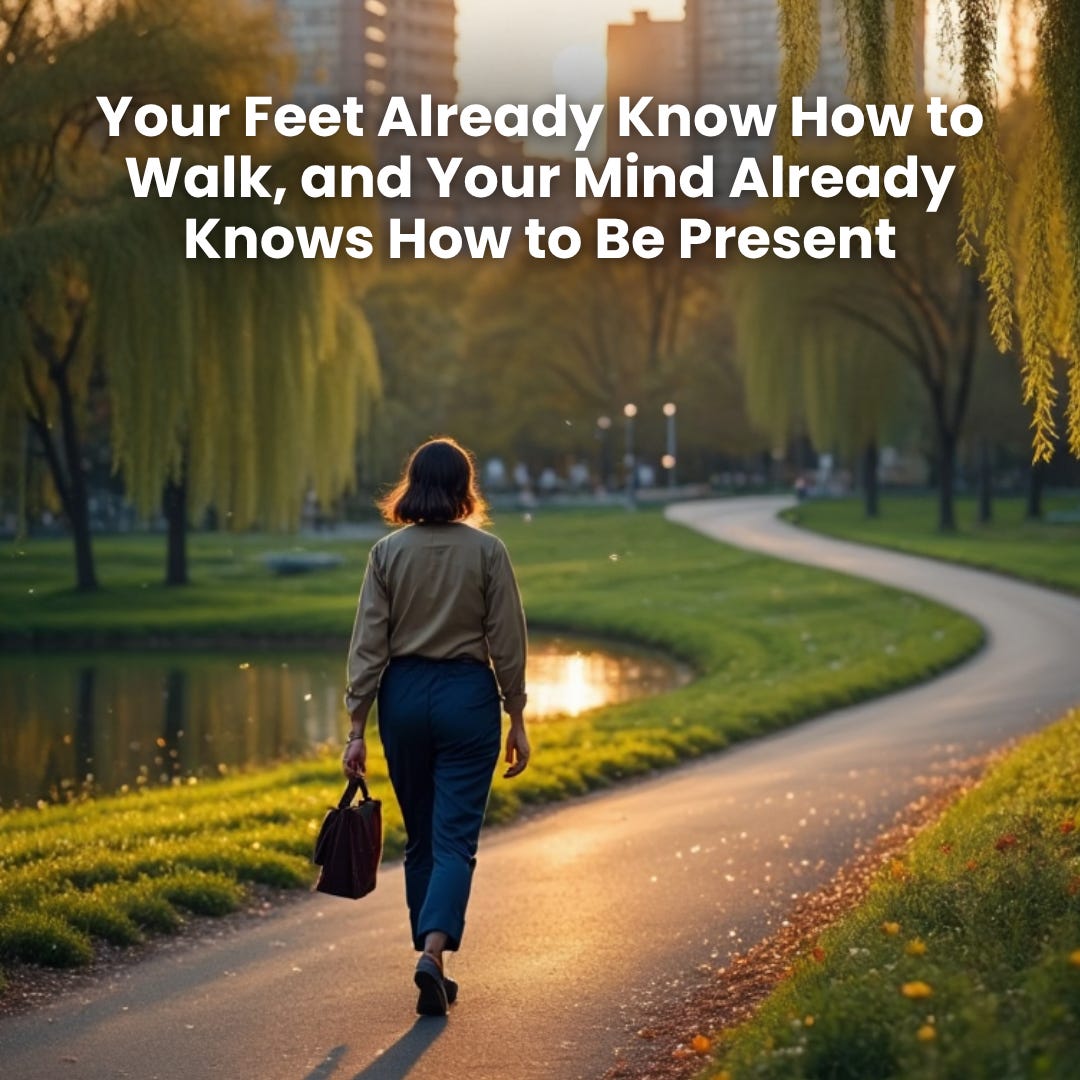
Your feet already know how to walk. Your mind already knows how to be present. You just need to give them permission to work together.
The Permission You've Been Waiting For
What if learning contemplative walking is actually much simpler than you think?
The spiritual traditions that seem so complex and intimidating? They all started with someone putting one foot in front of the other with intention.
You don't need to understand the philosophy before you begin. You don't need special equipment or a perfect location. You don't even need to call it "contemplative walking" if that feels too formal.
How about mindful walking? Walking as a spiritual practice? Sacred walking? Silent walking? Walking through Nature?
You just need to slow down and notice what happens when you do.
Your Simple Starting Point
Start with one 10-minute slow walk this week—no technique required, just curiosity.
Choose any path. Set the intention to simply be present with the act of walking. When your mind inevitably wanders (it will), gently bring your attention back to your feet touching the ground.
That's contemplative walking. Everything else is just refinement.
What happened during your first slow, intentional walk? I'd love to hear about your experience—reply and let me know what you noticed.
Ready to go deeper? I share weekly insights on contemplative walking practices, sacred travel, and finding spiritual wisdom through movement in nature. [Subscribe for more →]
P.S. - I'm currently developing a Le Puy Camino contemplative retreat for June 2026. If you're interested in experiencing walking meditation on one of Europe's most ancient pilgrimage routes, subscribe to me on Substack for early access and retreat preparation content.