

If you find this post helpful,
please like it + leave a comment
about what it shifted in you.
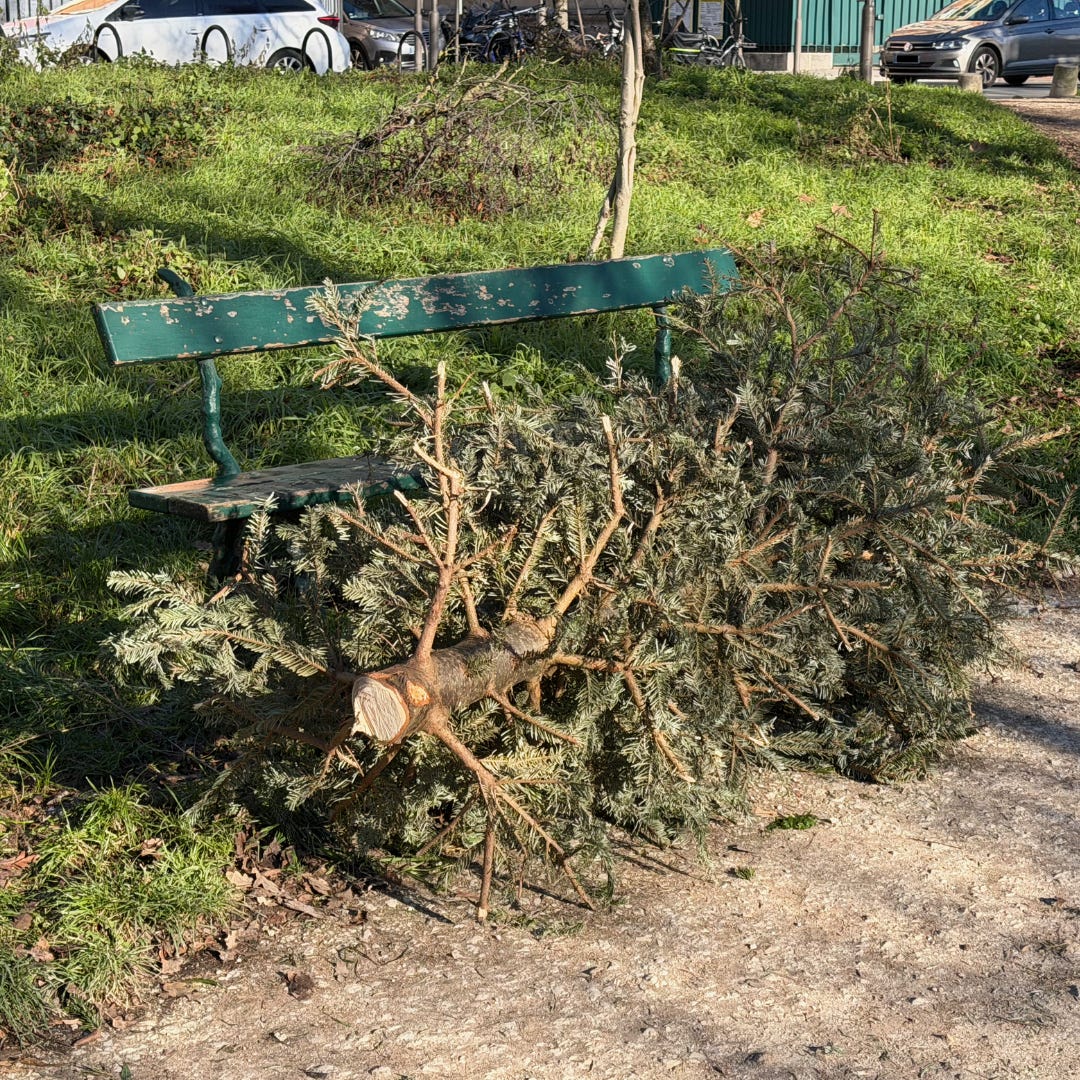
I was two thirds of the way through an 8.5 mile walk when I saw it.
A Christmas tree lying on its side near a park bench. Brown needles scattering across the frozen ground. Branches bent at angles that suggested it had been tossed rather than placed.
Across the street, luxury apartment buildings rose against the grey January sky.
I stopped walking.
This was not the first discarded tree I had seen since the holidays ended. Paris sidewalks had been lined with them for weeks, waiting for municipal collection. But something about this one caught me differently. Maybe it was the setting. Maybe it was the contrast between the expensive real estate and the abandoned tree. Maybe my mantra had been working on me for miles, opening something that rushing would have kept closed.

I stood there longer than made sense.
What My Body Knew Before My Mind Did
The feeling came before the thought.
Sadness first. A heaviness in my chest that surprised me with its intensity. This was just a tree. Just a Christmas tree, like millions of others discarded every January.
Then something harder to name. A troubled feeling. Almost like witnessing disrespect. Like walking past someone being treated poorly and feeling it in your gut even before you understand what you are seeing.
The tree had been killed for Christmas.
I do not mean that dramatically. I mean it literally. This tree had been growing somewhere, alive, part of a forest or a tree farm. It had been cut, transported, sold, decorated, admired for a few weeks, and then carried outside and left on the ground like trash.
Not even recycled. Not turned into mulch that might return some of what was taken. Just discarded.
Its life cycle had been forcibly stopped. Then its death was further disrespected. Used and thrown away without a second thought.
I felt this in my body before I could articulate any of it.
What an Ecospirituality Lens Reveals
This is what I mean by an EcoSpirituality lens.
It is a way of seeing that makes visible what rushing past would miss. When I walk with presence, when my attention is open rather than closed, the world reveals things I would otherwise never notice.
Most people walked past that tree without a glance. I know because I watched them do it while I stood there. Couples talking. A jogger with headphones. A woman pushing a stroller. The tree was invisible to them. Background. Urban debris waiting for cleanup.
An ecospirituality lens does not create what is there. It reveals what is there. The grief I felt was not manufactured. It was appropriate. The tree deserved better. My sadness was correct.
This is one of the things Rewilding the Soul teaches: how to see what is actually happening in our relationship with the more than human world. Not through ideology or argument, but through attention. Through slowing down enough to let the world show us what we have been trained not to notice.

The discarded tree was a small thing. It was also everything wrong with how we live.
The Severed Relationship
What the tree revealed was a pattern.
We take from the Earth without acknowledgment. We use for our purposes. We discard when finished. This cycle has become so normal that we do not even see it as a relationship anymore.
But it is a relationship. Everything is relationship.
The tree was not an object. It was a living being that had been growing, photosynthesizing, exchanging gases with the atmosphere, providing habitat for insects and birds, participating in the vast web of connections that makes life possible. Then it was cut. Then it was decoration. Then it was garbage.
At no point in this process did anyone pause to acknowledge what was happening. No gratitude for the tree’s life. No recognition that something was being taken. No offering in return.
This is what I mean by severed relationship. Not that we stopped relating to the natural world. We cannot stop. We are part of it. We depend on it for every breath. But we have severed our awareness of the relationship. We have made it invisible to ourselves.
The tree across from the luxury apartments made it visible again.
The Absence of Reciprocity
Indigenous traditions around the world share a common understanding: taking requires giving back.
They often approach this reciprocity with thanks. When you harvest a plant, you leave an offering. When you hunt an animal, you honor its spirit. When you take from the forest, you give something in return. Not because of superstition, but because of relationship. You do not take from those you love without acknowledgment. You do not receive gifts without gratitude.
This is reciprocity. The practice of maintaining balance in relationship.
The Christmas tree represented the complete absence of reciprocity. It was taken. It was used. It was abandoned. No offering. No return to the soil. No gratitude.
Multiply this by every Christmas tree discarded every January. Multiply it by every product consumed and thrown away. Multiply it by every resource extracted and never replenished. The scale of broken reciprocity is almost impossible to comprehend.
I am not arguing that we should stop using trees or stop celebrating holidays. I am noticing what the ecospirituality lens reveals: we have forgotten that we are in relationship. We have forgotten that taking comes with responsibility. We have forgotten how to give back.
I will avoid talking about oil from the ground, and how it got there.
The Luxury Apartments
I keep thinking about the luxury apartments across the street.
This is not a critique of wealth. It is an observation about insulation. When you have enough resources, you can distance yourself from consequence. You can take without feeling the taking. You can discard without seeing where the discarded things go.
The more wealth, often the more severed the relationship.
Not always. Not inevitably. But often. Because wealth buys convenience, and convenience means not having to think about where things come from or where they go.
The person who discarded that tree probably did not feel anything. It was just a task. Take down decorations. Get rid of tree. Move on to the next thing. No grief, because grief requires relationship, and the relationship had been severed long before the tree was ever purchased.
I stood there grieving on their behalf. On all our behalf.
From Consumer to Kin
Here is what I am learning.
The discarded tree reveals where we are. Consumer relationship with the natural world. Taking without acknowledgment. Using without gratitude. Discarding without thought.
Rewilding the Soul points toward where we could be. Kinship relationship with the more than human world. Taking with awareness. Using with respect. Returning what we can. Grieving what we cannot restore.
The movement from consumer to kin does not happen through information. I already knew intellectually that Christmas trees are cut, used, and discarded. The information changed nothing.
The movement happens through attention. Through stopping long enough to see what is actually there. Through letting the body feel what the mind has been trained to ignore.
This is why contemplative walking matters. Not as escape from the world, but as deeper entry into it. An ecospirituality lens is not something you think your way into. It is something you walk your way into. Step by step. Attention offered to what is actually here.

The discarded tree was a teacher. I did not expect to learn anything on that stretch of my walk. I expected to pass through, covering distance, mind elsewhere.
Instead I stopped. I saw. I grieved.
That grief is the beginning of something. Not despair. Beginning. The first movement from consumer to kin.
A Practice of Reciprocity
If you want to begin practicing reciprocity, here is a simple way to start.
The next time you take something from the natural world, pause. It does not matter how small. A flower from your garden. Vegetables from the store. Water from the tap. Paper from a notebook.
Pause and acknowledge what you are receiving. Name it, if only silently. Thank you for this. I receive this.
Then ask: What can I give back?
The answer might be attention. Noticing where this thing came from. Learning about its journey to you. The answer might be care. Using it well, not wasting it. The answer might be actual return. Composting. Recycling. Choosing options that close the loop.
The practice is not about perfection. It is about waking up. Remembering that you are in relationship. That taking is only half of a cycle that requires giving back.
One pause at a time. One acknowledgment. One small act of reciprocity.
This is how consumers become kin.
On Friday, I will explore what your body knows about winter that your calendar keeps ignoring. The rest your culture refuses, your body will eventually demand.
Walk With Me
If this resonates, I invite you to subscribe to Where Insight Meets Earth, my weekly reflections on contemplative walking, ecospirituality, and embodied practices for navigating what overwhelms us.
If you want to delve more deeply into this, I am launching the Rewilding the Soul EcoSpirituality Certificate at Cherry Hill Seminary in March 2026—a year-long journey exploring Earth kinship through contemplative practice. Learn more here.
In September 2026, I’m leading a contemplative walking retreat on France’s ancient Le Puy Camino, seven days of silence, movement, and practices for metabolizing what sitting cannot, in the most beautiful landscape you can imagine, on a 1,000-year-old pilgrimage path. Details here.
Hit reply anytime. I read and respond to every message.
~ Jeffrey
I love hearing what this tree awoke in you. And the life you gave it through this piece. Your writing also made me think of all the living trees we pass by without gratitude. My neighborhood has many big old trees, but I don't see as many teenage trees growing up behind them. And yet, I know that it's the trees that hold the energy for this neighborhood... they make it what it is!
The shift from seeing the tree as debris to recognizing it as witness to severed reciprocity is powerful. Most ecospirituality writing stops at gratitude practice, but naming the absence of return gets at somthing deeper. That juxtaposition with luxury apartments isn't accidental - wealth does buy distance from consequence. I've noticed this in my own life when convenience choices accumulate into a pattern of taking wthout acknowledgment. Simple but uncomfortable truth.