

I asked him first.
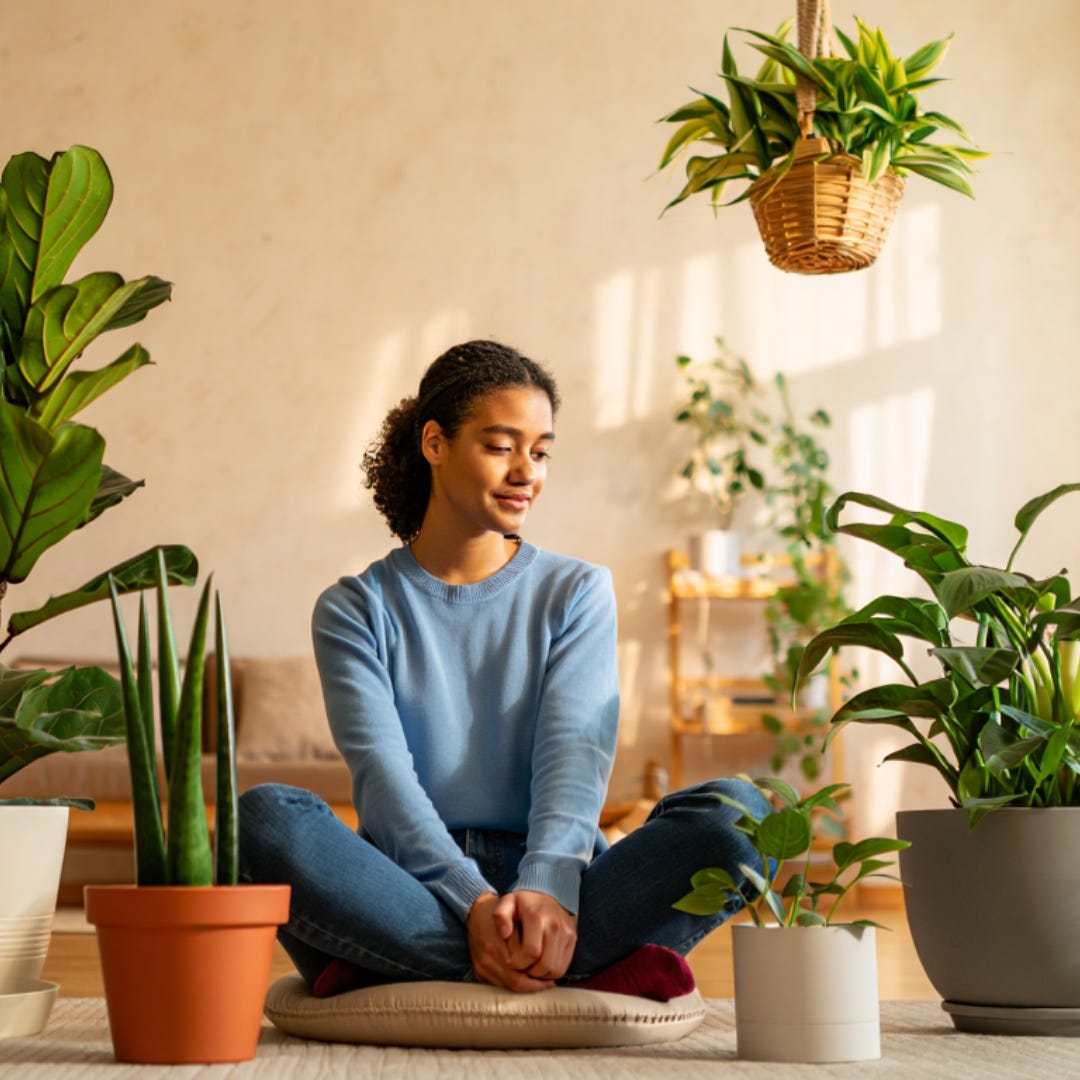
Before I stroked his leaves, I asked if he minded. This might sound strange to some people, but it felt necessary. He’s a houseplant I recently re-potted, a being I’ve been learning to care for after under-watering him, then over-watering him, and now we’re both finding a new balance together.
He has a new stem that appeared recently. He sits in muted sunlight now, in the center of my table, a place of prominence where I can see him throughout the day.
When I touched his leaves, they were soft but firm. Various shades of green caught the light differently depending on angle and time of day.
What Neighbor Actually Means
I’ve been developing this 13-Day EcoSpirituality Challenge, and Day 5 asks participants to meet a plant neighbor.
Not a plant. Not a being. A neighbor.
Words matter. Neighbor reminds us of kin, of others who live near us and have their own lives, though we’re often so very connected.
A neighbor isn’t someone you own. A neighbor is someone you live alongside, someone whose well-being affects yours and whose presence shapes your daily experience.
When I call this houseplant my neighbor, I’m acknowledging he has his own life. His own needs. His own responses to light and water and touch that I can learn but never fully control.
I don’t own him. I share space with him.
That changes everything.
The Trees at Boundaries
On my Camino walks across France, I find myself drawn to certain trees.
Not the dramatic forests or famous landmarks. The solitary trees standing in the middle of fields or at boundary points between properties. Trees that mark thresholds, that stand alone but connect different spaces.
I send blessings toward them as I pass. Sometimes I stop. Sometimes I just acknowledge them silently.
What surprised me is that some of these trees are known by other pilgrims too. Other Wild Guides and Camino walkers who’ve developed relationships with the same boundary markers. We recognize them. We speak about them. We share our observations and pictures of how they change with seasons, with storms, with time.
These aren’t famous trees with names in guidebooks. They’re neighbors we’ve met along the way.
Being a neighbor doesn’t require fame or significance. It requires presence and recognition.
What Makes Someone Shift
As an ordained Wild Guide working on a forest bathing certification, I’m learning what makes people shift from seeing plants as scenery to seeing them as neighbors.
Some people get it immediately. Those drawn to ecospirituality already understand plants as kin, as something we’re connected to and not owners of.
But others need something more. A reminder. A bridge.
I often ask about trees they climbed as children. About grandmothers who talked to plants while watering them. About the specific apple tree in their yard that taught them what ripe fruit tastes like straight from the branch.
Sometimes I talk about Christmas trees. Not as decorations, but as beings brought into homes, given water, surrounded by family energy for weeks. What does that feel like for the tree? What energy do they hold?
Or picking fruit. The intimate act of reaching into branches, selecting what’s ready, feeling the slight resistance before release. That’s not harvesting scenery—that’s interaction with a neighbor who offers something.
These memories live in most people. They just need permission to acknowledge them without feeling foolish.
Once someone remembers a plant relationship from childhood, the shift happens. They stop seeing plants as background and start seeing them as lives happening alongside their own.
Finding Balance Together
This houseplant I asked permission from has taught me something about being neighbors.
After I repotted him with clean, fresh soil, we both had to adjust. He needed to settle into new space. I needed to learn his water needs in different conditions.
I under-watered at first. He drooped. I over corrected and over-watered. He struggled differently.
Now we’re finding balance. I watch him more carefully. I check soil before watering instead of following a schedule. I notice how quickly he dries out based on temperature and light.
He responds. New stem. Happier color. Different posture.
This is what neighbors do. They adjust to each other. They learn each other’s patterns. They find ways to coexist that honor both lives, not just one.
I can’t treat him the same as every other plant. He’s not generic houseplant. He’s this specific being with specific needs in this specific light at this specific time.
Neighbors require attention to particularity. To the actual individual you’re living alongside, not the category they belong to.
The Permission Question
When I asked permission before touching his leaves, something shifted in me.
I wasn’t just being polite to a plant. I was acknowledging agency. The possibility that he might prefer not to be touched. That his consent matters even if I can’t hear verbal response.
This is what forest bathing teaches. What my certification training reinforces. Plants aren’t passive objects receiving our attention.
They’re responsive beings with preferences and boundaries. They lean toward light. They close at night. They respond to touch and sound and presence.
When I stroke leaves after asking permission, I’m listening for response through texture, through the quality of touch, through what my body senses beyond words. Soft but firm tells me something. Various shades of green teach me something.
This is relationship. Not projection. Not performance. Actual meeting between two living beings.
One has language and opposable thumbs. The other has photosynthesis and roots. Both have lives worth acknowledging.
Your Practice Today
Here’s what I’m inviting you into: meet one plant neighbor today.
Find a plant near your sit spot or home. A tree. A weed. A flower. A houseplant. Anything growing. Spend five minutes just being with them.
Look closely at leaves, stems, the way they reach for light. Notice color variations. Growth patterns. Who lives near them.
Ask permission before touching. This isn’t performative politeness—it’s acknowledgment that they have agency even if you can’t hear verbal response.
Then touch if it feels right. Notice texture. Temperature. The way leaves respond.
You don’t need to know their name. You’re not trying to identify species. You’re meeting a neighbor.
Notice how this is a living being sharing this place with you. They have their own life happening alongside yours. You’re connected, not owners.
One participant in the challenge wrote about meeting a dandelion they’d been about to pull as a weed. After five minutes of actual attention, they couldn’t remove it. It had become someone, not something.
Another met a maple tree they pass daily on their commute. Five minutes of standing together changed their entire relationship to that walk. Now they greet the tree every morning.
I asked a houseplant permission and learned about finding balance together.
What This Changes
After this morning, I can’t teach “plant identification” without teaching relationship first.
Knowing names matters. Scientific names, common names, Indigenous names—all valuable knowledge. But naming without meeting creates catalog, not kinship.
Meet first. Notice particularity. Ask permission. Pay attention to response.
Then learn names as deepening of relationship, not replacement for it.
When EcoSspirituality folks hear this, they nod. They already know plants aren’t scenery. But many people need permission to remember what they knew as children: that trees have personalities, that gardens respond to attention, that plants are neighbors worth greeting.
The shift from scenery to neighbor changes how we move through the world. It changes what we’re willing to protect. What we’re willing to advocate for. How we design our spaces and our lives.
You can’t ignore a neighbor’s wellbeing the way you ignore scenery. Neighbors matter because you’re connected. Their lives affect yours. Your choices affect theirs.
Tomorrow
Tomorrow, we notice what we’ve been taught. We move into Days 6-9: LOOK DEEPER.
But that looking will be richer because today you met a neighbor. Because you practiced seeing plants as kin with their own lives instead of backdrop for yours.
For now, find one plant. Spend five minutes. Ask permission before touching.
Meet your neighbor. They’ve been waiting.
I’m developing a 13-Day EcoSpirituality Challenge and sharing what I’m learning here. Tomorrow: noticing what we’ve been taught as we move into looking deeper. If you’d like to practice along, consider subscribing for reflections on EcoSpirituality, sacred walking, and kinship with the more-than-human world.
Who did you meet today? I’d love to hear in the comments below.