

If this post resonated with you,
please like it + leave a comment
about what it shifted in you.
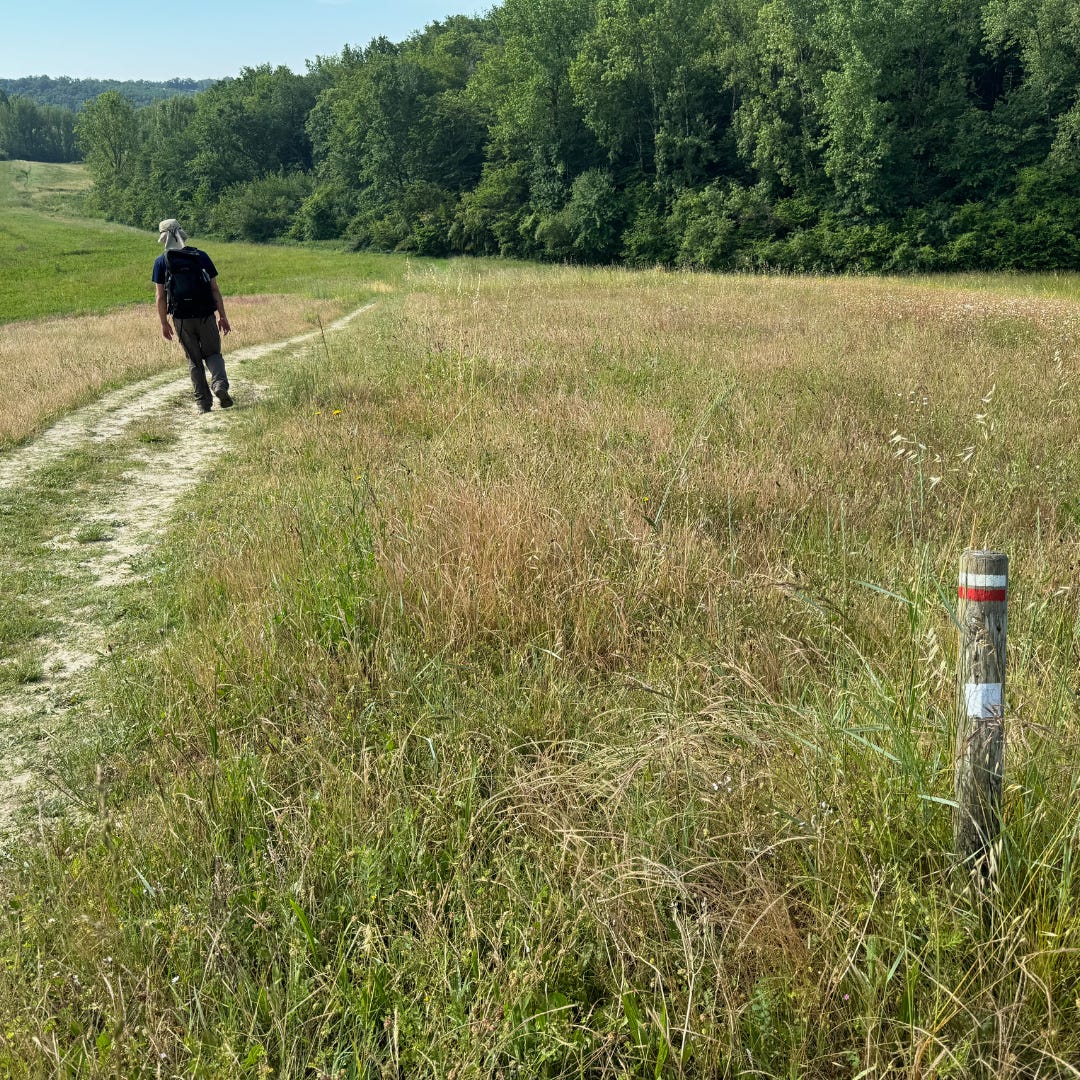
When people learn I guide contemplative pilgrimage retreats, they often ask about logistics.
How many miles per day? Where do you stay? What if someone gets injured? Do you carry the bags or do participants carry their own?
These are reasonable questions. They are also not the questions that matter most.
The logistics of pilgrimage can be researched online, mapped on apps, booked through agencies. Anyone with a credit card and an internet connection can arrange to walk the Le Puy Camino route. The path is marked. The gîtes are listed. The kilometers are known.
What cannot be arranged online is the space to actually feel what arises when you walk. The permission to process in silence. The freedom to connect with the natural world without being pulled back into social performance.
That is what guiding contemplative pilgrimage actually requires and what I try to support in what I offer.
What My First Camino Taught Me
My first Camino was a guided experience. The logistics were handled, but not in a way that served what I actually needed.
A service vehicle transported us to accommodations sometimes away from the Camino path itself. The idea was to give us more options, more comfort, more amenities than the simple gîtes along the route. Instead, it made me feel disconnected from the pilgrimage itself. We were walking the Camino by day and then being driven somewhere else entirely to sleep.
Meals were mandatory, or at least expected, group affairs. Walking together was assumed. Talking as a group was the norm. The guide had created what many people want: a built-in community, shared experience, and connection.
I did not need more social time. I did not need more talking.
What I needed, though I did not know it at the time, was silence. I had come from a very busy professional life. My mind was full of noise. What I needed was space to process, to be quiet, to let the walking do its work without constantly being pulled back into conversation.
The forced social time may work for some. It did not work for me. Every group meal felt like an obligation. Every expectation of togetherness pulled me away from the internal work I had come to do. Staying away from the path itself meant I could not wander the village in the evening, could not sit outside a centuries-old gîte and feel the weight of all the pilgrims who had slept there before me.
I finished that Camino feeling like I had missed something. The transformation I was looking for had not happened. The pilgrimage had become another form of social performance, just in a different setting, disconnected from the path that held the real power.
Processing What I Actually Needed
It took years, and the stillness that COVID forced on all of us, for me to understand what had happened.
I realized there is more than one way to walk the Camino. The social, communal experience is valid. It is what many people need and want. The friendships formed on the trail, the shared meals, the stories exchanged over wine in the evening—for some, this is the heart of pilgrimage.
But it is not the only way.
Some of us need silence to connect. We need space to process. We need the freedom to walk alone with our thoughts, to let the landscape speak, to hear what arises when we finally stop talking and allow the natural world we walk through to gently speak to us.
This is not antisocial. It is contemplative. It is a different kind of pilgrimage, one that prioritizes depth over connection, silence over conversation, the internal journey over the external community.
I needed to explore what this meant for me. Over five Camino walks, I have learned what I actually need from pilgrimage. Silence. Solitude within community. Space to process. Permission to be quiet.
I am trying to be the guide I needed but did not have.
Contemplative Depth Is Not for Everyone
I want to be honest about this.
The kind of pilgrimage I guide is not for everyone. If you want the social experience, the group dinners, the constant companionship, there are many guides who offer that beautifully. That is a valid and meaningful way to walk.
What I offer is different.
I offer contemplative depth. Long stretches of silent walking. The freedom to process your experience in your own way. Connection with the natural world that requires quiet to hear.
This works for people who need silence to connect. People whose busy professional lives have filled them with noise. People who suspect that what they need is not more input but more space.
None of this is forced, of course. The expectation is simply that silence will be the norm unless you need something else. This is the opposite of most guided experiences, where talking is the default and silence feels like something you have to escape to find. Here, contemplation is the container.
Dinners are generally shared around a common table, as that is what is most available in the rural areas where we will be staying, but even then, the expectation is to embrace whatever silence you need. Walking alone together. Sharing space without the obligation to fill it. There is no right way for this to happen.
If you thrive on group energy and shared conversation, this is probably not the right experience for you. If you come alive in silence and need space to hear yourself think, it might be exactly what you have been looking for.
Why Four People and Private Rooms
I am leading only four people on the Le Puy Camino in September 2026.
This is not a marketing tactic. It is what contemplative pilgrimage requires.
With four, I can hold genuine space for each person. I can notice what someone needs without them having to ask. I can adjust the rhythm, create room for a conversation or for silence, depending on what is arising.
With eight or twelve, the container becomes too large. The guide becomes a manager. The intimacy that contemplative work requires becomes impossible.
Four people. Seven days walking. One ancient route.
I am also arranging for private rooms for everyone who attends. This is almost unheard of on the Camino, in France or Spain or anywhere else. The traditional model is shared dormitories, communal sleeping, constant togetherness.
I am doing it differently because I know what I needed and did not get.
Every accommodation I have booked is directly along the Le Puy Camino path. Not transported elsewhere for more options or more comfort. You will sleep where pilgrims have slept for a thousand years. You can wander the village in the evening. You can sit outside a centuries old gîte and feel the weight of all those who walked before you.
After a day of walking, after whatever has surfaced on the trail, you need space to process. You need a room of your own where you can be quiet, journal, weep, stare at the ceiling, sleep early, or stay up late. You need the freedom to integrate your experience without performing wellness for roommates.
Private rooms are not a luxury. They are part of the container. They are what makes contemplative depth possible.
The Guide I Needed
Here is what I have learned from five Camino walks:
The guide’s job is not to create community. Community may emerge, but it cannot be forced. The guide’s job is to create conditions where transformation can happen, and then to protect those conditions.
For contemplative pilgrimage, those conditions include silence. They include solitude within the group. They include permission to process at your own pace, in your own way.
The guide I needed would have said: “You do not have to join us for dinner. You can walk ahead or behind. You can be silent all day if that is what you need. The pilgrimage is yours. I am here to hold the space, not to fill it.”
That is the guide I am trying to be.
I am not offering the social Camino experience. I am offering something quieter, deeper, more interior. A pilgrimage that creates space for the natural world to speak. For your own wisdom to surface. For the silence to do its work.
A guide does not walk for you. A guide walks with you through what you cannot walk alone. Sometimes that means conversation. Often it means walking beside you in silence, trusting that the path itself is enough.
If you have any questions about this, please message me:
Walk With Me
If this resonates, I invite you to subscribe to Where Insight Meets Earth, my weekly reflections on contemplative walking, ecospirituality, and embodied practices for navigating what overwhelms us
In September 2026, I am leading a contemplative walking retreat on France’s ancient Le Puy Camino. Seven days of walking in presence on a 1,000 year old pilgrimage path. Only 4 participants. Private rooms for everyone. Every accommodation directly on the path where pilgrims have walked for centuries. Silence as practice, not punishment. If you are curious about what contemplative pilgrimage might offer you, details are here.
If you want to delve more deeply into this, I am launching the Rewilding the Soul EcoSpirituality Certificate at Cherry Hill Seminary in March 2026, a year-long journey exploring Earth kinship through contemplative practice. Learn more here.
This sounds so lovely and will be a profound experience! I am fortunate that when I walked in 2013, I had many hours of solitude and it was the healing I needed.
This is so beautiful and immediately resonant. I can feel the difference between being pulled to socially and emotionally support others vs sinking into my own process and entering a much bigger conversation with the lands.