

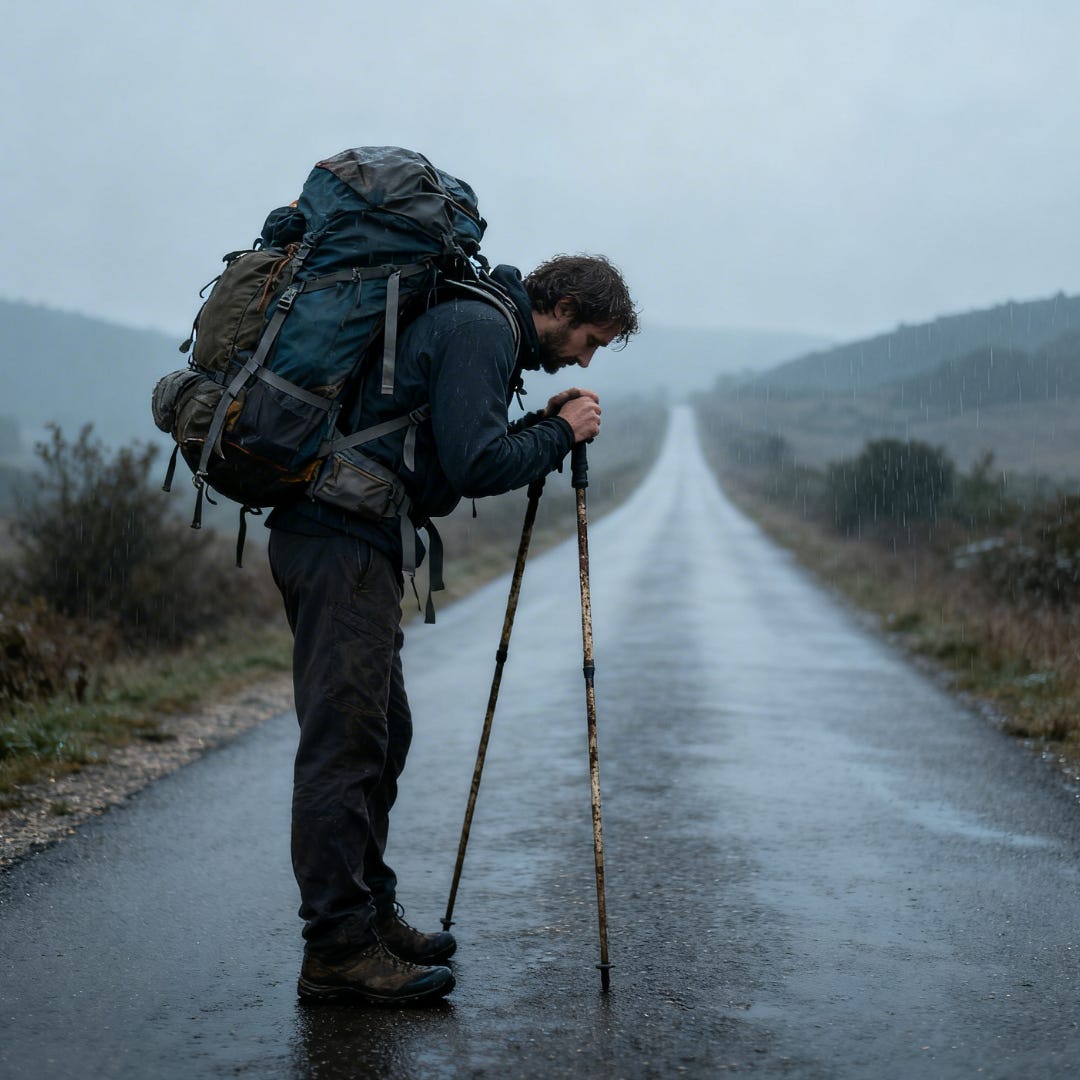
On my first Camino I carried a laptop.
I also carried extra layers for weather that might turn, backup items for problems that might arise, and contingencies for situations I could not fully name. By the time I lifted the pack onto my back at the start, I had prepared myself for every version of the walk except the one I was actually about to take.
The laptop came out once.
The weight was with me every single day.
If you are standing at the edge of a new chapter, perhaps a career shift, a relationship ending, a spiritual practice that no longer fits, an identity you are trying to leave behind, and something feels heavier than it should, I am speaking to you.
Not because you have done anything wrong. Because most of us were never taught the difference between preparation and the fear of letting go. The two feel identical from the inside until you have to carry them uphill for fifteen miles.
You Only Notice the Dead Weight When You Cannot Put It Down
There is nothing like walking a pilgrimage route day after day to clarify what you actually need.
Everything in your pack that does not earn its weight makes itself known. Not on day one, when the novelty of beginning carries you forward. On day three, when your shoulders have had two nights to register what they are bearing, and your feet have begun to negotiate with the terrain. By day five, the unnecessary things have become something close to enemies.
Dead weight becomes undeniable only when you must carry it every single day.
This is as true of what we carry in our lives as it is of what we put in our packs. The guilt about a relationship that ended badly. The stress about decisions that cannot be undone. The shoulda, coulda, woulda of a past that is finished, regardless of how much attention we continue to give it. These do not reveal themselves when we are moving fast enough to outpace them. They reveal themselves when the path slows us down, and the weight becomes impossible to ignore.
The question worth sitting with is not how much you are carrying. It is whether what you are carrying belongs to the life you are actually living now.
Just in Case Is Usually a Story From the Past
Most overpacked bags are not the result of poor planning.
They are the result of “what if.” What if the weather turns, and I do not have the right layer? What if I need something I left behind? What if the new situation requires more of me than I currently have?
This feels like responsibility. It presents itself as wisdom and careful preparation.
Look at it directly, though, and something else comes into focus. The “what if” is almost never about the future. It is about a past situation that went wrong, and the attempt to prevent that particular version of wrong from happening again. We carry the solutions to problems we have already survived into situations that have entirely different requirements.
This is how we unknowingly carry an old life into a new one.
We force the logic of a previous version of ourselves into an experience that is asking something entirely different. We suffer because we are carrying a life that no longer exists into a life that has not yet been given room to begin. The wonder and the awe of walking somewhere genuinely new get strangled before they have a chance to arrive. We are too weighted down by what was to feel what is.
Why New Chapters Feel Strangely Like Old Ones
In years of walking pilgrimage routes and companioning people through significant transitions as a chaplain at NYU, I have watched what people carry and what carrying it costs them.
The physical pack is almost always a mirror of the interior one.
People arrive at the Camino ready for change but still carrying guilt, shame, unfinished identities, and stories they have not yet released. Guilt about family relationships that have frayed. Guilt about friends they no longer speak to. The weight of a version of themselves they have outgrown but have not yet been willing to set down. They come specifically to close the door on a previous life, to walk far enough and long enough that a new chapter becomes possible.
Overpacking keeps them tethered to the very thing they came to leave behind.
Not intentionally. Not consciously. But every time they lift that pack and feel the weight of what they brought just in case, they are shouldering the old life one more time. The new chapter never quite gets to begin. Not because it is unavailable. Because there is not yet space for it.
Packing Light Is Not Minimalism. It Is Honesty.
To walk lightly is not about owning less.
It is about telling the truth about what the new situation actually requires, as opposed to what the past trained you to fear. There is an old saying on the Camino: the path provides. Not in a magical sense. In a practical one. What you actually need tends to be available if you are not so weighted down by imagined needs that you cannot recognize what is already here.
The same is true of every genuine new beginning.
What we need for the new chapter will be available. But only if we arrive light enough to receive it, open enough to recognize it, and honest enough to admit that the equipment we brought from the last chapter may not be what this one requires.
What Letting Go Actually Asks
Setting down what you do not need is not a dramatic act.
It is a quiet one. It requires admitting that the past is no longer happening, that its problems and its logic and its defenses do not travel with you unless you choose to carry them, and that continuing to carry them is a choice rather than a necessity.
This is harder than it sounds because the weight is familiar. We have carried it long enough that it feels like part of us. Without it, a question surfaces: who am I if I am not managing, preparing, and protecting against what has already happened?
The answer is not something you think your way into. It is something you experience your way into by walking, by returning to a practice without performing it, by putting the pack down and noticing that you are still standing.
Someone lighter. Someone with hands free for what is actually here.
One Practice Worth Trying Before Your Next Step
You do not need a pilgrimage route to begin this.
Before your next significant step—a decision, a transition, or simply tomorrow morning—pause and ask what you are carrying that belongs to a version of your life that is already complete. Write it down without editing. Then ask honestly whether what you have named is something you genuinely need for what is ahead, or something you are afraid to set down.
You do not need to release everything at once. You need to notice what you are carrying and why.
That noticing is where the weight begins to lift.
What the Path Is Actually Asking
On the Camino, you feel the cost of carrying too much within days.
In life, you can carry it for years without realizing.
Until something in you quietly asks: what if this next chapter is not asking more of me? What if it is asking less?
In May, I will carry 97 miles worth of what I actually need on the GR65. Nothing from a previous version of that walk. Nothing just in case. What the path requires, honestly chosen, honestly carried.
The walk ahead is a new situation. I have learned to pack for it honestly, meaning honestly to myself.
What are you carrying into your next chapter that belongs to the last one?
Please share questions, anything you learned, or perhaps something you tried as a result of this experience.
Do You Want to Walk Together?
Spring is on the path. The route is waiting.
If this opens something you want to keep exploring, go outside today and sit in one spot for ten minutes. Return tomorrow and sit again. Notice what becomes visible on the second visit that the first one could not hold.
If you want something more structured, the September 2026 Contemplative Walking Retreat on the Le Puy Camino in France is built around this exact principle. The practice is not scheduled alongside the walk. It is woven into every step of it. Seven days of walking the GR65 in a small group, with enough silence and enough return to let the path teach what it actually has to offer.
Start outside. Start today.
The earth is not waiting for you to enroll anywhere.
Profound look at what the need to be prepared for all possible issues does to our present.