

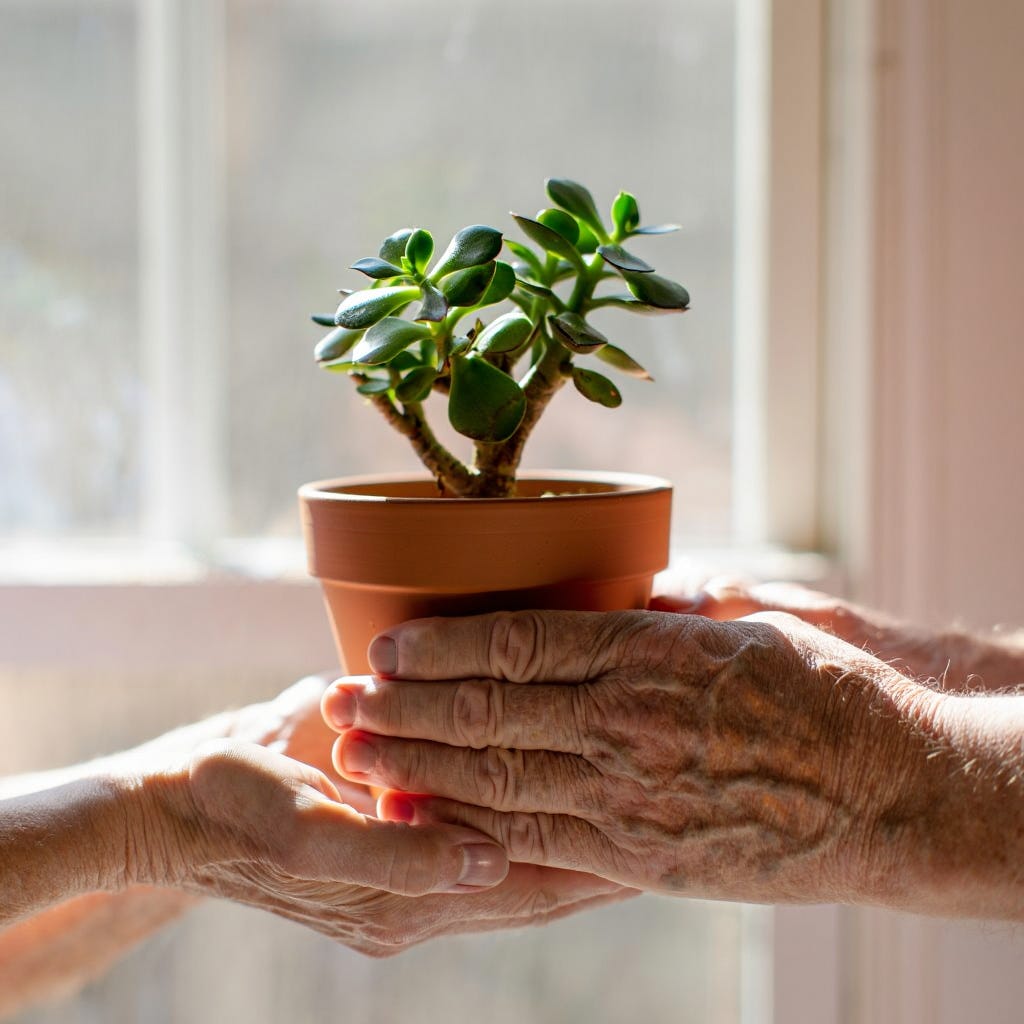
This morning I stood with one of my houseplants, pruning dead and dying leaves.
I was breathing with her. Speaking with her. Explaining what I was doing as I removed what had become dried and brown, what had served its purpose and now needed release. Then I watered her, still breathing together, still speaking.
Not as performance. As relationship. Who doesn’t know somebody who talks to houseplants as they are watered?
This is what breathing with means to me. Not a meditation technique borrowed from other traditions. Recognition of kinship with beings who literally create the air that keeps me alive.
She gives oxygen. I give carbon dioxide. We sustain each other.
Breath We Don’t Notice Until We Struggle
Something most breath practices don’t mention is that we breathe without awareness until breathing becomes difficult.
I know this personally. I have respiratory issues that make strenuous hiking challenging without preparation. On steep Camino ascents, every breath becomes conscious, deliberate, work.
When breath comes easily, we forget we’re doing it. The exchange happens automatically: lungs fill, lungs empty, oxygen in, carbon dioxide out. We’re part of an everlasting cycle we rarely acknowledge.
Then something changes. Altitude. Exertion. Illness. Suddenly breath demands attention.
Suddenly we remember we need air. That air comes from somewhere. That breathing is relationship, not just biology.
Most people don’t think about breath until they can’t catch it.
The Practice That Carries Religious Baggage
As an ordained Wild Guide developing this 13-Day EcoSpirituality Challenge, I’ve learned that sometimes when I invite people to focus on breath, some resist.
Not because they don’t want to breathe. Because breath practices feel Buddhist or Yogic to them.
If those traditions come with baggage, personal or cultural, focusing on breath can feel like crossing a boundary they’re not ready to cross. Like adopting someone else’s spiritual framework when they’re seeking their own.
I understand this. I respect it.
So when I teach breathing practice, I don’t frame it as meditation technique. I frame it as remembering kinship with plants and trees who make breathing possible.
This isn’t borrowed spirituality. This is ecological reality.
You breathe because plants exist. They breathe because you exist. This reciprocity predates all human spiritual traditions. It’s not Buddhist or Yogic or Christian or anything else.
It’s simply honest and true.
The Tree Before Cutting
Once I spent time with a tree who had to be cut down.
He was in a dangerous area on a hill and would surely fall and do significant damage in a storm. The decision was made. But before the cutting, I wanted time with him.
I stood close. Placed my hand on his bark. Breathed with him.
Not to save him. Not to change what was coming. To acknowledge what he’d given: decades of oxygen, shade, habitat for birds and squirrels, beauty through seasons.
To breathe with him one last time.
This is what forest bathing teaches. Not as relaxation technique, though it does relax. As practice of recognizing relationship with beings we usually treat as scenery.
I’m currently working on forest bathing certification because it connects so many aspects of my service as an EcoSpiritual Guide: walking practice, breath awareness, sensory attention, reciprocity with the more-than-human world.
When you breathe with a tree about to be cut down, you’re not doing a breathing exercise. You’re honoring kinship.
You’re saying: I see you. I receive what you’ve given. I witness your ending.
That tree taught me what “breathing with” actually means.
Scientific Reality Meets Spiritual Obligation
Scientifically, plants take in carbon dioxide and release oxygen through photosynthesis. We take in oxygen and release carbon dioxide through respiration.
This exchange has continued for millions of years. Every breath you take contains oxygen created by plants. Every breath you exhale feeds plants who need carbon dioxide.
From a scientific perspective, this is simply how it works.
From a spiritual perspective, this creates kinship, and kinship creates obligation.
Not guilt. Not debt. Obligation in the older sense: mutual responsibility within relationship.
If plants literally support your life’s breath, you have spiritual obligation to care for them. Not because it’s virtuous. Because relationship requires reciprocity.
You cannot breathe without plants. They cannot thrive without the carbon dioxide you exhale. This isn’t abstract interconnection philosophy.
This is the actual basis of continued life on Earth.
Breathing With My Houseplant
When I was pruning this morning, I wasn’t just removing dead leaves.
I was participating in relationship. Speaking with her. Explaining what I was doing. Thanking her for oxygen. Offering water in return.
Some people would call this strange. Talking to plants. Breathing intentionally with a houseplant during routine care.
But if this plant is creating oxygen I’m breathing right now, why wouldn’t I acknowledge that? Why wouldn’t I speak? Why wouldn’t I recognize the exchange?
She gives. I receive. I give. She receives.
This is breathing with instead of just breathing. Not as technique. As awareness of actual relationship.
When I guide others in contemplative practices, I use breath to situate people in reflective, peaceful space. To slow us down. To become open to new insights. To deepen into relationship.
But I’m not teaching them to breathe differently. I’m teaching them to notice they’re already in relationship with every plant around them.
Every breath proves it.
Your Practice Today
Here’s what I’m inviting you into: breathe with a plant or tree today.
Not as meditation. As recognition of kinship.
Step outside. Find a tree, a garden plant, even a houseplant if that’s what’s available. Stand close. Place your hand on bark or leaf if you want.
Breathe slowly for five minutes.
Notice: this being is creating oxygen you’re breathing right now. You’re exhaling carbon dioxide it needs. You are in intimate relationship with this life.
You don’t have to adopt any spiritual tradition to recognize this. You don’t have to become Buddhist or practice yoga or join any framework.
You just have to notice what’s already happening: mutual exchange. Reciprocity. Kinship.
Some traditions call this “breathing with” rather than just “breathing.” Spend time in this awareness of mutual exchange.
If breath practice has felt loaded for you, try it this way instead: as ecological recognition rather than spiritual technique. As acknowledgment of relationship rather than meditation method.
One participant in the challenge wrote about breathing with a maple tree in their yard and suddenly understanding why they feel grief when forests are cleared. Another noticed their houseplants differently after this practice, seeing them as living kin rather than pretty decoration.
I pruned dead leaves and remembered that care is part of kinship too.
What This Changes
I can’t teach breath practice the same way I used to.
I can’t separate technique from relationship. I can’t pretend breathing is just about calming your nervous system or counting inhales and exhales.
Breathing is the most intimate relationship you have with the plant world. Every moment of your life depends on this exchange.
The plants creating your oxygen right now deserve recognition. Acknowledgment. Care.
Not because it makes you more spiritual. Because kinship creates mutual obligation.
They support your life’s breath. You support theirs through care, through advocacy, through remembering they’re not scenery or resources.
They’re kin.
Tomorrow
Tomorrow, we meet a plant neighbor. But that practice will be deeper because today you remembered breath is already relationship.
For now, find a plant. Breathe together for five minutes.
Notice the exchange. Feel the kinship.
Recognize the spiritual obligation that comes with beings who literally support your life.
I’m developing a 13-Day EcoSpirituality Challenge and sharing what I’m learning here. Tomorrow: meeting a plant neighbor. If you’d like to practice along and be notified about the next step, consider subscribing for reflections on EcoSpirituality, sacred walking, and kinship with the more-than-human world.
What did breathing with a plant teach you today? I’d love to hear in the comments below.