

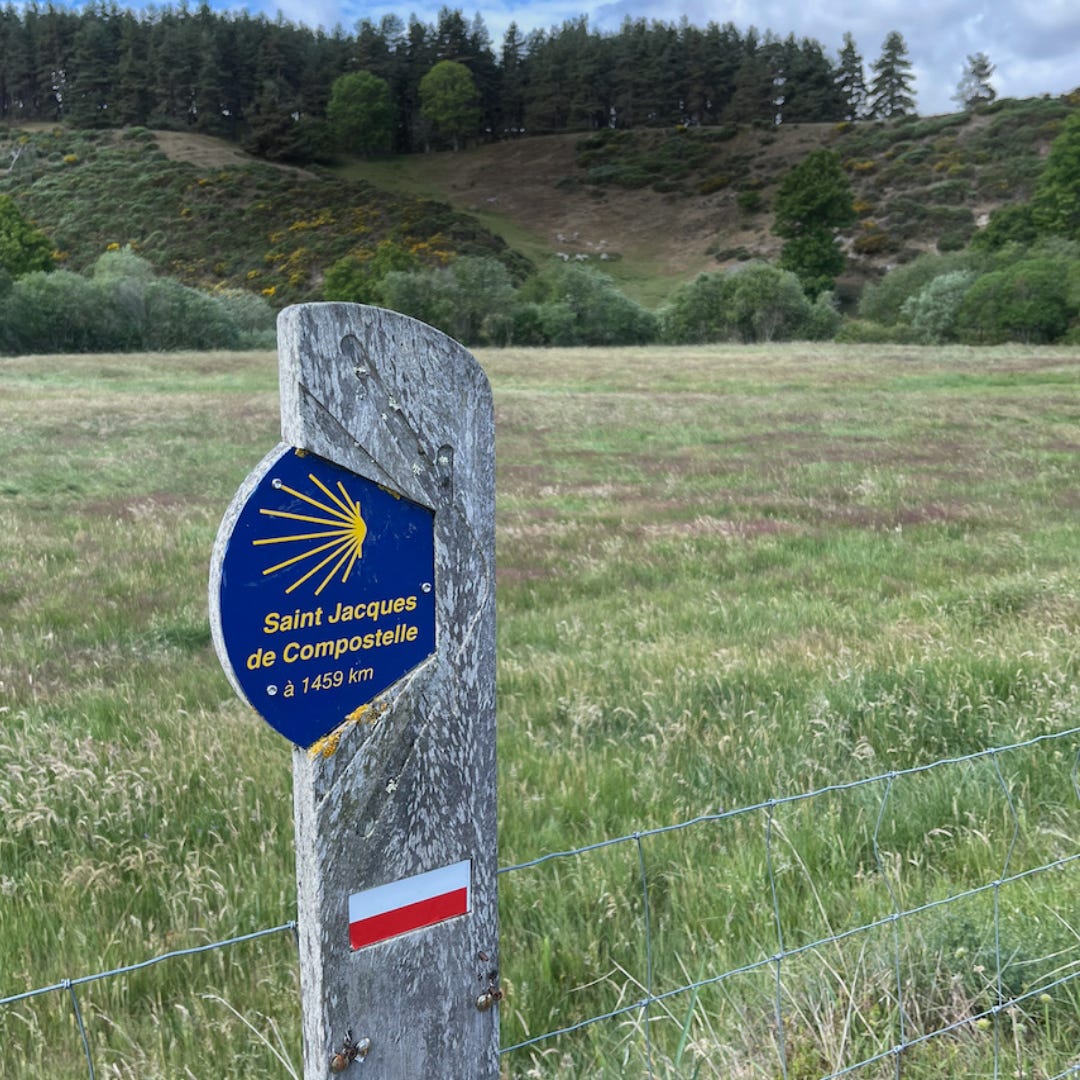
Every May, I disappear into rural France for seven days—and return as someone slightly different.
Not dramatically transformed. Not suddenly enlightened. Just... shifted. Like a photograph that's been adjusted by a few degrees, bringing hidden details into focus.
I've been walking sections of the Le Puy Camino route for four years now. Averaging ninety miles over seven days of walking, moving progressively along the same ancient path that medieval pilgrims traveled for over a thousand years. This path has been incorporated into the hiking trail system across Europe, the Grandes Randonnées (GR). Each May, I cover a different stretch of the GR65, from the volcanic plateaus around Le Puy-en-Velay to the Pyrenees.
I'm sharing this story now because we live in a culture obsessed with dramatic change, and I wanted to offer something different. Something that works for me. Something I think may also work for you.
We expect transformation to arrive like a lightning bolt—sudden, complete, elsewhere. But real change, the kind that actually lasts, happens differently.
The Myth of Dramatic Transformation
Modern culture sells us the fantasy that authentic change requires complete reinvention.
New job. New city. New relationship. New spiritual practice. New you!
We're told to disrupt everything, pivot constantly, optimize relentlessly. As a chaplain at New York University, I watch brilliant students exhaust themselves chasing the next breakthrough, the next level, the next version of themselves.
But what if the deepest changes happen not through constant motion, but through committed return?
After walking almost 400 miles of the Le Puy route across four years, I've learned that transformation isn't about escape—it's about coming home to who you actually are. The path doesn't change you by making you different.
It changes you by making you more yourself.
The path doesn't change you by making you different. It changes you by making you more yourself.
My first year ever on the Camino, which actually happened before I started walking in France, was different. I expected a dramatic revelation or an aha moment. I was carrying the weight of a career transition, a bucket list item to walk the Camino in Spain that I could not explain, and that familiar modern anxiety of not being where I was "supposed" to be at this stage of life. I thought seven days of walking would deliver answers wrapped in mystical experience.
Instead, I got blisters, frustrations with the crowds of pilgrims endlessly talking and making noise, along with the slow recognition that I'd been asking the wrong questions entirely.
The Medicine of Rural Silence
Having initially walked the path in Spain and remaining unfulfilled, I felt called to try something different. I moved upstream, so to speak, to the Camino in France. In this, I discovered that the French countryside in late May offers something increasingly rare: genuine quiet.
Not the forced silence of a stationary meditation retreat or the artificial peace of wellness centers. This is organic silence—the kind that emerges when you walk for hours through rolling farmland, past ancient stone villages where the only sounds are cowbells across valleys and your own footsteps on thousand-year-old paths.
As an Educational Consultant and EcoSpiritual Guide, I've studied various contemplative practices. But nothing compares to the reset that happens when you spend seven consecutive days moving through the landscape at a walking pace. The nervous system downshifts. The mind stops generating its endless commentary. The endless pings on the phone stop demanding my attention. The siren of social media ceases to direct me toward its own ends.
You begin to hear what's been buried under digital noise. You begin to regain personhood with the self and kinship with the natural work.
The Le Puy route passes through some of France's most beautiful rural terrain. Volcanic hills covered in dense forest. Limestone plateaus dotted with medieval churches. Fields of sunflowers and wheat stretch toward horizons unbroken by urban sprawl. In May, everything is green and blooming, and that excitement of new life is contagious.
This beauty isn't decorative. It's functional. After walking through the countryside for three or four days, something shifts in your relationship with time, with your own thoughts, with what actually matters. The landscape performs a kind of spiritual surgery, cutting away what's artificial and reconnecting you with what's essential.
Perhaps it also infuses us with energy and a sense of kinship with all of life.
Medieval pilgrims understood this. They knew that certain places, traversed at certain speeds, in certain states of receptivity, could facilitate a transformation that no amount of reading or thinking could accomplish. Their destination was the Spanish city of Santiago de Compostella and the forgiveness of sins, while many modern pilgrims, myself included, know that the healing comes through the journey itself.
The Path That Knows You
Each year, I walk a different section of the same route.
Year by year, different sections revealed different truths. The misty Aubrac plateau taught me about spiritual depth I'd been avoiding. The medieval village of Conques, with its ancient abbey and steep cobblestone streets, showed me the power of returning to what's sacred. The Célé Valley, carved deep between limestone cliffs and dotted with hidden monasteries, helped me understand the difference between solitude and loneliness.
The path recognizes you before you recognize yourself.
Walking creates a unique state of consciousness—alert but relaxed, moving but present. After repeated years of 90-mile walking weeks spread across seven days, patterns become visible that remain hidden in ordinary life. You notice which thoughts repeat under stress. You see how your body holds anxiety. You recognize the difference between fatigue and resistance, between thinking and clearing the mind.
These weren't dramatic revelations. They were quiet recognitions, the way you might notice the exact moment dawn becomes morning.
But they stayed with me in ways that more dramatic insights never had.
The Le Puy route has been teaching this for over a millennium. Every generation of pilgrims has walked these paths carrying their own questions, their own weights, their own need for clarity. The stones remember all of it. The streams cleanse our heavy weights away. The landscape holds space for whatever you bring.
Getting Back to Yourself
The most profound change isn't becoming someone new—it's returning to who you actually are beneath layers of social conditioning and digital distraction.
Walking strips away what's unnecessary. What remains isn't a new version of yourself, it’s who you were before the world told you who to be.
After days of carrying everything you need on your back, covering many miles each day, sleeping in simple gîtes and chambres d'hôtes, eating basic food, you remember what your body actually requires versus what culture tells you it should want. You reconnect with natural rhythms—sunrise, fatigue, hunger, rest—that have been organizing all life for millennia.
In late spring, the French countryside mirrors this process of natural emergence. Everything is growing without forcing, blooming without striving. The vineyards are thick with new leaves. Wild roses climb stone walls that have stood for centuries. Rivers run clear and full from winter snow.
There's profound medicine in witnessing this kind of organic unfolding while you're walking at the pace your ancestors walked, carrying what you need, depending on your own physical capacity to move you forward. It calibrates something essential that modern life systematically disrupts.
By day four or five, I always reach the same realization: I don’t need to become someone else or live up to another’s vision of who I should be.
I need to remember who I am when I'm not performing, not optimizing, not trying to be anywhere other than exactly where I am. This isn't spiritual bypassing or naive contentment. It's the deep rest that comes from stopping the exhausting project of self-improvement long enough to discover what remains when you're not working on yourself.
The Return That Changes Everything
I'm sharing this story now because many people are navigating periods of uncertainty and change.
The cultural message is always the same: change your circumstances, change your location, change your approach. But what if the most transformational thing you could do is commit more deeply to something that already calls you?
The Le Puy Camino has taught me that real change happens through return, not escape. Going deeper into what you know serves you rather than constantly seeking new strategies, new practices, new versions of yourself.
After four years of walking the same path, I'm not the same person who started this practice. But I haven't become someone else. I've become more fully myself.
I am the one who embraces contemplative walking as a spiritual practice—weaving ancestral wisdom with the Sacred Wild to guide seekers through pilgrimage and silence.
The ancient route strips away what's unnecessary and reveals what remains. It teaches the difference between motion and movement, between change and transformation, between seeking and finding.
If you've been exhausting yourself trying to change everything at once, perhaps the answer isn't another dramatic pivot. Perhaps it's finding your path—the practice, the place, the rhythm that helps you return to yourself—and walking it long enough to let it change you.
🌿 Thank you for reading Where Insight Meets Earth. If this spoke to you, I'd love for you to share it with someone who might need permission to stop running from themselves.
If you'd like to keep walking with me, subscribe to receive future reflections on pilgrimage, eco-spirituality, and kinship with the more-than-human world.
For those called to experience the transformative power of the Le Puy route of the Camino de Santiago, I will be offering a small-group contemplative walking retreat in May of 2026. Learn more about walking this ancient path with an ordained Wild Guide at Walking Through Nature.