

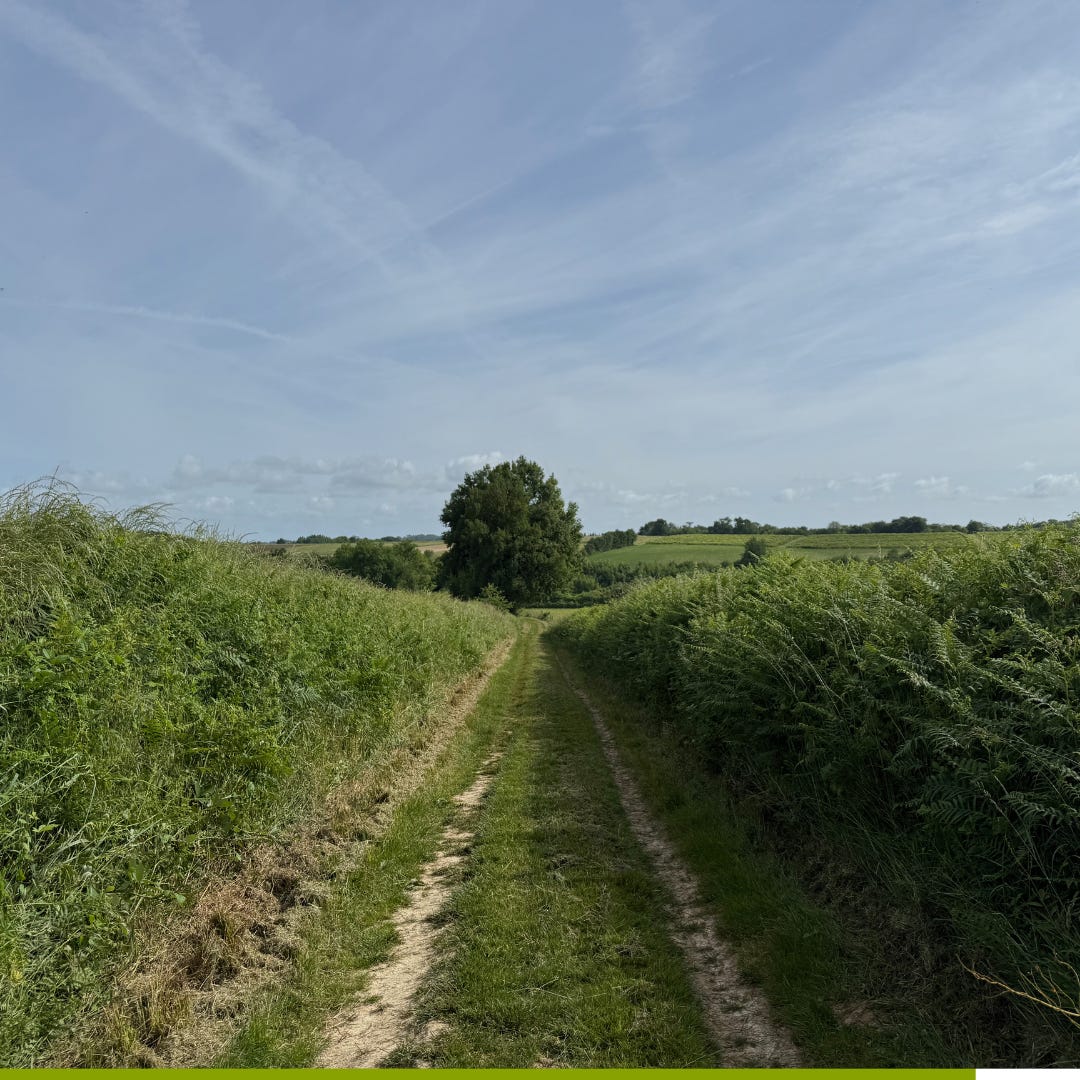
On my first Camino de Santiago pilgrimage, I believed long-distance walking would change me through sheer mileage. I tracked numbers, marked stages, and tried to outpace my doubts. The expectation was simple: walk far enough and insight would arrive.
At least that is what many guidebooks seemed to suggest, outwardly.
Five Caminos later—through France, Spain, and again this summer, finishing the Le Puy route into Saint-Jean-Pied-de-Port—I’ve learned what distance cannot teach.
It isn’t the distance that changes you. It’s the way you walk it.
Why Distance Isn’t the Point in Long-Distance Walking
A predawn start once led me out of a small village beneath a sky still thin with stars. The fields held the last breath of night. I walked alone, not to prove anything, but because silence felt like the right companion.
Miles (or kilometers, as this was in Europe) stopped mattering that morning. Without calculating pace or scanning for the next café, attention widened. The curve of the trail, the scent of warming earth, the birds stitching sound through hedgerows—everything sharpened. The walk felt less like travel and more like inhabiting the moment.
It was one of many small awakenings that helped shift my mindset on annual pilgrimage walks.
Maps can measure the ground covered. They cannot measure attention.
The deepest walk I’ve taken wasn’t the longest. It was the moment I finally paid attention.
How Repetition Reveals More on Pilgrimage
Step after step can sound like monotony. At first, it was. My mind fidgeted, my body resisted, and the old urge to “get somewhere” tried to set the pace.
Something softened when repetition became prayer. This is how I worked through, tried on, and finally memorized my personal rule of life. I remember when this began to happen along the rural and quiet paths toward Pimbo, a tiny ancient village between Miramont-Sensacq and Fichous-Riumayou (my destination that night).
Panting as I climbed across cattle paths and between fields, I felt momentarily one with the walk. The hike turned mystical. Gravel underfoot, wind across wheat being harvested, and breath syncing with my stride: the ordinary grew radiant.
Movement did not erase stillness. Movement made stillness possible.
Walking Without Performance: A Pilgrim’s Shift
I have raced to finish before the sun grew hot. I have pushed to keep up with faster companions (namely, everyone!). Quick days are not wrong. They simply do not tell the whole story.
If anything, quick days miss the point. Learning happens through the repetition of walking, not in achieving the destination.
The idea of performance once shaped my walking. Pace, metrics, “making good time”—all of it formed a quiet competition with myself. The Camino did not ask for that. The path never cared how fast or how far I went.
The faster I moved, the less I appreciated the birds, babbling brooks, cowbells, or the scent of wild roses along the way.
Permission to stop tracking changed the quality of presence. Pauses arrived more often: trees inviting rest beneath their branches, ancient springs offering cool water from deep in the earth, cloud patterns shifting as if only for me. The counters and maps on my phone stopped setting the rhythm. The land did.
Walking ceased being a means to an end. It became a place to meet myself.
Mindful Walking at Home: Pilgrimage Without a Plane Ticket
Not everyone can fly to France or Spain. Pilgrimage has never been a location anyway. Pilgrimage is a way of walking.
I have found the same depth on a wooded loop near home or an evening circuit around the block. The difference sits inside attention. When I return to a familiar path with a quieter mind, it reveals itself again—moss brighter, shadows more articulate, breath more honest.
You do not need more miles to enter this. You need mindful walking where you already live.
This is the core of walking as a spiritual practice.
Presence reshapes the journey; miles only measure it.
Not the End, Just the Next Step
There is a silence that arrives after many miles. Not absence, but presence. Layers loosen: urgency, self-critique, the impulse to optimize. Underneath waits a steadier rhythm that belongs to the land more than to any schedule.
Pilgrimage has never been a grand escape for me. It has never been about something external; as I choose to do it, its repetition has shifted and enriched my life.
It is a slow remembering—a return to relationship with the ground, with breath, with the unhurried strength of attention. The path has never asked me to prove anything—only to show up. I am then able to learn along the way without the ordinary distractions of work or responsibility. This is why I liken long-distance walking or pilgrimage to an active retreat.
One step. Then another. No arrival required.
Something to Walk With This Week
Here are a few prompts to consider—for journaling, mantra creation, or a brief pause between tasks:
Which path—literal or interior—asks to be walked more slowly right now?
What might shift if you stopped tracking progress and started noticing presence?
Could a walk you take this week become more than exercise?
I’d love to hear what opens for you. I always read and respond. 🌿
If this resonated, consider sharing it with someone who’s walking their own path right now.
If you’d like to keep walking with me, subscribe for weekly reflections on pilgrimage and eco-spirituality—mindful walking, seasonal rhythms, and the sacred ties between people and place—rooted in the Camino way of living: presence, attention, and deeper belonging with the living Earth.
I've felt this when I did a solo pilgrimage in New Mexico a few years ago. It changed me in ways I'm still figuring out and working through. I want so badly to do the Camino before I'm too old! Next September is my goal. I think I'll take the route that starts in France...... Thanks for writing this.
I love this. Walking has been my spiritual practice for almost 40 years. I love that moment when trees stand out from the background and sparkle with stillness, solidity, presence. If I'm walking now, and the world stays flat, I can ask for the shift: Please come. It loves to be invited. Often, I'll start by singing something chanty. Dona Noblis Pachem, or something similar, but TV commercials work, too. When I'm singing, I'm not thinking. I've always wanted to walk the Santiago or the Appalachian Trail. But the park down the hill shines with tranquility most days.