

After three years of guiding people through spiritual crises at New York University (NYU), I've learned that most of what we call anxiety is actually a nervous system crying out for the one thing our ancestors knew instinctively—sacred interruptions.
As a Chaplain at NYU who's walked the Camino five times, I've discovered something that will change how you think about managing stress. The same students who couldn't sit still for a 10-minute meditation could walk mindfully for hours, their nervous systems naturally settling into what neuroscientists call the "rest and digest" state. My PhD in educational research has helped me confirm what I'd observed: the path to peace isn't sitting still in a chaotic world—it's moving consciously through it.
Here are three practices that will reset your nervous system in under 20 minutes, backed by cutting-edge research published just this month.
Why Movement Works When Meditation Fails
Before I give you the practices, you need to understand why they work.
Traditional meditation advice tells you to sit still and empty your mind. Think of nothing, except your breath, and let everything else go. For most people dealing with chronic stress, this feels impossible. Your racing thoughts don't magically disappear because you closed your eyes. In fact, sitting still often makes the mental chatter louder.
There's a scientific reason why stillness fails when you're overwhelmed.
What the Latest Research Actually Shows
A fascinating new study published this month in Frontiers in Psychology directly tested what I've observed through years of guiding stressed individuals.
Researchers at Daegu Catholic University compared static meditation (sitting) with kinetic meditation (movement) in 35 novice meditators, measuring both their subjective experiences and objective nervous system responses. These weren't experienced meditators—they were people just like you who had previously found meditation "inaccessible or impractical." The results validate everything I've learned from walking ancient pilgrimage routes and guiding overwhelmed students.
Here's what they discovered that changes everything:
Finding #1: Movement Beats Stillness for Focus
The study found that "focused attention was significantly higher in kinetic meditation than in static meditation." This validates why my students who couldn't meditate sitting down could walk mindfully for hours. Your nervous system actually focuses better when your body is gently moving.
Finding #2: Sitting Meditation Makes You Drowsy
"Static meditation induced significantly more drowsiness than kinetic meditation, with unguided static meditation causing the highest level of drowsiness." This explains why so many people fall asleep during traditional meditation and then think they're "bad at it." You're not broken—the method just doesn't match how stressed nervous systems actually function.
Finding #3: Movement Provides Natural Focus
The researchers discovered that "movement provides a natural attentional anchor—such as proprioceptive or bodily sensations—that supports sustained engagement with reduced cognitive effort." Translation: your body becomes your meditation teacher, giving your mind something concrete to focus on instead of trying to focus on "nothing."
Finding #4: Perfect for Beginners
Most importantly for those who've struggled with meditation: "For novice meditators—especially those who initially perceive meditation as inaccessible or impractical—movement-based meditation with clear guidance may serve as an effective entry point."
The Nervous System Connection
The study measured heart rate variability (HRV), which "reflects the time variability between heartbeats and is linked to vagus nerve activity, a key component of the parasympathetic nervous system." Higher HRV indicates better stress recovery—and movement-based practices naturally optimize this without requiring years of training.
This research validates what medieval pilgrims knew instinctively: when your nervous system is overwhelmed, the solution isn't to sit still—it's to move with intention. No wonder the ancient adage solvitur ambulando, it is solved by walking, has so much more value today when it is so desperately needed.
Ready to try what actually works?
Practice 1: The Sacred Pause (2-3 Minutes)
When to use: The moment you feel your nervous system activating—racing thoughts, physical tension, that familiar overwhelm.
Step 1: Stop what you're doing and step outside immediately.
Don't think about it—just move toward the nearest door or window. The research shows that "for novice meditators, movement-based meditation with clear guidance may serve as an effective entry point." This practice gives your overwhelmed nervous system exactly what it needs—a physical anchor that requires no special skill or training.
Can’t get outside? Face a window instead to connect you to the energies in the living world
Step 2: Feel your feet making contact with the ground.
This isn't metaphorical—you're literally grounding your nervous system through physical sensation. The study found that movement provides "proprioceptive or bodily sensations" that naturally support focus.
Step 3: Take five conscious steps forward.
With each step, mentally say: "I am here. I am present. I am safe."
Step 4: Stop and take three deep breaths, noticing how your chest feels different than when you started.
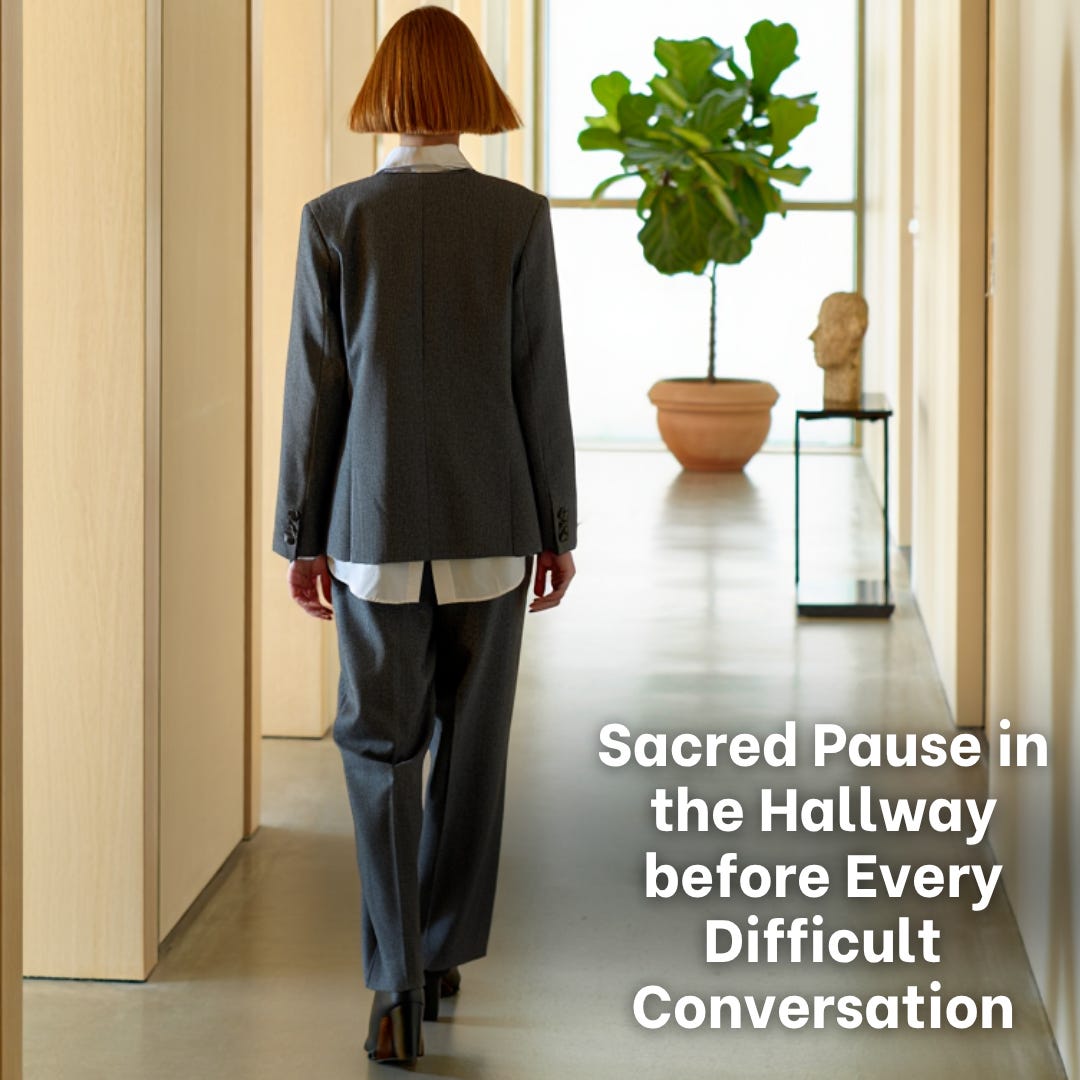
Real-world example: I taught this to a nonprofit executive director who was having panic attacks during board meetings. Now she takes a "sacred pause" in the hallway before every difficult conversation. She reports feeling 80% calmer within three minutes.
Practice 2: Threshold Breathing (5-10 Minutes)
When to use: When you need a deeper reset—during lunch breaks, between meetings, or when transitioning from work to home.
Step 1: Find any threshold—a doorway, bridge, path entrance, or even the entrance to your building.
Step 2: Stand at the threshold for 30 seconds.
Breathe in your current state (stress, overwhelm, fatigue) without trying to change it. The research found that "kinetic meditation may be easier to self-administer for novices, likely because bodily movement provides a natural attentional anchor that reduces cognitive ambiguity."
Step 3: Breathe out with peaceful confidence, trusting in your inner wisdom to guide you through whatever lies ahead.
Step 4: Cross the threshold slowly and mindfully, imagining you're leaving your activated nervous system state behind.
Step 5: Walk for 5-10 minutes at a pace that feels sustainable, focusing on the rhythm of your feet touching the ground.
You're literally walking yourself into a different nervous system state.
Real-world example: A nurse practitioner uses this between patient visits. She crosses the threshold of each room mindfully, leaving the previous patient's energy behind and arriving present for the next person. Her stress levels dropped 60% within two weeks. Guess what this did to how she showed up to new patients?
Practice 3: Ancestral Grounding (15-20 Minutes)
When to use: When you need a deep nervous system reset—end of difficult days, before important decisions, or when feeling disconnected from your purpose.
Step 1: Choose a walking route—around your neighborhood, in a park, or even in a large building.
Step 2: Begin walking slowly, imagining you're following the footsteps of all who've walked this ground before you.
With each step, mentally connect to the great lineage of humans who have used walking as a path to wisdom—pilgrims, seekers, ancestors who faced their own versions of overwhelm. Let their accumulated knowledge support your nervous system's return to calm. Feel how the earth has held countless people just like you who needed peace.
Step 3: End by standing still for one minute, noticing how your body feels different than when you started.
This practice accesses what researchers call "co-regulation"—borrowing stability from sources outside your individual nervous system. The research shows that "focused attention was significantly higher in kinetic meditation than in static meditation," and this practice maximizes that benefit through conscious connection.
Real-world example: A teacher uses this after school every day, walking the same path while imagining all the educators who've walked before her. She says it transforms her from "depleted" to "renewed" in 15 minutes, allowing her to be present with her own family.
Your Daily Sacred Interruption Rhythm
Here's how to integrate all three practices into your routine:
Morning: Use the Sacred Pause before entering your workspace to set a calm tone for the day. Midday: Practice Threshold Breathing during lunch or between major tasks to reset your nervous system. Evening: End with Ancestral Grounding to transition from work energy to home energy.
Emergency Protocol: When stress spikes unexpectedly, immediately deploy the Sacred Pause, then follow with Threshold Breathing if you have time.
Weekend Reset: Use a longer Ancestral Grounding walk (30-45 minutes) to deeply restore your nervous system for the week ahead.
What to Expect
Initially: You'll notice immediate relief during the practices, though the effect may feel temporary at first.
As you continue: Your nervous system will begin anticipating these rhythms, and you may find yourself naturally craving these moments of reset. The practices start feeling less like something you "should do" and more like something your body genuinely wants.
With consistent practice: The sacred interruptions become automatic responses to stress, and you'll likely notice your overall baseline shifting toward calm. Others may begin commenting that you seem more present, centered, or grounded—changes that happen so gradually you might not notice them yourself.
Remember: The research shows that "unguided static meditation resulted in the highest level of drowsiness," which is why these movement-based practices work where sitting meditation fails.
Your nervous system isn't broken—it just needs rhythm, not stillness. Silent, static meditation works for many people, though I was never one of them.
I bet you weren’t, either.
Start Today
Your nervous system has been waiting for this invitation.
Choose one practice and try it right now. Don't wait for the perfect moment or the right conditions. The research proves that "movement-based meditation with clear guidance may serve as an effective entry point," and these practices require no special equipment, location, or experience.
Step outside. Find a threshold. Remember that your feet know the way to peace, even when your mind has forgotten.
The ancient paths are calling. Your nervous system is listening.
Which sacred interruption will you try first?
Jeffrey Keefer is an Ordained Wild Guide, Chaplain at NYU, and Professor of Research Methodology who has walked the Camino five times. His book "Walking a Threshold" offers 45 days of contemplative prompts for pilgrims and wanderers. If you're ready to explore these practices more deeply, I'm developing a comprehensive contemplative walking retreat on the Le Puy Camino route. Subscribe for weekly practical guidance on integrating ancient wisdom with modern life.
P.S.: After you try one of these practices, I'd love to hear about your experience. Your nervous system's wisdom is unique, and your insights help me refine these teachings for others walking this path.