

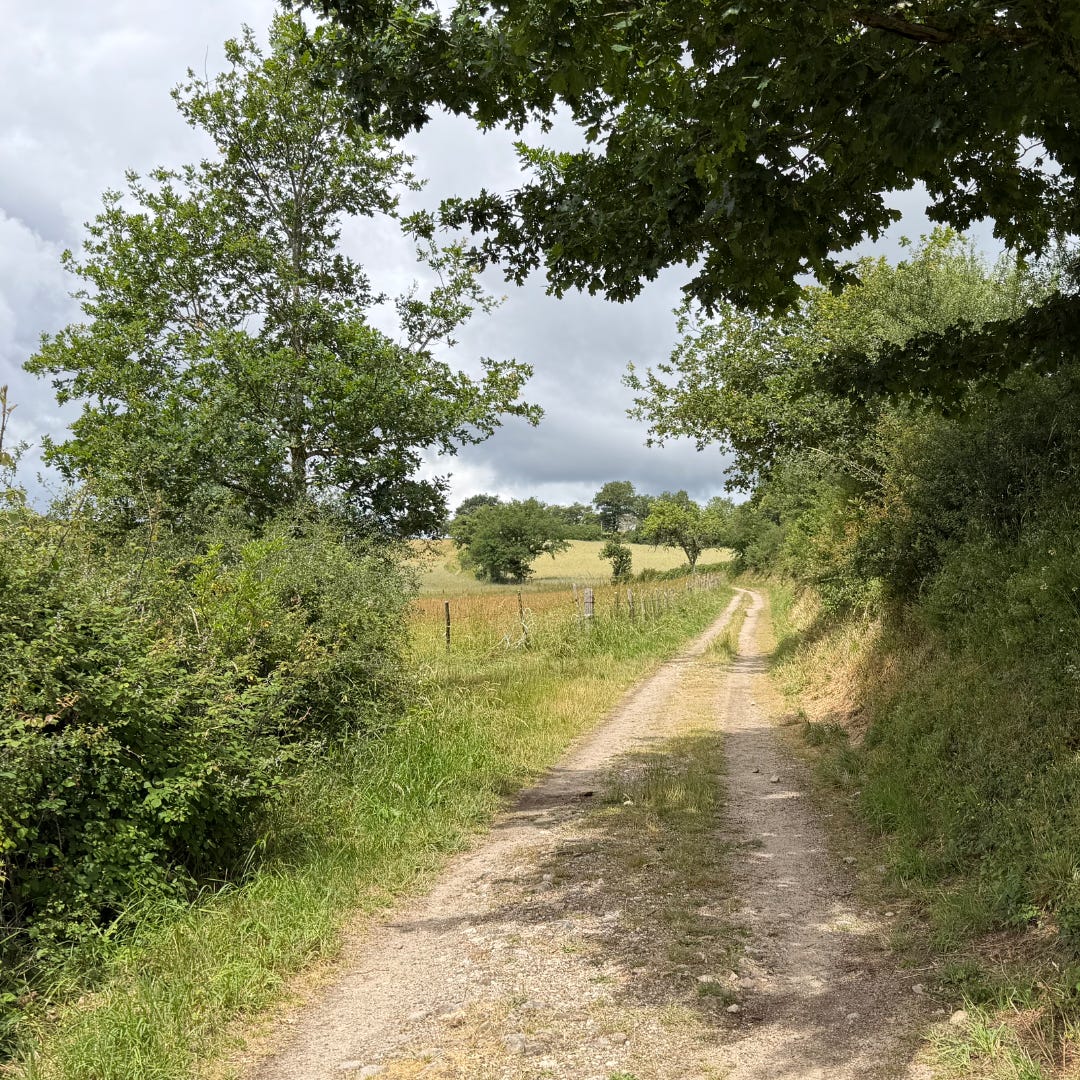
I walked 98.9 miles across southern France in June and never meditated once.
At least, I never meditated the way the instruction books mean it. Classical walking meditation asks you to rest your attention on the soles of your feet, on your breath, on the lifting and settling of each step. I practiced that way for years, and it kept me sealed inside my own head while the living world went on around me, unmet.
For years, I felt something real happening on those walks and had no words for it. I had also absorbed the rule most of us are handed: that meditation, done right, means stillness, silence, and solitude, and that anything else is a lesser substitute, a beginner’s compromise on the way to the cushion. By that rule, whatever I was doing on the trail did not count. What follows is the language I finally found and how I earned it.
The Direction Nobody Asks About
Most conversations about meditation focus on posture and place.
Seated or moving, cushion or trail, indoors or out. The more useful question is one I rarely hear asked: which direction is your attention pointed? Seated meditation turns attention inward, in stillness. Walking meditation, as usually taught, turns attention inward while moving. The feet become an anchor, the path becomes background, and the practice remains a private event that happens to occur outdoors. A person can walk a forest trail this way for an hour and never actually meet the forest.
Contemplative walking reverses the direction. The silence is the same. The direction is different.
The old rule had it partly right. The silence is essential, and I keep it for hours at a stretch. What the rule mistook was the rest: the stillness and the solitude were never the point, only the container one tradition used. Walking keeps the silence and trades the container, and nothing about the practice becomes lesser for moving through a field rather than sitting in a room.
Two Definitions, Six Years in the Making
I want to give you the definitions as I now hold them and be honest about how long they took.
For years, I practiced without words for what I was doing. I knew it was not walking meditation as the books taught it, and I knew it was not hiking with a spiritual mood attached, but when people asked what I did on the Camino, I reached for other people’s language and felt it miss. The words arrived slowly, tested against hundreds of miles, revised after each summer, and they only settled into their current form this year, in time to be said aloud last week to a gathering in The EcoSystem community of the Wild Church Network and the Center for Wild Spirituality, the community where I trained and was ordained.
Here is the first, the practice itself:
Contemplative Walking is walking slowly, in silence, with attention given to the living world. Silence is not withdrawal. It is how we become quiet enough to be met.
Every word earned its place. Slowly, because the pace is the door, and hurry seals it. In silence, because the narrating mind blocks the meeting, and this took me the longest to learn, since I resisted the idea that my own commentary was the obstacle. Attention given, rather than paid, because giving is a gift and paying is a transaction, and the living world is owed the former. The second half, about silence, is the correction I most needed: for years I treated silence as going without, a discipline of subtraction. It is the opposite. It is preparation for company.
Here is the second, the larger claim:
Walking as a Spiritual Practice. The walking itself is the practice. Not the road to somewhere sacred. The sacred is underfoot. We do not walk alone. What we carry, we carry in the company of kin.
This one distinguishes what I do from the two things it is most often mistaken for. Pilgrimage, as usually imagined, treats walking as transit, the holy thing waiting at the far end. Exercise with reflection added treats walking as a container; the body is busy while the mind does the real work. Both make walking instrumental. My claim, and it took all six Caminos to trust it, is that the walking is the encounter, the sacred met stride by stride, and the company of the living world is present the whole way, whether we are quiet enough to notice or too loud to be reached.
When I presented both definitions to the gathering last week, the room did something I did not expect. They took the words further than I had.
What the Old Monks Knew
This distinction is older than it sounds.
The Christian monastic tradition separated meditatio from contemplatio. Meditatio is the active, discursive work, the mind chewing and turning over. Contemplatio is receptive beholding, being with, being met. Most modern meditation, seated or walking, is meditatio in new clothes. What I practice on the Camino is closer to the old contemplatio, and the whole body does it: the rhythm of steps, the breath, the fatigue, the weather on the skin. Hour after hour, the planning mind quiets, and we open to wonder.
This history matters because it means the practice carries a lineage. If something real has been happening on your walks, you have been practicing a mode of contemplation that the monasteries named a thousand years ago, and the rule most of us inherited, stillness or nothing, kept only half of what the tradition actually held. Contemplative walking recovers the other half and gives it back to the body and the Land.
One Being at a Time
Here is what the practice keeps teaching me, and what the gathering seized on most.
Attention on a contemplative walk is never drawn to the landscape in general. It is drawn to a singular being. This tree, not the forest. This cow, not the herd. This moss on this stone. On the June walk, the Land offered itself back exactly that way, one being at a time: a cow in a field of flowers who [met my eyes and held them], two frogs in a pond outside Espalion whose [calling pulled me off the path], a stream that [asked nothing of me at all], a full day of rain that became [one of the fullest days of the week].
None of that was scenery. Each was a meeting, and each required silence first, since a mind still narrating cannot be interrupted by a frog.
When I described this to the gathering, the room named something I had been circling for years without saying plainly: the agency runs both ways. The walker does not only pay attention. The Land calls out. The cow turned her head first. The frogs raised their voices. The initiative so often belongs to the living world, and the practice is mostly a matter of becoming quiet enough to be reachable.
Any Path Will Do
You do not need a route across France.
The practice travels in three movements, and they fit the path outside your own door. Walk slower than feels natural. Turn attention outward, toward one living being. Let silence do the work. That is the whole method. The sidewalk maple, the crow on the wire, the weed in the fence line are all kin, all capable of the meeting, and the only equipment is a pace and a quiet you choose.
If meditation has ever left you feeling sealed inside your own head, or if you set it aside years ago because stillness never fit you, the practice may simply have been pointed in the wrong direction. Turn it around. The living world has been waiting on the other side of the silence.
What walk, or pilgrimage, has stayed with you, and why? I would be glad to hear about it in the comments.
If you find this useful, please like or leave a comment.
The Rewilding the Soul EcoSpirituality Certificate at Cherry Hill Seminary, where I teach, is currently underway with this year’s cohort. The September 2026 Contemplative Walking Retreat I am leading on this same section of the Le Puy Camino is full. New offerings, including future retreats and additional teaching opportunities, will be announced here in the months ahead. For now, the practice itself is what matters most, and it is available to you wherever you are walking this week.
Where Insight Meets Earth is a reader-supported publication. To receive new posts and support my work, consider becoming a free or paid subscriber.
I have also walked many Camino’s, and I genuinely approached each as a pilgrimage. I have also walked several non-pilgrimage trails - Italy and England coast to coast and Stevenson in France, and they are quite different experiences. My first Camino was a life changing experience but France was special. I titled my stories about the Le Puy route “Walking the Magical Mystery Tour in France.” They were all hard work and gave me remarkable friendships and experiences.
Loved this.
And it doesn’t help that ‘contemplatio’ makes English speakers think of the word ‘contemplation,’ which adds to the confusion between ‘meditatio’ and ‘contemplatio’…