

If you find this useful, please like or leave a comment.
Spring is not about you. It never was.
The maple outside the window has been opening its leaves for two weeks now. The pace is not metaphorical. The leaves are not unfurling in order to teach anyone anything. They are doing what maples do in May, which is a long and specific kind of work involving sugar, water, light, and a hundred small calibrations against frost and wind.
Around the same time, my inbox filled with newsletters explaining what spring means for my personal growth. Bloom where you are planted. Shed what no longer serves you. Plant the seeds of who you are becoming. The language is so widespread by mid-May that it has the quality of weather. You walk through it whether or not you asked to.
The dissonance you may have felt this month is not precious or oversensitive. It is accurate. Something happening outside your window is being conscripted into a story about you, and the conscription is so casual that even careful spiritual writing does it without flinching. Spring becomes the season everyone agrees to use as a self-help framework. The maple is not consulted. The relationship runs one way, and one-way relationships, in nature as in everything else, do not deepen over time.
The grammar of who the season belongs to
Robin Wall Kimmerer writes about the grammar of animacy, the way our language defaults to treating other species as objects rather than as persons. The default carries into how we write about seasons. Spring becomes a backdrop, a metaphor source, a feeling I have, a lesson I extract. The actual beings doing the work of spring disappear into the scenery.
A different grammar is available. It begins with a question I have been asking myself this May: Who is spring actually for?
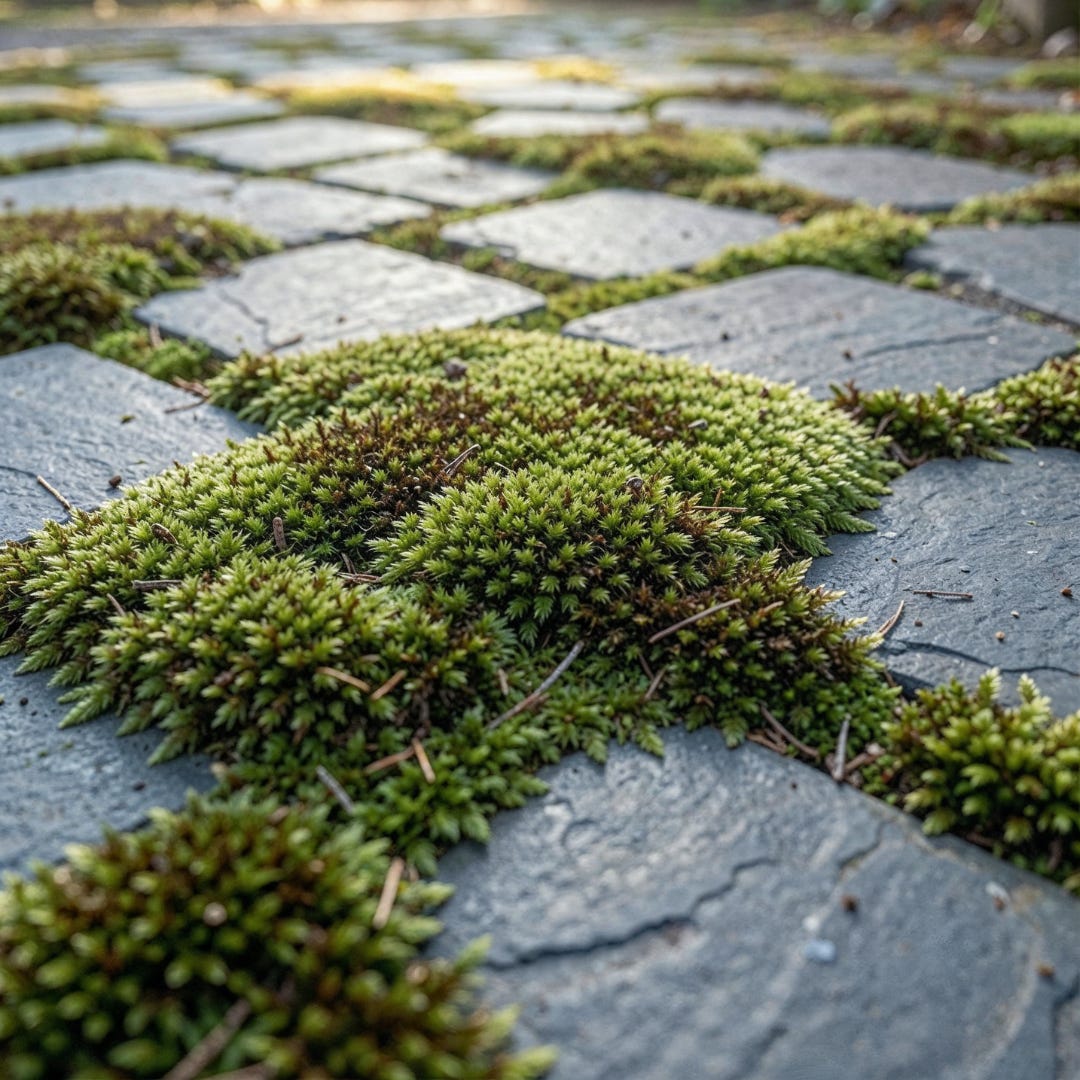
The answer is specific and humbling. Spring is for the maple, which is spending enormous metabolic resources to grow this year’s leaves. Spring is for the goldfinches who are eating dandelion seeds that the lawn care industry has spent decades teaching us to poison. Spring is for the moss on the north side of the pavers on the walkway, which is doing its slow patient photosynthesis in the cool damp before summer arrives. Spring is for the bees, who are working from the moment the temperature crosses some threshold none of us can feel. Spring is for ten thousand beings within a hundred yards of wherever you are sitting.
You are welcome to witness it. You are not the audience.
What changes when you stop extracting
Most spring-metaphor language operates like a vending machine. The reader watches the season, takes what it offers, and walks away with insight. The season is treated as a source of personal meaning to be mined.
If you have been doing ecospiritual practice for any length of time, you already know the limit of that arrangement. It does not deepen. It produces the same lessons every May, slightly rephrased. The bloom-where-you-are-planted reader in 2024 receives the same content in 2026.
Another practice is available, and it is the same one the Earth Journaling piece pointed to. You stop asking the season what it has for you. You start asking what the season is doing.
Try it this week with one being. One maple, one patch of clover, one specific bird who is currently in your yard, your park, or the median strip of the street where you live. Watch what that being is actually doing right now in mid-May. Not what it represents. Not what it teaches. What it is doing. Where it puts its energy. What it has not yet started doing that you can predict will arrive in the next two weeks. What it has finished that was happening three weeks ago.
The consequences of this shift are larger than the size of the shift would suggest.
The reciprocity that becomes available
When you stop using spring as a mirror, something else becomes possible. You begin to notice that the maple has been here a long time. That this particular goldfinch is part of a population that has nested in this particular place for generations. That the soil under your feet is older than every spiritual tradition any of us has read.
You begin to register, faintly at first, that the relationship runs both ways. The maple is not noticing you the way you are noticing it. The reciprocity is not symmetrical. The maple is, however, part of an ecosystem you are also part of, and your attention is one of the few offerings you can make that costs the maple nothing.
This is what my Gaulish hearth repeatedly points me back to. The land is kin. Not metaphor kin. Not as if kin. Kin in the older sense, where you have obligations to a being you did not choose and cannot fully understand.
Spring is not about you because spring is about everyone. Including the maple. Including the goldfinch. Including the moss.
You happen to be present for it. That is already a remarkable inheritance.
One small invitation
This week, before you read another newsletter telling you what spring means for your inner work, go outside.
Find one being. Watch what that being is doing for fifteen minutes. Even five minutes if life is too busy. Do not journal yet. Do not extract a lesson. Do not turn it into a metaphor for your own becoming. Just watch.
If you have a sit spot, return to it. If you do not, the bench in your park works, or the patch outside your front door, or the tree you pass on your commute. Specificity matters more than location.
Notice what is happening that has nothing to do with you.
That is where the relationship begins.
Tell me, in the comments: what is one being near you doing right now that has nothing to do with your personal growth? I read every response.
Carrying your intentions on the Camino
At the end of this month, I begin a solo seven day walk on the GR65, the Le Puy route of the Camino de Santiago in rural France. I will carry a folded piece of paper in my pocket.
If there is a name, a situation, or a quiet request you would like carried with me along the path, you are welcome to send it through the form on my website. Religious, spiritual, and secular intentions are all welcome.
I will print the full list at the end of the day on Wednesday, May 27, and carry it with me beginning May 30. The window is short. Once I leave, the list is set.
Related reading
If this piece pulled at you, two earlier posts go deeper into the same animistic premise.
Earth Journaling: The Practice of Writing What the Earth Gives You offers a writing practice rooted in contact with the more-than-human world rather than reflection about it.

The Sit Spot: The One Practice That Teaches What Walking Cannot is a comprehensive guide to returning to one specific place until that place begins to reveal itself to you.

The Rewilding the Soul EcoSpirituality Certificate at Cherry Hill Seminary, where I teach, is currently underway with this year’s cohort. The September 2026 Contemplative Walking Retreat I am leading on this same section of the Le Puy Camino is full. New offerings, including future retreats and additional teaching opportunities, will be announced here in the months ahead. For now, the practice itself is what matters most, and it is fully available to begin today.
Where Insight Meets Earth is a reader-supported publication. To receive new posts and support my work, consider becoming a free or paid subscriber.
This gave me a lot to think about. I'm currently recovering from knee replacement and spending far more time observing the world than I normally do. Yesterday, I had the pleasure of observing a chunky Monarch caterpillar create his chrysalis. While I acknowledge, the caterpillar is certainly not here for my personal growth. I have been finding, especially on harder days. The natural world offers a lot of beautiful lessons that have been deeply encouraging. Maybe it's more about approaching our observations with humility and reciprocity. Grateful for the thoughtful reflection.
This is a beautiful piece, embracing the present with curiosity rather than an agenda, speaks to my soul.