

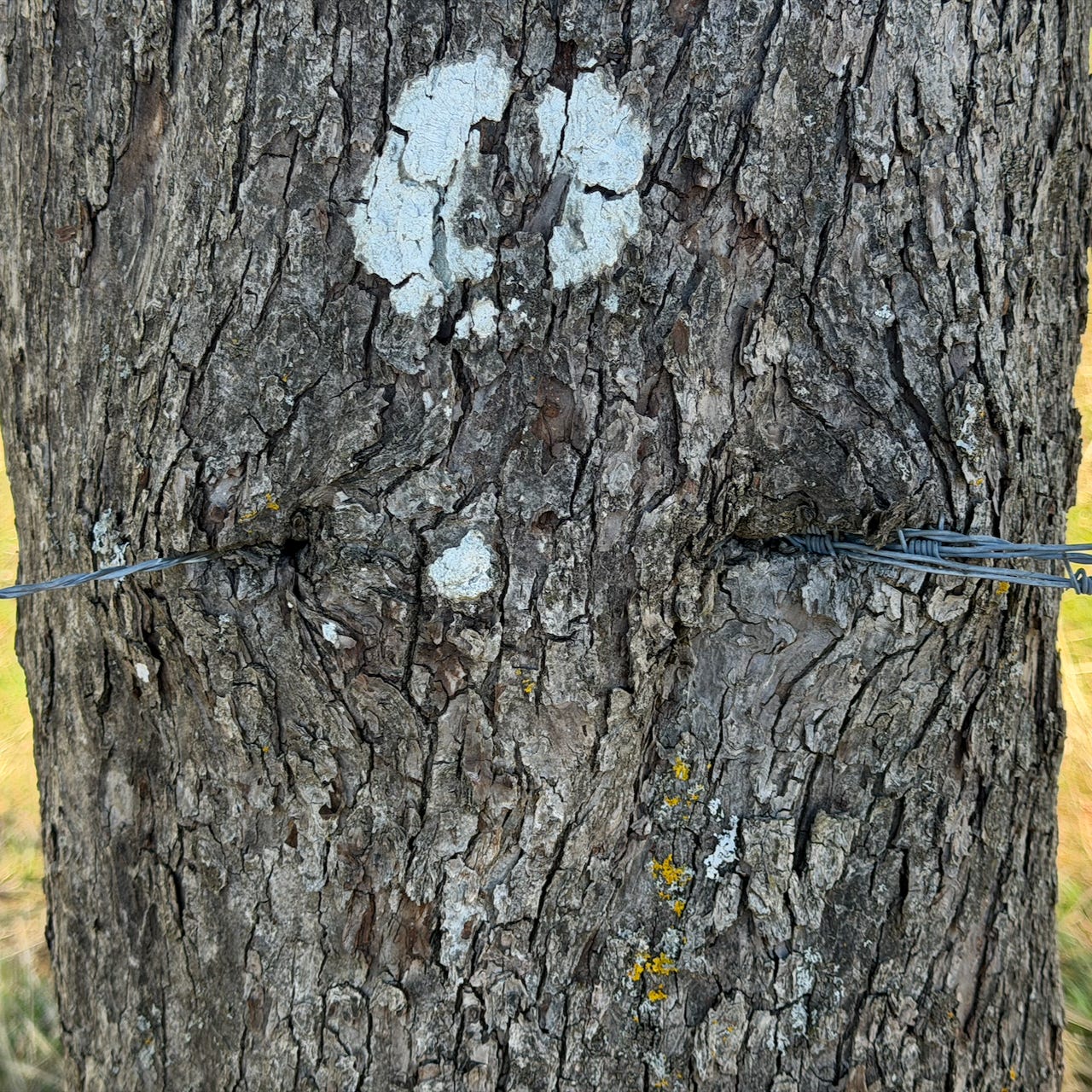
At 2:15 in the afternoon on Friday, September 11, on the long descent toward Conques, a tree stopped me.
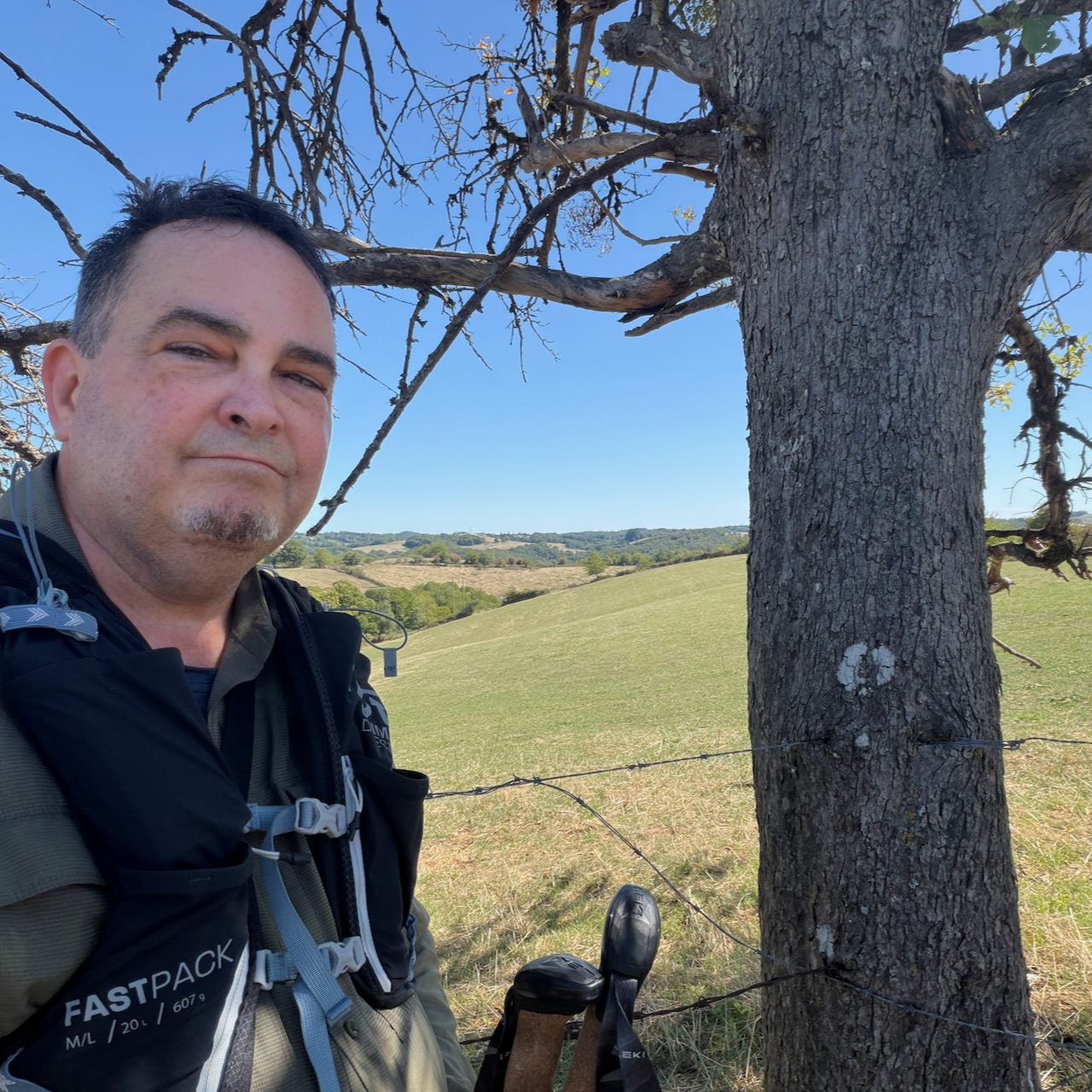
I had been walking for 7 days by then, most of them in silence, guiding 4 people along the Le Puy route of the Camino in France. As an ordained Wild Guide who has walked the Camino 7 times, I know that descent. I had passed this particular tree several times on earlier walks and had never once looked at it. Perhaps I had seen it, but only as background.
The tree had grown around a strand of barbed wire.
What follows is a single encounter, start to finish, in the practice I call Earth-Based Lectio Divina. Four movements adapted from Guigo II, the twelfth-century Carthusian monk who wrote about Lectio Divina, with the living world as the text in place of scripture. I wrote the movements out in July, and this is the first time I have shown one encounter running all the way through.
A Tree Everyone Walks Past
Everyone who walks to Conques along the GR65 Le Puy Camino route in France passes this tree.
It stands shortly before Saint-Marcel, on ground that thousands of pilgrims cover every season, and I have been one of them. I had come down that path several times before, with a pack on my back and Conques somewhere ahead. The tree held its wire through all of it.
The tree had not changed. My pace had.
The Practice in 4 Words
Lectio Divina involves reading a sacred text and internalizing it. Earth-Based Lectio Divina connects us with the sacredness of life that is all around us, and brings us into kinship.
Receive one being,
Ponder what they offer,
Respond with care,
and stay long enough to Belong.
Receive is the moment something stops you, one presence rather than the whole view. Ponder is staying with what stopped you and letting it work on you before you go looking for what it means. Respond is answering what you met, aloud or in silence, and putting back anything you picked up.
Belong is staying past the point where you have decided the encounter is finished, and it is the movement most of us skip. Nothing appears to be happening because we are still moving at our speed, and the encounter completes itself only when we slow to the speed of what stopped us.
The 4 names describe what already happens when you give a living being your sustained attention. They are there to help you recognize where you are, rather than to be worked through in order.
1. Receive
Something stops you, and you do not choose it.
I was walking alone, mid-stride, and then I was standing still. The wire ran into the trunk on one side and came out the other, and the bark had swelled and closed over it in a long vertical seam. I had been watching the path in front of my shoes for 7 days, which may be why I finally saw something beside it.
The inner posture: I allow encounter, and I let meaning come as it will. No judgments and no explanations or wondering why this, now.
2. Ponder
The tree looked well.
It was in leaf, upright, holding a full crown under a blue September sky. Something manufactured to separate had been attached to its side years ago and ran straight through its middle. The tree had answered by growing. My first thought was that it had overcome the wire.
Trees do not close their wounds the way human bodies do. They wall off the damage and lay new growth around it, a process the plant pathologist Alex Shigo called compartmentalization.
The wire is still in there, and it will still be in there when this tree is 200 years old.
The tree built a life that permanently includes the wire and continued growing at full strength.
The inner posture: I am part of what I am noticing.
3. Respond
What you receive from the living world asks something of you.
I spoke to the tree about the wire and about what it had cost. I spoke to it about carrying on as well as it could with something inside it that was never meant to be there. I told it I knew something about that, and left it there. I had nothing to offer, so I thanked it, which was what I had.
The inner posture: I am in relationship here.
4. Belong
I asked the tree whether I could put my hand on the seam.
Then I did, over the place where the bark had closed around the wire, and I stayed. What arrived while I stood there was recognition. I have carried things I did not choose and grown around them, and the growing never removed them, and here was another life that had done the same, standing in the sun on a Friday afternoon in September.
I had never experienced belonging in this way before.
The inner posture: nothing to do, I belong here.
What 7 Days of Silence Actually Changed
The practice did not find me a remarkable tree.
The tree was ordinary, public, and already known to me. What the silence changed was my speed, and with it my availability. Contemplative walking asks us to deepen at a pace that is not the one we arrive with, and by that final afternoon I had been at that slower pace long enough for something beside the path to reach me.
The September 2026 Contemplative Walking Retreat is now complete, and I am keeping a list of people who would like to hear about the two I am starting to develop for next year, including a return to this same path.
What made this possible was repetition and pace, and both of those are available on any route you take often enough to stop seeing.
The Practice: The Route You Already Know
Name. The Route You Already Know.
How long. One walk you have taken many times, or 20 minutes of one.
Where. The way to the station, the same 3 streets, the loop around your block, a corridor, a courtyard, the path to the bus stop.
What to attend to. One living presence on that route that you have passed many times and never stopped for. A street tree, moss on a wall, a hedge, the weeds at the curb. Whatever catches your attention as you slow to notice.
What you may notice. You may find that the first pass gives you nothing and that the second or third is where it begins. You may find that what stops you is something you have been walking past for years. Stay with it.
What Is Waiting on Your Own Route
Something on the route you already walk has been standing there through every pass you have made, holding whatever it holds. It has been waiting for the week you are slow enough to be stopped by it.
Walk your familiar route this week and give one presence on it the 4 movements. Receive one being, Ponder what they offer, Respond with care, and stay long enough to Belong.
What is on your regular route that you have passed a hundred times and never once stopped for? Go and look this week, then tell me what you found.
If you find this useful, please like or leave a comment.
If you try the practice I offered, I welcome hearing how it goes for you.
The Rewilding the Soul EcoSpirituality Certificate at Cherry Hill Seminary, where I teach, is currently underway with this year’s cohort, and planning for 2027 is nearly complete. For now, the practice itself is what matters most, and it is available to you wherever you are walking this week.
Contemplative Walking is a reader-supported publication. To receive new posts and support my work, consider becoming a free or paid subscriber.
Beautiful, Jeffrey. I didn't quite grasp this when you explained it to me but I think I do now. I want to bring this practice into my everyday life.
What I find myself wondering is how has this practice changed you?