

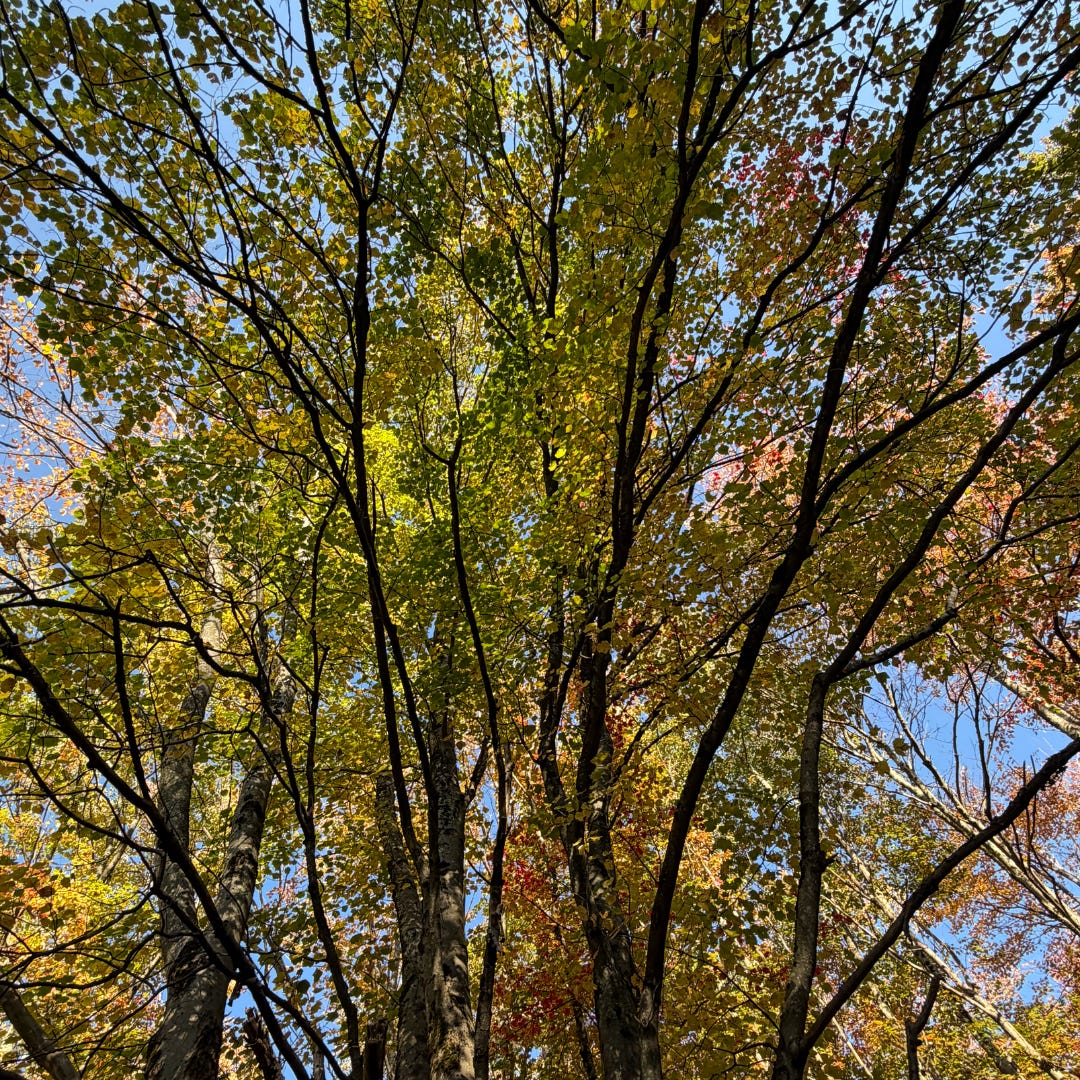
Across the street from my house stands a tree I was advised to cut down.
The advice came from 2 people who know their work. The landscape gardener caring for my struggling apple trees suggested that removing her would give the apples more light. A tree service I had hired to prune some taller trees agreed that removing her would likely help the apples thrive.
For a while, I was convinced.
The reasoning made sense. The apple trees needed light, she was casting shade, and the decision was mine to make. I teach people to slow down with the living world, and still my first response was to accept the advice before spending time beside the tree herself.
Anyone who tends a garden, a yard, or a few trees eventually faces a version of this choice. What helped me decide was 2 weeks of watching her, and from those weeks came a simple practice of 3 visits for anyone weighing whether a living being on their land should be removed.
When the Body Disagrees With the Plan
Over the following days, the decision that made sense in my head began to weigh on my body.
I kept looking across the street at her. Her trunks rise so closely together from the base that I cannot see them as separate, and I am still unsure whether she is 1 tree with several trunks or several trees growing closely together. Whatever she is, she looked healthy and strong, and her leaves were turning spectacular autumn colors.
For 2 weeks I watched them change.
Each day the case for cutting her held up less well in my mind and pressed more heavily on my body. Some nights it kept me awake. I have learned to take that kind of disagreement between head and body seriously, since on the Camino my body kept walking long before my mind understood why.
Weighing the Apples Fairly
The apple trees have real problems, and light is the smallest of them.
This past year, we learned they were planted incorrectly, with the metal around the root balls never removed. Since then, insects that bore through their trunks have attacked them, and they are now being treated. They already receive hours of sun each day, and cutting her down might have given them perhaps 1 more.
More light would likely help the apple trees, though it would still be nowhere near enough to justify removing a healthy, thriving tree.
I still care about the apples. After 2 weeks of watching her, though, I could no longer consider their needs without considering her life as well. I decided to let her stand.
Crossing the Street
When I finally crossed the street to visit her, I stood beside her trunks and looked up into what remained of her color.
I asked if I could take a photograph of her up close to help me remember her beauty and majesty. The image at the top of this post is the one she allowed.
Her leaves are still falling as I write this.
What She Is Doing Right Now
Before her leaves fall, a tree is already preparing for what comes next.
As autumn days shorten, a deciduous tree begins reclaiming nutrients from her leaves, and much of their nitrogen returns to her woody tissues for future growth. A thin separation layer then forms at the base of each leaf stem, allowing the leaf to detach. The yellows and oranges we admire were present all summer, hidden by green chlorophyll, while many trees also produce fresh red pigments in autumn.
During the 2 weeks I spent deciding whether to let her go, she was letting go of her leaves and keeping what she would need for spring.
The Question Underneath the Advice
The gardener and the tree service gave sound advice about the light.
Their advice addressed 1 condition the apple trees needed, and it was offered in good faith. Watching her brought another relationship into my decision. Cutting her down would have answered the smallest of the apples’ problems at the cost of her whole life.
I keep returning to 1 question. Which lives do we decide are expendable for a better harvest, and how well do we know them before we decide?
Encounter by Day, Review by Night
Looking back, those 2 weeks held both practices I have shared here, in an order I never planned.
By day I watched her from across the street, staying with 1 being long enough for an encounter to deepen, which is the heart of Earth-Based Lectio Divina. By night, lying awake, I went back over what I had seen. Without knowing it, I was moving through the 4 movements of the Earth-Based Examen I shared last week.
Thank. I had received her strength and her color, there across the street every day I looked.
Remember. I kept returning to her trunks, so joined at the base that I could not see them as separate.
Discern. The advice had treated her as standing wood in the way of a better harvest, while what I was living with was a relationship.
Turn. I crossed the street, asked her permission for a photograph, and let her stand.
I recognized the pattern only afterward.
The Practice: Visit Before You Decide
The 3 visits below gather what those 2 weeks taught me into a form you can use with any living being whose removal is under consideration.
Visit Before You Decide
How long. 3 visits on 3 different days, about 10 minutes each.
Where. Beside a tree marked for removal, a hedge you plan to clear, or a patch of plants in the way of a new garden bed. Find a position where you can comfortably attend to the being before you.
What to attend to.
First visit. Notice the being as they are now, including their shape, texture, movement, and condition. Perhaps touch them and feel their life. Let observation come before evaluation or judgment.
Second visit. Notice who lives with them, such as birds, insects, and fungi, along with the shade they cast and the ground around them.
Third visit. Ask what they give and what removing them would end. Notice how your body responds alongside your reasoning.
What you may notice. A decision that felt simple from a distance may become harder, or clearer. The visits may change your decision, or change how you carry it out. Either way, you will have spent time with the life your decision affects.
In the Northern Hemisphere, autumn and winter are when much tree work gets scheduled. In the Southern Hemisphere, spring clearing and planting raise the same question.
If something living on your land or in your care is marked for removal this season, visit it 3 times before the work begins. For me, 2 weeks of watching ended with a tree still standing.
Have you ever considered removing a tree, or another living being, that you had come to know? What did you decide?
The second cohort of the Rewilding the Soul EcoSpirituality Certificate at Cherry Hill Seminary, where I teach, begins in March 2027, and applications are now open. It offers a year with a small group focused on spiritual practice grounded in direct, reciprocal relationship with a specific place and its more-than-human inhabitants.
Contemplative Walking is a reader-supported publication. To receive new posts and support my work, consider becoming a free or paid subscriber.