

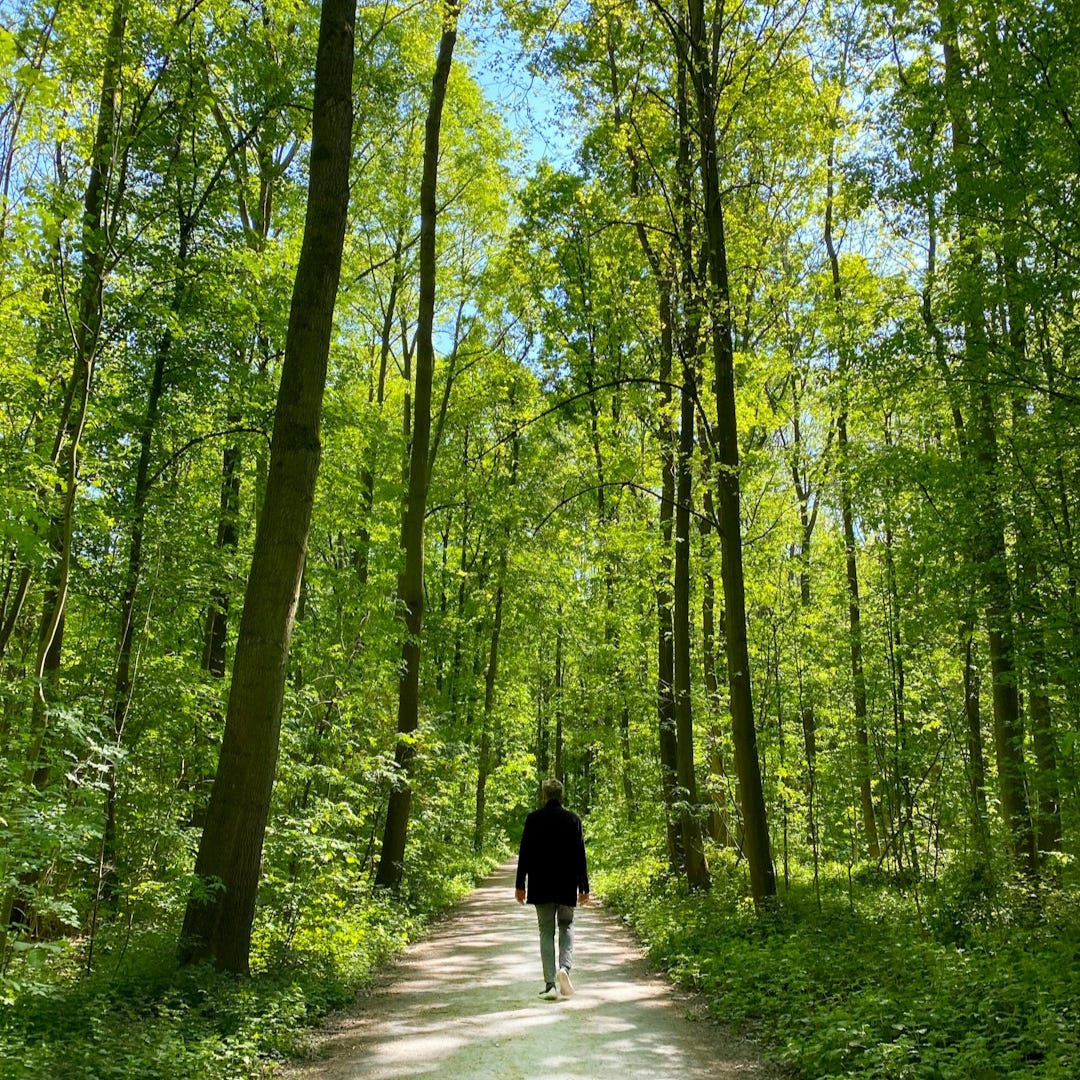
Unpopular opinion: Your overthinking mind isn't the enemy of meditation—
It's precisely why walking meditation will work when sitting meditation fails.
I used to think my analytical brain was broken for spiritual practice. I had years of wrestling with meditation apps, fighting my thoughts, wondering why everyone else seemed to "get it" while my mind kept generating endless ideas, analysis, and solutions. Don’t even get me started on being judged by those who think they own meditation and can say with all conviction that they meditate right while I do it wrong.
Unpopular opinion: Your overthinking mind isn't the enemy of meditation—
It's precisely why walking meditation will work when sitting meditation fails.
The breakthrough came not on a cushion, but on a walking path during my years of silent Camino de Santiago practice.
The Ferrari Brain Problem
Traditional meditation asks you to empty your mind. But analytical minds don't work that way. You need input, not absence.
You've probably spent months trying to force what I call a "Ferrari brain" into bicycle meditation. High-performance minds require high-performance practices.
How can you sit still and think of nothing when you do 16-hour days of non-stop knowledge work?
Walking meditation gives your analytical mind something legitimate to process: terrain underfoot, balance micro-adjustments, breathing rhythm, the interplay of light and shadow, the gentle chirp of birds, and surprising scents on the breeze. Your mind stays engaged while naturally quieting—no forcing required.
What's Actually Happening (The Science Part You'll Love)
Here's what's happening neurologically that makes this so effective for analytical minds:
Walking activates bilateral brain processing—left foot, right foot, left brain, right brain working in coordination. This is the same mechanism that generates your best insights during shower thoughts or those late-night breakthrough moments.
You're not fighting your thinking. You're creating optimal conditions for it to settle into a state of stillness naturally.
Why Sitting Meditation Backfires for Analytical Minds
The analytical mind spirals when forced to watch itself meditate:
"Am I doing this right?"
"Why can't I stop thinking?"
"This meditation thing clearly isn't working for me."
Walking shifts your attention outward—to the path ahead, your breath, what's actually here now. The mind naturally settles when it has something real and immediate to focus on, rather than judging its own performance.
Oh, and did I mention how walking meditation also opens us up to relationship with the Natural world? Save that for another day…
My Camino Discovery
During my contemplative walking practice on the Le Puy route in France, part of the extended UNESCO World Heritage Sites that comprise the Routes of Santiago de Compostela, I finally understood what I'd been missing. After years of failed attempts at traditional meditation, ten minutes of intentional walking meditation changed everything.
My mind wasn't broken. It just needed the right conditions to discover its own natural quiet.
If sitting still and quiet works for some people, then that is wonderful for them! I finally found an ancient form of meditation that works for me.
The path became my teacher. Each step, each breath, each moment of attention to the ancient route under my feet created the stillness my analytical mind had been seeking all along.
The Practice (What You Can Do Today)
Start simple:
Choose a path. It can be around your block, through a park, even a hallway.
Set an intention. This isn't exercise—it's contemplative practice.
Walk slowly. Let your analytical mind process the sensations: feet touching ground, air moving in and out, sounds and sights shifting with each step.
When thoughts arise (and they will), don't fight them. Let them pass like scenery. Your attention naturally returns to the walking itself.
Start with 10 minutes. That's enough to discover whether this clicks for your particular mind.
The Deeper Truth
Your thinking mind isn't the obstacle to spiritual practice—it's the very intelligence that can recognize the sacred in the ordinary act of placing one foot in front of the other.
Walking meditation works for analytical minds because it honors how you're wired while creating space for something deeper to emerge.
What if the meditation practice you need is the one that works with your mind, not against it?
If this resonates, I'd love to hear about your own experience with walking meditation. Reply and tell me: What happened when you tried moving meditation instead of sitting still?
Ready to go deeper? I share weekly insights on contemplative walking practices, sacred travel, and finding spiritual wisdom through movement in nature. [Subscribe for more →]
P.S. - I'm currently developing a Le Puy Camino contemplative retreat for June 2026. If you're interested in experiencing walking meditation on one of Europe's most ancient pilgrimage routes, subscribe to me on Substack for early access and retreat preparation content.
I have been doing this for a week now because of this post, and I totally agree. Walking in nature is the best for analytical minds. I will continue.
I love that you refer to meditation backfiring for those of us with analytical minds! I can’t stop watching myself! Walking mindfully in nature was my salvation.