

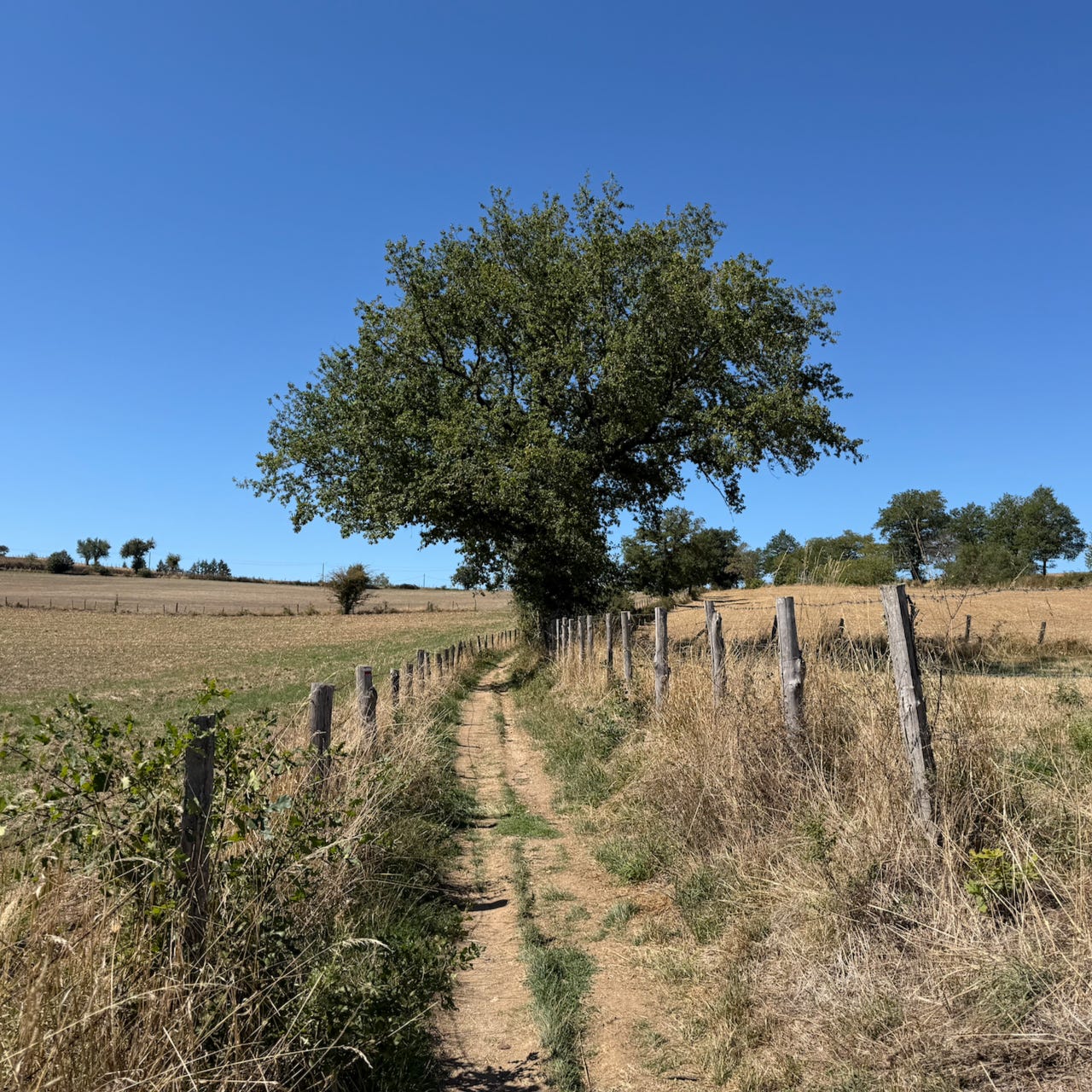
I am celebrating the Fall Equinox today, Monday, over lunch.
The equinox itself arrives on Tuesday, September 22, at 8:05 in the evening Eastern time.
As a chaplain at New York University and an ordained Wild Guide who has walked the Camino 7 times, I have spent years with people who want to mark the turning of the year without signing up for anything. The question I hear most often is some version of whether they are doing it right. Underneath that is usually a worry about time, because the honest version of the question is whether an hour is enough when you cannot give a day.
An hour is enough. What follows is exactly how I am planning to celebrate it, written before I do it, so you can take it to your own ground this week and try what works for you.
The Moment and the Marker
The equinox is an instant rather than a day.
At 00:05 UTC on September 23, which is Tuesday evening where I live, the sun crosses the celestial equator heading south. Day and night are not actually equal at that moment, since the bending of light in our atmosphere and the width of the sun’s own disk push the true balance a few days later. The instant itself passes while many are cleaning up from dinner.
So I personally fix it on the 21st, and I know that is the wrong day most years.
I do this with all of the astronomical turnings. Thanksgiving is the same arrangement. Nobody remembers the date; everybody remembers the 4th Thursday, and the fixed marker is what makes the gathering happen at all. A moving target gets observed by almost no one.
There is a version of this on every long footpath. The Le Puy route through France is waymarked in red and white, and someone chose that rock and that fencepost. The marks are arbitrary. The path does not need them. Walkers do, and a waymark you can find is worth more than a precise position you cannot.
What I am after is a date I will keep.
What I Am Planning to Do
I am giving it a lunch hour.
I will go out without a destination and wander, a word I do not often use in my writing, because most of what I teach has a route. This one has an hour and no endpoint. Going out at all is a kind of agreement to be met.
I will walk slowly enough that something can reach me, and I will let that something choose me rather than the other way around.
When it does, I will run the 4 movements I have written about here before, adapted from Guigo II, the twelfth-century Carthusian monk whose Ladder of Monks set out 4 movements for reading scripture slowly. The living world stands in for the text.
Receive one being. Ponder what they offer. Respond with care. Stay long enough to Belong.
Nothing in that requires a forest or a free day. A city park works. So does a backyard, a canal path, a courtyard, or the grounds of the building where you work.
The Offering, and Why It Is Peanuts
I will have unsalted peanuts in the shell in my pocket.
If I am moved to leave something, that is what I will leave. They are unsalted because salt is hard on small animals, in the shell because the shell breaks down, and modest in quantity because a pile of food beside a path creates problems for everyone who walks it afterward. Care about what I leave behind is part of the offering rather than a qualification on it.
The reasoning underneath is simple. Something was received, so something is given. I am not performing a rite. I am completing an exchange that was already underway. All relationships need to be reciprocal to grow and last.
If peanuts are wrong for where you are, leave something else, including something you made, or leave nothing and say thank you instead. Departing with care is a real response.
What I Am Carrying in Case
A small journal is going in my bag.
If I am moved to write, I will sit down and write, most likely badly, and that will be fine. If I am moved to build something from what is already on the ground, leaves, stones, or seed heads arranged in a circle, I will do that instead and leave it for the weather to take apart. If I am moved to stay somewhere for 20 minutes longer than I planned, the rest of the hour can go.
None of that is a step. They are permissions, carried in case the hour asks for them.
Readers south of the equator are meeting the same instant from the other side, as their light lengthens rather than shortens. The practice holds either way. What changes is what you are marking.
The Common Mistakes
The first is treating the hour as a performance.
There is no correct way to walk out on the equinox, and no one is assessing it. If you find yourself checking whether you are doing the movements properly, you have stopped attending to anything outside your own head, which is the only way to actually get this wrong.
The second is concluding that nothing happened.
Some hours give you very little. You walk, the light is ordinary, nothing reaches out, and you come home with a pocket of peanuts and no story. That hour still counts. Practice is built on returning rather than on arrivals, and the walk that gives you nothing does the same work as the one that stops you in your tracks, which you will only discover later.
The third is waiting for 8:05 on Tuesday and then wondering why there is nothing magical or mystical happening. Waiting around with hope is not a plan.
The Practice
The Equinox Hour
How long. One hour. A lunch break will do.
Where. Wherever you already walk. A city park, a backyard, a canal path, a courtyard, the grounds of your building.
What to attend to. One living being that reaches you first. Then the 4 movements. Receive one being, Ponder what they offer, Respond with care, and stay long enough to Belong.
What you may notice. You may find that wandering without a destination is harder than walking with one. You may find that something reaches you in the first 5 minutes, or in the last 5, or not at all. You may find that the hour was longer than it needed to be, or far too short.
Marking It Where You Are
Celebrating the turning of the year does not require a tradition, a belief, or a day off. It requires an hour and some willingness to be interrupted.
Go out this week, on whatever day you can keep. Give 1 hour to a route you already walk, let 1 living being reach you first, and carry something small in case you want to leave it behind.
Who reached you, and what did you leave?
If you find this useful, please like or leave a comment.
If you try the practice I offered, I welcome hearing how it goes for you.
Contemplative Walking is a reader-supported publication. To receive new posts and support my work, consider becoming a free or paid subscriber.
What a delightful suggestion. I was particularly interested in your discussion about why you mark this time on a fixed date - that makes perfect sense. These days, I mark the cycles of the year in my journal, noting the time and azimuth of sunrise and sunset each day here where I live. It's another way of connecting here, to this place. So Saturday I will take a walk to mark the turning of the year and I will let you know how it goes.