

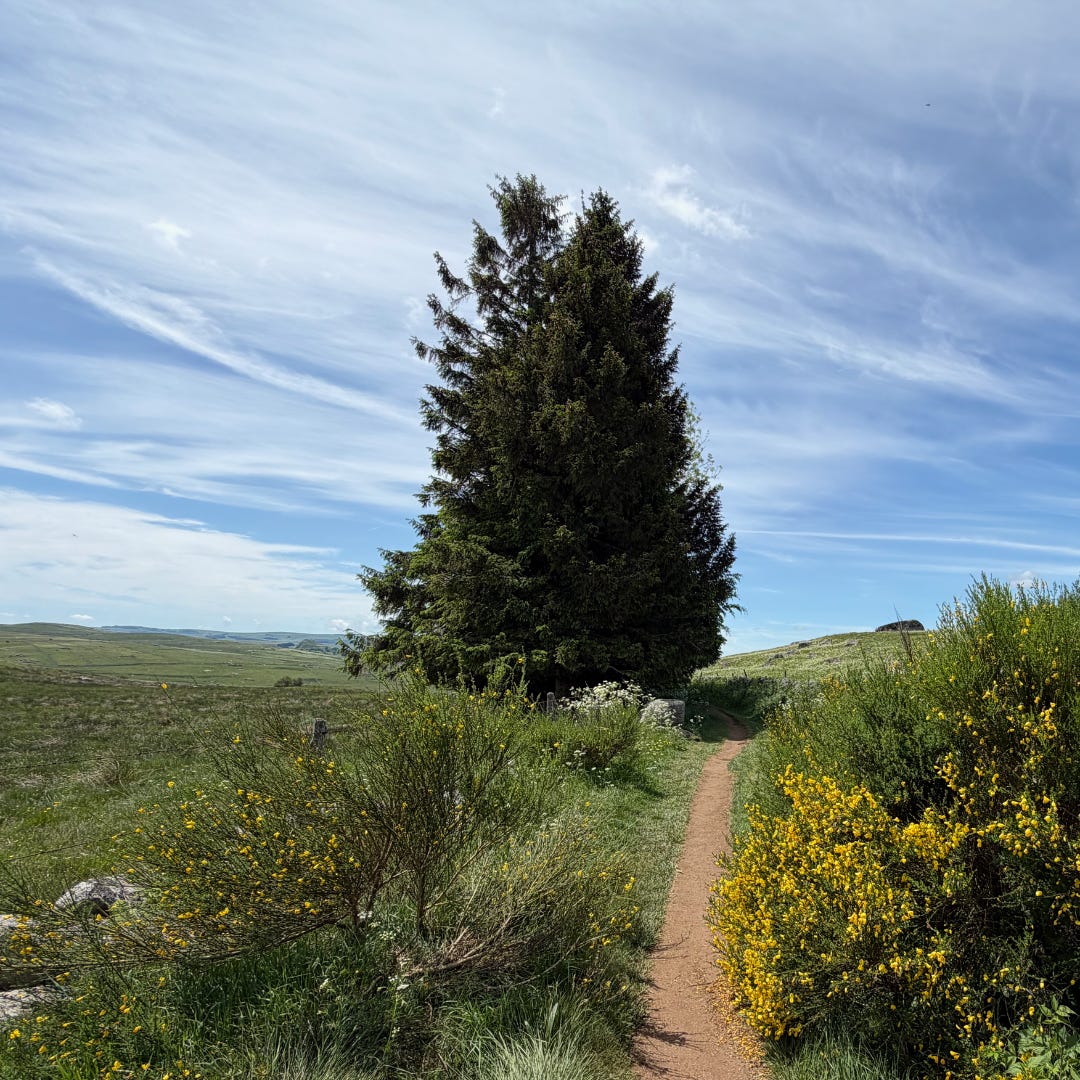
You can spend an hour outdoors and still feel as though you were never there.
You finish a walk and realize you spent it thinking about work, replaying a conversation, or planning what comes next. If you want to connect with nature but do not know where to start, try spending 10 minutes with 1 tree. You do not need to know its name, enjoy hiking, or have any experience with meditation.
A tree beside your bus stop or outside your window is a fine place to begin.
Perhaps you have been looking for a spiritual connection with nature. Perhaps you simply want a few minutes when nobody needs anything from you. Either is a good reason to stop.
A Reader’s Question
A reader recently wrote to me about the woods at her retirement community.
A small group cares for them, removing invasive plants and planting native ones. Some of her neighbors value the woods, while others, she told me, do not know they are there. She wanted to help them find their way in.
Her question reaches well beyond that woodland.
How do we begin noticing the living world once it has become background, and how do we share a place we love with someone who has not yet found a reason to visit? As a guide who leads contemplative walking retreats, and as a Forest Bathing Guide and Forest Therapy Practitioner certified by the Forest Therapy Hub, I have found that the first step is smaller than most people expect. You can take it on your own or with a friend, even without knowing whether or how it works. Trees are all around us, so begin with whichever one is closest.
3 Steps for Your First Visit
A first visit with a tree takes only 3 simple steps, and none of them require experience, special words, dedicated equipment, or even a shift in worldview or belief system. You can follow them on your own, or read them aloud to someone you have brought along.
1. Choose a Tree Nearby
Choose somewhere convenient, such as a courtyard, a neighborhood park, a churchyard, or a street you already travel.
The tree can be young or old, plain or striking, alone on a sidewalk or at the edge of a woods. Choose one that catches your attention, or simply the one nearest a bench. You can stand or sit, and if getting outside is difficult, a tree you can see through your window works, too.
You do not need to know its species, since learning its name can come later.
2. Take a Moment to Arrive
You may reach the tree with your mind still busy with everything you were doing beforehand.
Forest bathing, a practice of slowing down and attending to the natural world through the senses, offers a simple way to arrive. Read this slowly, to yourself or to someone with you:
Stand or sit where you are, and let your eyes take in this place. [Pause] When you are ready, close your eyes or soften your gaze, and feel the ground or the seat holding you. [Pause] Notice the air on your face, and the breath moving in and out of your nose.
If your thoughts keep moving, let them, and when you remember, return to something you can see, hear, or feel.
3. Notice 1 Detail
Look at the tree long enough to notice something specific: a seam in the bark, a branch reaching toward the light, a bud, or the place where the trunk meets the ground.
Then choose 1 of these invitations:
Find a word for the bark. Rest your fingertips lightly on it, or look closely without touching. Is it ridged, cool, smooth, or something else?
Listen from where you stand. Leaves may be moving, a bird may be calling, or traffic may be passing behind you. On an ordinary street, the traffic is part of what you hear.
Let a memory come. Does this tree remind you of one you have known before, perhaps outside a childhood home, beside a school, or along a familiar road?
If a memory carries you away for a while, look back at the tree in front of you before leaving and notice 1 thing about this tree, here today.
You may feel curious, settled, distracted, or awkward, or you may feel very little. Whatever you feel, you can visit again.
Where the Spiritual Connection Begins
The word spiritual can make a simple practice sound as though it requires a profound experience or a long commitment.
You can set that expectation aside and spend a few minutes noticing the tree’s own life: where new growth is appearing, what rests in its branches, how far its roots might reach. For me, spiritual connection with nature begins with this willingness to meet the living world up close, where it already is. Over time, a familiar tree can become part of how you belong to a place.
Before leaving, you might offer a quiet thank you, and leave the bark, leaves, and branches where they are. The tree is alive, so you might also wish it good health.
When you are ready to go further, How to Read the Land the Way You Read a Sacred Text shows how Earth-Based Lectio Divina deepens this relationship. This short visit is a place to begin. My own began with a tree across the street, which I wrote about in The Tree I Was Invited to Cut Down.
If You Want to Bring a Friend
The same visit works just as well for 2, and it may be the easiest way to share a place you love.
Make the invitation specific and easy to accept: “Would you like to spend 10 minutes by the trees with me? There is a bench nearby.” Let your companion choose what interests them, and give each of you a little quiet before talking. When you love a place, it is tempting to explain why it matters before your companion has had time to notice anything themselves.
Afterward, ask, “What caught your attention?” If they tell you about the bark, listen to the bark story, and if they remember their grandmother’s garden, listen to that.
For my reader’s community, I suggested a short, regular walk with places to sit along the way, where each person spends time with 1 tree and shares a word or a memory before heading home.
The Practice: 1 Tree, 10 Minutes
The whole visit fits into a short practice you can save and try this week, on your own or with someone you would like to bring along.
1 Tree, 10 Minutes
How long. About 10 minutes, or 20 if you bring someone and talk afterward.
Where. Anywhere with a tree you can stand or sit near, including one you can see from your window.
What to attend to.
Choose a tree nearby.
Arrive by reading the invitation slowly.
Notice 1 detail through the bark, a sound, or a memory.
Share what caught your attention, if you came with someone.
Return another day.
What you may notice. A tree you have passed many times may begin to look different, or a memory you have not thought of in years may return.
The first step toward connecting with nature can be as small as 10 minutes and 1 tree. Choose a tree near you this week, and return another day to see what has changed.
What tree from your life comes to mind first, and where did it stand?
The second cohort of the Rewilding the Soul EcoSpirituality Certificate at Cherry Hill Seminary, where I teach, begins in March 2027, and applications are now open. It offers a year with a small group focused on spiritual practice grounded in direct, reciprocal relationship with a specific place and its more-than-human inhabitants.
Contemplative Walking is a reader-supported publication. To receive new posts and support my work, consider becoming a free or paid subscriber.