


If you love old churches, ruins, and sacred sites, you may know this way of visiting them. You arrive, find the door, and go inside, and the fields, rivers, and hills around the place become the distance between one site and the next.
For years, I visited holy places like that. I have walked 7 Caminos, and on the early ones, the land was mostly scenery I passed through on the way to the next chapel or cathedral. The Célé Valley route in France is where that began to change. In May 2027, I will walk it again on a private retreat, alone and in silence.
Here is what I found there, along with a way to look at any old place near you so the ground beneath it becomes part of your visit.
Why I Chose This Route
I chose the Célé Valley as the next stage after walking from Le Puy-en-Velay. Everyone I spoke with told me how beautiful it was. They talked about the historic sites and the views, and I was looking forward to both.
Something else was changing in how I approached the Camino. I had already begun exploring ecospirituality and what it means to be in relationship with the more-than-human world. On earlier Caminos, the land was often a beautiful setting for my pilgrimage. This was the first time I deliberately made my relationship with the land part of the pilgrimage itself.
I went expecting historic places and beautiful landscapes. I found both, and I was beginning to notice how closely they belonged together.
3 Places That Grew Out of the Land
What struck me most was that each of these places exists because of what the land offered first.
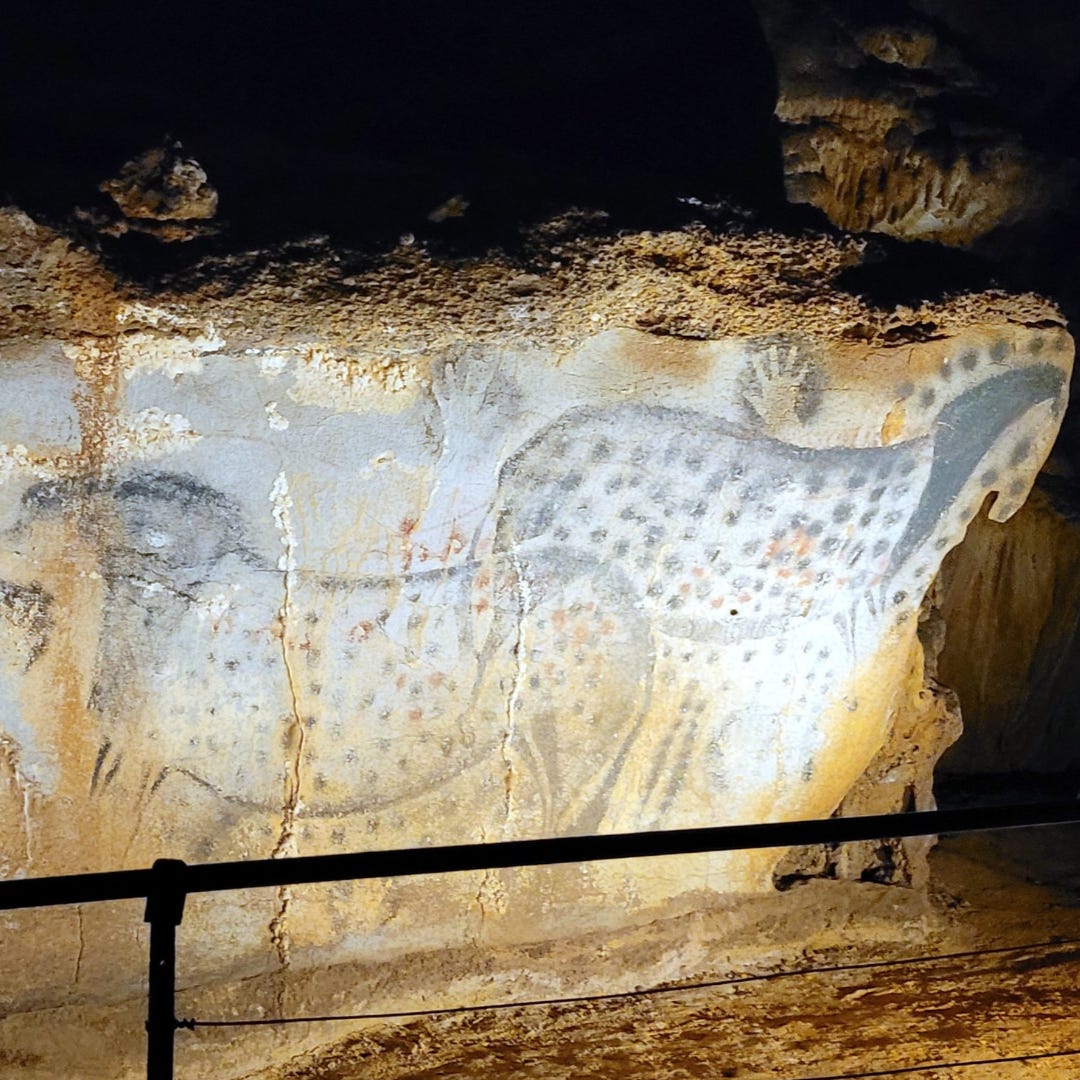
Pech Merle. Near Cabrerets, water worked through limestone over millions of years to create the passages and chambers of this cave. About 29,000 years ago, people painted spotted horses on its walls, along with the outlines of human hands and other figures. We do not know what these paintings meant to the people who made them. We do know the artists worked within a place that water and stone had shaped long before them.
Rocamadour. This medieval sanctuary rises against a limestone cliff above the canyon of the Alzou, its chapels following the contours of the rock face. Pilgrims have come here for centuries, drawn by devotion to the Black Madonna and the traditions surrounding Saint Amadour. The cliff gave the sanctuary its height, its shelter, and its shape. Rocamadour could not exist anywhere flat.
Saint-Cirq-Lapopie. This medieval village sits on a rocky height about 100 meters (330 feet) above the Lot River. Its location offered protection and a wide view of the valley. Although it was built as a village and Rocamadour as a sanctuary, it shows the same relationship between people and place, with buildings that still follow the rock’s contours.
In all 3 places, water and stone came first, and people followed. The painters, the pilgrims, and the villagers each responded to what the land had already given: shelter, height, protection, and a river.
What Walking Showed Me
If you arrive by car or bus, you can visit these places as separate destinations. Many people do this every year. Walking between them, you spend most of each day with the river, the limestone, and the oak and juniper on the slopes, and the sites begin to look like moments in a longer story the land has been telling.
I still remember the first time I walked this path and saw the river valley, with the village of Espagnac-Sainte-Eulalie far in the distance. The sight stopped me in my tracks. From the pilgrimage path, I could see distance, texture, and layers of color, with the village and its ancient priory set within the valley. People have been finding layers of meaning here for centuries, and that view of a village held within its land has stayed with me to this day.
Somewhere between the sites, I stopped treating the land as the space between destinations. The river and the cliffs had histories and relationships of their own, and they were there long before any painter, pilgrim, or village. The human history stayed important to me. I began to see it as part of a much longer story, in which the land shaped where people could settle, what they could build, and how they came to understand what was sacred.
That shift is close to the first movement of Earth-Based Lectio Divina, Receive, which I wrote about in How to Read the Land the Way You Read a Sacred Text. Before you interpret a place, you let it speak, paying attention to what is there before deciding what it means for you.
I am still learning to approach places this way, partly through my Earth-Based Examen at the end of each day, which helps me remember what I noticed while walking. Somewhere with so much history and so much to see makes it easy to fall back into old habits. The more attention I give to the living world, the more it becomes a presence I am walking with.
I will return to the Célé Valley in May 2027 for a personal silent retreat, partly to prepare for guiding 4 walkers along this route in September. I want to spend time with the land again before I invite others to meet it.
A Practice for an Old Place Near You
You do not need to travel to France to look at an old place this way. Any old place near you has been shaped by its land, and you can begin by walking around it before you go in.
Name. Reading the Ground Beneath an Old Place
How long. 20 to 30 minutes
Where. An old place you can reach easily, such as a church, a cemetery, a stone wall, an old bridge, a spring or well, or a tree older than you
What to attend to.
Walk slowly around the outside before you go in or come close.
Notice what the land offered here: stone, water, height, shelter, or a view.
Ask why people chose this spot over the ground nearby.
Notice who lives here now: trees, birds, insects, mosses, or other beings sharing the place.
Then go in or come close, and notice whether the place feels different.
What you may notice. The building or marker may begin to look like a response to the land around it. You may also notice that the living world still inhabits and shapes the place, long after the people who built it are gone.
Every old place you have visited stands on ground that was there first. If you walk around it before you go in, you may find that the land has been part of its story all along.
Which old place near you would you walk around first?
In 2027, I am guiding 2 Contemplative Walking Retreats in France: the Le Puy Camino in August and the Célé Valley in September, each limited to 4 walkers. Register by December 31, 2026, with the code Camino10 for 10% off.
The second cohort of the Rewilding the Soul EcoSpirituality Certificate at Cherry Hill Seminary, where I teach, begins March 10, 2027. Applications are open. It is a year of spiritual practice with a small group, grounded in relationship with your own place and its more-than-human inhabitants.
Contemplative Walking is a reader-supported publication. To receive new posts and support my work, consider becoming a free or paid subscriber.
I love the way you see the sites as moments in the longer story of landscape. The Chemin St Jacques and Cele Valley really lend themselves to this perspective. Even the modern departments are named for the river catchments. I found I had a keen understanding of the landscape units I was walking through, far more than in other Caminos
Rome, where every old church is sitting on something older and the ground keeps giving it away. The walk between two of them explains both better than either one does inside.