

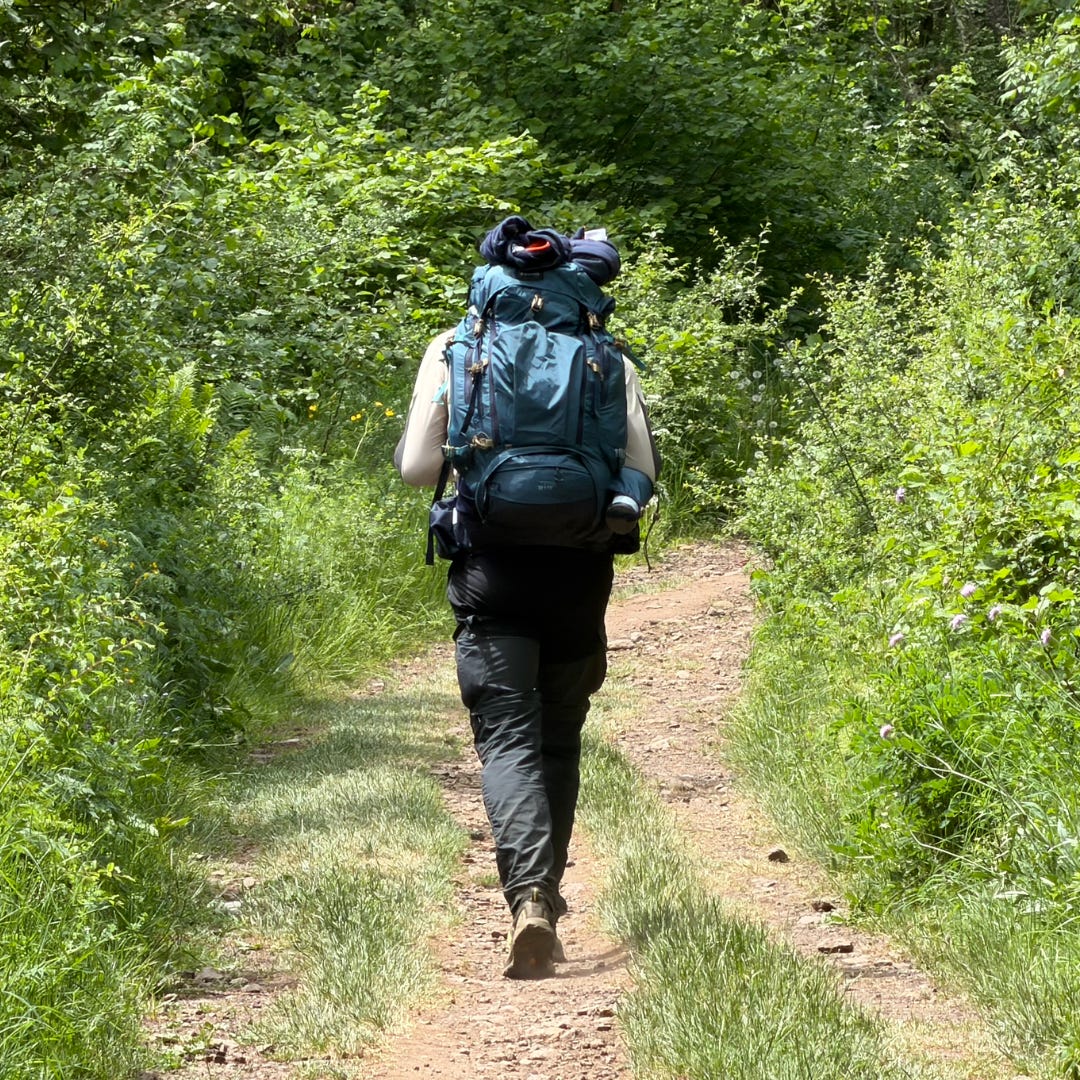
You can enjoy being with people and still long for time when nobody expects anything from you.
Many people feel this most on a walk. You head outside with a friend, a partner, or a family member, the whole hour fills with catching up, and you come home having noticed almost nothing around you. You enjoyed the company and still missed the quiet you went out for.
There is a way to have both. Agree to walk the first 20 minutes in silence, and let each of you notice the place in your own way. It works for a couple whose walks fill up with logistics, a parent and a teenager, an introvert and an extrovert, or a friend who is grieving and tired of talking.
A silent walk together gives you exercise, time with the living world, and company all at once. You are not alone on the path, which can make it feel more communal, and for some people, safer, than walking by yourself.
I learned this by guiding others. This September I walked the Le Puy Camino for the 7th time, guiding 4 people on a contemplative walking retreat across 7 days and about 95 miles from Le Puy-en-Velay to Conques. Silence and attention to the living world sat at the center of each day, and the week changed how I think about walking together.
Why I Have Always Walked Alone
My first Camino was with a guided group, and I found its expected togetherness difficult.
Walking with the group, gathering for 3 meals a day, and joining every conversation left little room for the quiet I had come for. I did not have the words to describe this at the time, and I was miserable without knowing why.
On later Caminos, I walked alone, at my own pace, free to stop for several minutes when something caught my attention, without having to explain why. I could still share dinner with other pilgrims and return to silence the next morning.
I began calling this solitude without isolation.
I have practiced it for the past few years on walks with my nephew, where we both find the silence we want without feeling alone.
When I planned a retreat for others, I asked whether a group could make room for the same freedom. I limited the retreat to 4 people, arranged private rooms (something rare on the Camino in France), and kept our lodging along the Camino itself. We shared a route, a rhythm, and times to gather, while each person had room for their own pilgrimage.
Four People, Four Different Pilgrimages
As the guide, I carry the practical details: where we are going, what to expect, where we will meet, and what anyone needs along the way.
I take those responsibilities seriously, and I also know their limit. I can introduce a practice, invite someone to slow down, or offer a question to carry along the trail, while what each person notices, remembers, or begins to love belongs to them. As a lifelong educator used to helping people understand things, I still find that hard.
When I passed someone on the trail, I offered a nod, a quiet hello, or a quick “Everything good?” It let them know I was nearby without pulling them out of their own walk. I wanted to give enough support to hold each person’s experience without making anyone feel they had to talk. This is the solitude without isolation I hoped to offer, and the one I have long wanted for myself.
Often the most useful thing I can offer is enough structure for someone to feel supported, followed by enough freedom for them to discover something I could never have planned. In 2027 I will walk 1 of the Camino paths alone in May, then guide 2 small contemplative walking retreats in August and September, built on this same balance of a shared path and personal silence, and the details are here.
A Shared Path Without a Shared Experience
Walking outdoors with others brings a temptation to share everything.
Someone spots an unusual bird and calls everyone over, or sees a view and gathers the group for a photograph. Shared discoveries can deepen a friendship, and I enjoy them. They also redirect attention, so whatever I was beginning to notice on my own gives way to what someone else is seeing.
Silence gives each person room to meet the place in their own way.
On our final day, during the descent toward Conques, I was walking alone when a tree that had grown around a strand of barbed wire stopped me. I moved through the 4 movements of Earth-Based Lectio Divina with it: Receive, Ponder, Respond, and Belong. The encounter was complete without a witness, and I kept it to myself rather than turning it into a teaching for the group.
One of the most meaningful encounters of a group retreat happened in solitude, inside a week spent with others. Some of the best company asks nothing of us but our presence.
Talk About the Silence First
In a world this noisy, silence with another person can feel awkward at first, as though something has gone wrong between you.
A short conversation beforehand helps. Agree on how long you will walk without talking, that either of you can speak if something needs attention, and that you will share afterward only if you both want to.
We already share silence with others when we meditate together, practice yoga, or sit in worship, and a walk can hold it just as well.
The Practice: Walking Together in Silence
This week, try the balance I found on the Camino with someone close to home.
Walking Together in Silence
How long. About 30 minutes, with the first 15 to 20 in silence.
Where. A familiar route, such as a park, a neighborhood street, or a path you both know.
What to attend to.
Ask a friend, partner, or family member to join you. You might say: “Would you walk with me for 20 minutes without talking? I would like to see what we notice together.”
Agree before you start on how long the silence will last and how either of you can break it.
Walk without talking unless something needs attention, each at your own pace.
Stop when something catches your eye, without calling the other person over.
Share 1 moment or living being that caught your attention once the silence ends, if you both wish.
What you may notice. The silence may feel awkward at first. After a few minutes, you may hear and see more, and the company may feel closer even without words.
Silence works only when both people welcome it, so if either of you needs to speak, speak.
Companionship and solitude can share the same path, and you can discover that on your own street. This week, send this to someone you love and ask them to walk with you in silence for 20 minutes.
Have you ever walked with someone in comfortable silence, and what was different about it?
The second cohort of the Rewilding the Soul EcoSpirituality Certificate at Cherry Hill Seminary, where I teach, begins in March 2027, and applications are now open. It offers a year with a small group focused on spiritual practice grounded in direct, reciprocal relationship with a specific place and its more-than-human inhabitants.
Contemplative Walking is a reader-supported publication. To receive new posts and support my work, consider becoming a free or paid subscriber.